Drip coffee maker vs pod coffee maker
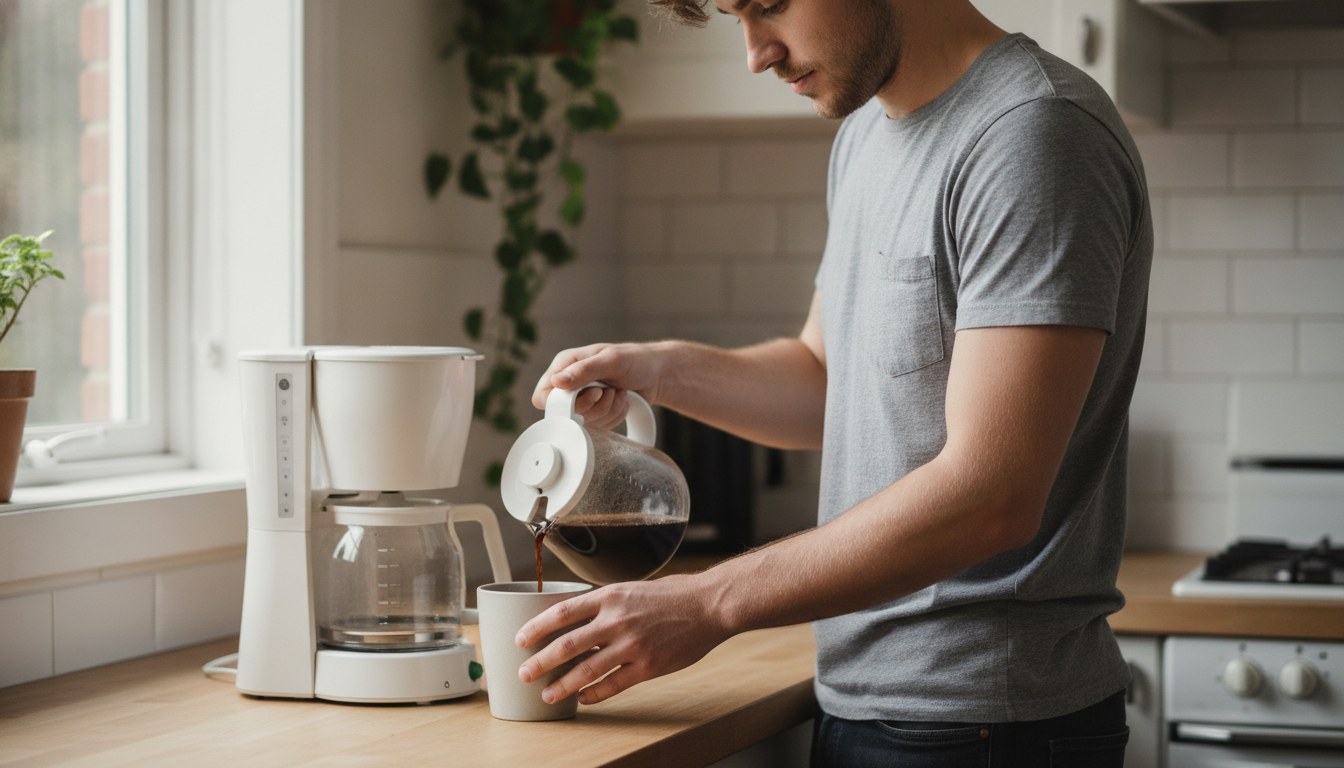
Two coffee makers can sit three feet apart on the same counter and still produce completely different mornings. One rewards a few extra minutes of patience with a full pot and a lower cost per cup; the other trades that patience for one fresh cup in under a minute. Neither habit is wrong, and the honest answer has less to do with taste snobbery than with how many people in the house actually drink coffee before work.
A drip coffee maker vs pod coffee maker choice comes down to volume, patience, and cost per cup. Drip machines brew a full carafe from ground coffee for less money per cup; pod machines brew a single cup from a capsule in under a minute, at a premium. Multi-cup households save more with drip; solo drinkers prefer the pod's speed.
| Spec | Drip coffee maker | Pod coffee maker |
|---|---|---|
| Brew time | Several minutes for a full carafe | Under a minute for a single cup |
| Cost per cup | Lower, using bulk ground coffee and a paper or reusable filter | Higher, since each capsule bundles portioning and packaging |
| Batch size | Brews a full pot at once, from about 4 to 14 cups depending on the model | Brews one cup at a time per capsule |
| Customization (grind, dose, ratio) | Full control over grind size, dose, and brew ratio | Fixed by the capsule; a stronger cup means a different pod |
| Annual energy use | Roughly 100-150 kWh/year, largely from the warming plate | Roughly 45-65 kWh/year, drawn in short brewing bursts |
| Reservoir range | Carafes commonly hold about 4 to 14 cups of water | Reservoirs commonly hold about 42 to 72 ounces before a refill |
| Cleanup | Filter basket and carafe need a real wash after regular use | Mostly occasional descaling and a quick tray wipe |
| Packaging waste per cup | Spent grounds and a paper or reusable filter | A sealed single-use capsule, recyclable only with some brands or programs |
| Quick Facts | |
|---|---|
| Drip coffee maker ownership (US, 2025) | 62% of coffee-drinking adults, up from 58% in 2020 |
| Single-serve/pod machine ownership (US, 2025) | 42% of homes, up from 40% in 2020 |
| Largest single-serve reservoir referenced here | Keurig K-Supreme, 66oz across 4 brew sizes |
| Largest drip carafe referenced here | Cuisinart 14-Cup Coffee Maker, 14-cup glass carafe |
How a drip coffee maker actually differs from a pod machine
A drip coffee maker heats water and lets it filter slowly through loose grounds into a carafe, while a pod machine punctures a sealed capsule and forces hot water through it into a single cup.
Shopping for a specific model? See our full coffee maker roundup — 10 models compared on the specs that decide it.
A drip machine works from a reservoir that heats water and releases it over grounds sitting in a paper or reusable filter basket. Gravity pulls the brewed coffee down into a carafe that can range from about four cups on a compact model up to fourteen cups on a larger one, a spread you can see across the machines in our pot coffee maker guide. That filter basket is also where most of the daily mess lives, since it has to come out and get rinsed after every pot.
A pod machine skips the basket entirely. Drop in a sealed capsule, close the lid, and a needle punctures both ends while a pump forces hot water through the pre-measured grounds inside, finishing in under a minute. That's the core of the drip vs single serve coffee maker debate: one brews to order from bulk beans you control, the other brews from a portion someone else already measured. Reservoir size still varies inside that single-serve category, from about 42 ounces on a compact model up to 66 ounces on a machine built for several cups in a row without a trip back to the sink.
Speed, batch size and your morning routine
A pod machine finishes one cup in under a minute; a drip machine takes several minutes but fills an entire carafe at once, so the faster machine per cup isn't always the faster machine for a whole household.
Speed is where pod machines win the argument outright, at least per cup. Press a button and coffee starts hitting the mug within seconds; there's no grinding, no scooping, and no filter to fuss with. That's a genuine advantage for one person making one cup before running out the door, and it explains a lot of the pod machine's popularity in offices and small apartments.
The drip coffee maker vs pod coffee maker gap shows up clearest once more than one person wants coffee. A drip machine spends several minutes brewing, but that one cycle can fill a full pot, and a warming plate on a model like the SHARDOR 10-Cup Programmable Coffee Maker holds it at drinking temperature for about two hours afterward, according to its own spec sheet. A pod machine making four cups back to back, one button press at a time, can easily out-last the total active time a drip machine spends brewing once for the whole table. Households with two or more regular coffee drinkers tend to notice this the first week, not the first month.
Cost over time: is a Keurig worth it
A Keurig or any other pod machine costs more to run day to day, because every cup comes from an individually packaged capsule, while a drip machine running on bulk ground coffee costs less per cup but takes more manual prep.
Whether a Keurig is worth it usually isn't a question about the machine itself; single-serve and hybrid machines don't cost dramatically more upfront than a mid-range drip machine. The real cost lives in what you feed it afterward. Every capsule is priced to cover its own packaging, portioning, and shelf life on top of the coffee inside it, and that markup repeats every single cup, every single day, for as long as you own the machine.
This is where the k cup vs ground coffee cost math gets uncomfortable for pod loyalists. A bag of ground coffee run through a basket filter costs meaningfully less per cup than the equivalent volume of capsules, since you aren't paying for individual packaging every time. A reusable capsule that you fill with your own grounds closes some of that gap without giving up single-serve convenience, though it brings back a little of the scooping and cleanup a sealed pod was supposed to remove. Anyone comparing current single-serve machines on reservoir size and brew options before deciding can start with our k cup coffee maker guide.
Does single-serve coffee actually taste different from drip
Sealed pods stay fresh longer than an open bag of pre-ground coffee, but you lose the ability to adjust grind, dose, or brew ratio; drip lets you control all three at the cost of doing them yourself.
The single serve vs drip coffee taste argument usually gets framed as pods losing to 'real' coffee, and that's an oversimplification. A capsule is sealed at the moment of grinding, which protects the coffee's oils from oxidizing the way a bag of pre-ground beans does once it's been opened and re-sealed a dozen times. Freshness at the point of brewing is a real point in the pod's favor, not a myth.
What a pod can't do is bend to your preference mid-brew. The grind size, the dose, and the brewing ratio are all fixed by whoever made the capsule, so a stronger cup means buying a different, pricier pod rather than adjusting a dial. A drip machine puts all three of those variables in your hands: coarser or finer grounds, more or less coffee per scoop, a longer or shorter brew cycle. That control is exactly why a lot of people who care about flavor still default to drip, even when a pod machine sits on the same counter for the days they're in a hurry.
Energy use, waste and cleanup: the environmental side
A pod machine draws less electricity per year than a drip machine that idles on a warming plate, but it also produces a sealed single-use capsule with every cup, a trade-off that doesn't resolve cleanly in either direction.
The drip coffee maker vs pod coffee maker gap on power draw is more one-sided than most people expect. An MIT Office of Sustainability comparison of common kitchen appliances put a drip machine's annual energy use at roughly 100 to 150 kWh a year, largely from the warming plate holding a pot at temperature, against roughly 45 to 65 kWh a year for a single-serve pod machine that only draws power in short bursts. Translated to a single cup, that same analysis estimated about 437 grams of CO2-equivalent for a drip-brewed cup versus about 205 grams for a pod-brewed one, mostly because the drip machine's idle warming time gets divided across however many cups actually get poured from the pot.
Waste tells a messier story. A drip machine leaves behind spent grounds and a paper or reusable filter; a pod machine leaves behind a sealed capsule that has to be pried apart, recycled by material, or thrown out whole, depending on the brand and your local program. A peer-reviewed life cycle assessment published in Scientific Reports in 2020 notes that other researchers have found single-serve pods can produce a lower environmental footprint per cup than a home drip brewer, because pods use a precisely dosed amount of coffee while people brewing drip at home often use more grounds than the water actually needs. It's a genuinely counterintuitive wrinkle: the machine that produces more visible trash per cup isn't automatically the one with the bigger footprint once you account for how much coffee gets wasted upstream.
Cleanup is the more everyday concern for most households. A drip machine's basket and carafe need a real wash on a regular basis, not just a rinse, or they start smelling stale. A pod machine mostly needs occasional descaling and a quick wipe of the drip tray, since there's no wet grounds sitting in a filter overnight. Despite the pod boom, drip is still the household default nationally: an automatic drip machine sits in 62% of American coffee-drinking households as of 2025, versus 42% for single-cup brewers, according to the National Coffee Association's Spring 2025 National Coffee Data Trends report; both figures climbed from 58% and 40% in 2020, which suggests people are adding a second machine more often than they're replacing the first.
Picking between a pod coffee maker vs drip coffee maker for your kitchen
Choose drip if more than one person in the house drinks coffee daily and cost per cup matters; choose a pod machine if you value speed and rarely brew more than one cup at a time.
The drip coffee maker vs pod coffee maker decision doesn't settle into one universal winner, and that's fine. A household where two or three people all want coffee before work is the clearest case for a drip machine: one brew cycle covers everyone, and the cost per cup stays lower over a year of daily use. A single-person kitchen, a guest room, or an office break area where different people want different amounts at different times leans pod, since nobody has to commit to a full pot just to get one cup.
There's also a middle option worth knowing about before you commit to one format. Hybrid machines exist that brew from either a capsule or loose grounds and can also fill a full carafe, like the Hamilton Beach FlexBrew Trio or the Keurig K-Duo, for households that genuinely can't agree. For a side-by-side look at both categories together, including where those hybrid machines land, our best coffee maker guide is the place to start, since it compares drip, pod, and hybrid models on the same page.
Drip wins on cost per cup, batch size, and full control over the brew; pod wins on speed, lower annual energy draw, and simpler cleanup. Neither is the objectively better machine. It is a real trade of money and hands-on control for time, and plenty of two-coffee-drinker households end up keeping one of each.
Frequently asked questions
Is a Keurig worth it compared to a regular drip coffee maker?
Which is cheaper, K-Cups or ground coffee?
Does single-serve coffee taste worse than drip coffee?
Can you use regular ground coffee in a pod coffee maker?
Which uses more electricity, a drip coffee maker or a Keurig?
Are coffee pods bad for the environment?
Sources & references
- Stuff versus Stuff: Battle of the Coffee Makers — MIT Office of Sustainability
- Life Cycle Assessment of Compostable Coffee Pods: A US University Based Case Study — Scientific Reports (Nature Portfolio, via PubMed Central)
- NCA Report: Coffee Beats Bottled Water as Top Purchased Beverage — Daily Coffee News, reporting the National Coffee Association's Spring 2025 National Coffee Data Trends report