Convection microwave vs standard microwave
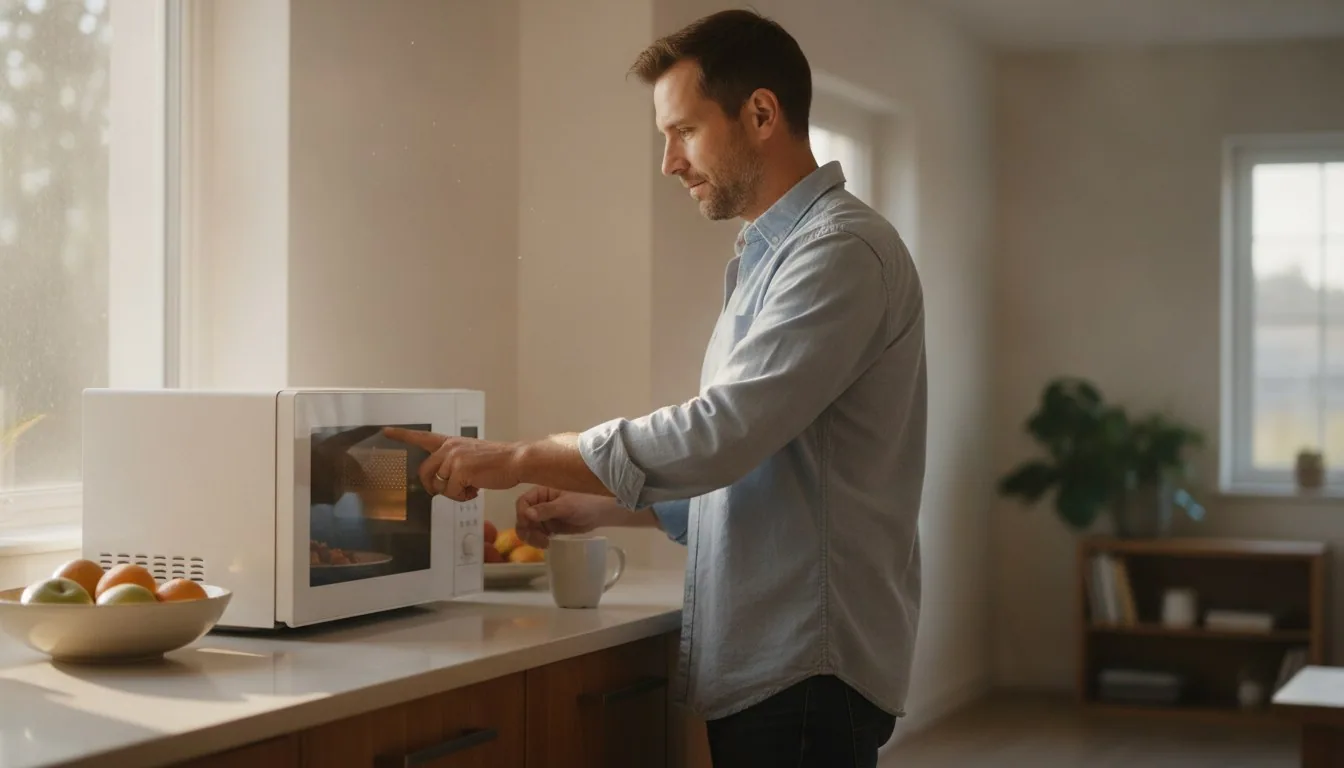
Every microwave heats food the same basic way, so it is easy to assume the fancier ones are just marketing. Then you try to crisp a chicken thigh in a plain microwave and get rubbery skin instead of anything you'd want to eat. The gap between these two appliances only shows up once you ask them to do something other than reheat coffee.
A convection microwave vs standard microwave comparison comes down to one added part: a heating element and fan that circulate hot air, letting the convection model bake, roast, and brown food like a small oven. A standard microwave only excites water molecules with microwave energy, so it heats and defrosts well but cannot crisp, brown, or bake anything.
| Spec | Convection microwave | Standard microwave |
|---|---|---|
| Heating mechanism | Magnetron plus heating element and fan | Magnetron only |
| Browning/crisping | Yes, via convection mode | Not possible |
| Reheating speed | Same as standard when using microwave mode | Fast, straightforward |
| Even heating | Improved by air circulation, not perfect | Prone to hot/cold spots |
| Standby power ceiling (built-in/OTR class, 2016 DOE standard) | 2.2 W maximum | 1.0 W maximum (countertop class) |
| Mechanical complexity | More parts: fan motor, heating element, extra controls | Simpler, fewer parts to maintain |
| Matches a full oven/grill for texture | Closer, but Consumer Reports found it still falls short | No browning capability at all |
| Quick Facts | |
|---|---|
| FDA microwave leakage limit (in-service ovens) | 5 mW/cm² at 5 cm from surface |
| DOE standby power ceilings, updated standard (compliance by June 2026) | 0.6 W countertop / 1.0 W built-in-convection |
| Compact microwave wattage tier | ~700 W |
| Midsize to large microwave wattage tier | 800-1,250 W |
| Usable capacity vs. advertised claim (countertop, CR testing) | ~50% of stated volume |
How a standard microwave actually cooks food
A standard microwave uses a magnetron to produce microwave energy that excites water molecules throughout food, generating heat from the inside without browning the surface.
Shopping for a specific model? See our full microwaves roundup — 10 models compared on the specs that decide it.
A standard microwave is a single-trick appliance, and that trick is genuinely useful. A magnetron generates microwave energy that penetrates food and agitates water molecules, which produces heat via friction. Because the energy comes from radiation rather than surrounding hot air, the process skips the browning reactions that happen in an oven — there is no dry heat scorching the surface, so nothing caramelizes or crisps.
That is also why microwaved food reheats fast but comes out soft everywhere, including spots where you wanted a crust. Cold spots and overheated edges happen because microwave energy does not distribute perfectly evenly through a load of food, which is part of why turntables exist. None of this is a flaw exactly — it's the tradeoff for speed. For defrosting a chicken breast or reheating rice, a standard microwave does the job in a fraction of the time an oven would need, and it does it with a control panel most people can figure out in ten seconds.
The FDA has regulated microwave oven manufacturing since 1971 specifically because of this radiation-based mechanism, and current federal rules under 21 CFR 1030.10 cap how much microwave energy is allowed to leak from an oven in service — no more than 5 milliwatts per square centimeter measured 5 centimeters from the surface. That number sounds alarming out of context, but real-world leakage on a properly sealed door and interlock system runs far below that ceiling, which is the whole point of the standard.
Convection microwave vs standard microwave: what the fan adds
A convection microwave keeps the magnetron but adds a heating element and a fan, letting hot air circulate around food the way a full-size oven does.
Open up a convection microwave and the magnetron is still there, doing the same job it does in the plainer unit down the appliance aisle. What changes is the addition of an electric heating element plus a fan that pushes that heated air around the cavity. Running convection mode alone turns the appliance into a small oven — no microwave radiation involved — capable of the browning and crisping a magnetron physically cannot produce.
Many convection microwaves also let you combine both mechanisms at once, cycling or blending microwave energy with hot-air circulation so food cooks from the inside and browns on the outside in less time than a standalone oven would need. That combination mode is the actual selling point, not convection alone — you could buy a countertop convection oven for browning duty and skip the microwave part entirely if speed on reheating didn't matter to you.
The fan-driven air also tends to even out hot and cold spots better than microwave energy alone, since moving air distributes temperature more predictably than radiation bouncing around a metal box. It is worth being honest about the ceiling here, though: Consumer Reports' lab testing on countertop convection microwaves found none of the models it evaluated consistently matched the texture of a real oven or grill. Convection mode narrows the gap. It does not erase it.
Cooking results: crisping, browning, and even heating
Convection mode enables actual browning and crisping that a standard microwave cannot produce, though lab testing shows it still falls short of a full-size oven or grill.
If your test case is reheating leftover pasta, both appliance types will get there in about the same time and you won't notice a functional difference. The split shows up the moment you want a crust, a sear, or a crisp edge. A standard microwave cannot deliver any of that under any settings — there's no heating element to brown with, full stop. A convection microwave can get part of the way there, turning frozen fries into something with actual crunch or finishing the surface of a small casserole, tasks a plain microwave will never manage no matter how long you run it.
The honest caveat, backed by Consumer Reports' own testing, is that convection microwave results still trail a dedicated oven or grill on texture. The cavity is smaller, the fan is usually less powerful than what you'd find in a standalone convection oven, and cooking times can vary more between models than manufacturers' marketing suggests. Treat convection mode as a genuine upgrade over zero browning capability, not as a full oven replacement.
For reference, our convection microwave buying guide breaks down current models with air-fry and grill combo functions if crisping and browning are the actual reason you're shopping, rather than a nice-to-have.
Energy use and standby power
US federal standby-power rules already draw a formal line between convection-capable built-in microwaves and countertop-only models, allowing the convection class a slightly higher standby-power ceiling for its added electronics.
This is one place where the difference between the two categories shows up in federal regulation, not just marketing copy. The US Department of Energy's energy conservation rules for microwave ovens, in effect since 2016, cap standby power at 1 watt for microwave-only and countertop combination models, versus 2.2 watts for built-in and over-the-range combination models — a category that specifically includes convection cooking features. An updated rule tightens both ceilings again, to 0.6 watts and 1.0 watt respectively, with compliance required by June 2026.
The gap exists because a convection unit's heating element, fan motor, and additional control electronics draw a little more power just sitting idle than a microwave-only unit needs. It's a small number in absolute terms — we're talking about a light bulb's worth of standby draw, not a meaningful line item on a utility bill — but it does reflect that convection microwaves are mechanically more complex machines, not just microwaves with a new button.
Active cooking energy use tells a different, more favorable story for both categories. Microwaving in general uses substantially less energy than firing up a full-size oven for the same task, since you're heating the food directly rather than heating a large air cavity and the walls around it first. That advantage over conventional oven cooking holds regardless of which of the two you own — the standby-power difference between them is a rounding error by comparison.
Capacity, wattage, and what actually affects everyday cooking
Capacity and wattage tiers matter more than the convection feature itself for day-to-day reheating speed and how much food fits inside.
It's easy to fixate on the convection question and skip the spec that affects daily use far more directly: wattage. Consumer Reports groups countertop microwaves into roughly three wattage tiers — around 700 watts for compact models, 800 to 1,250 watts for midsize units, and 1,000 to 1,250 watts for large ones — and higher wattage within any of those tiers generally means faster, more even reheating regardless of whether convection is present at all.
Interior capacity matters just as much day to day, but treat the number on a spec sheet with some skepticism. Consumer Reports' own testing found usable capacity runs well below what manufacturers advertise — roughly half of the claimed volume for countertop models, and somewhere in the 40 to 50 percent range for over-the-range units. A convection microwave in a compact size class still has a compact convection cavity; the added heating element doesn't create more usable interior room, and in some designs the fan housing actually eats into the space you'd otherwise use for a dinner plate.
Our countertop microwave guide lists current models across those wattage tiers and usable-capacity considerations if fitting your specific counter space and typical serving sizes matters more to you than the convection question itself.
A convection microwave is the better choice if you actually want browning, crisping, or small-batch baking without pulling out a full oven, and the standby-power tradeoff for that extra capability is minor. A standard microwave remains the simpler, lower-maintenance choice if reheating and defrosting are genuinely all you do, since you'd be paying for convection hardware you'd rarely use.
Frequently asked questions
Can I use a convection microwave just like a regular microwave?
Can you put metal or foil in a convection microwave?
Is a convection microwave worth the extra cost over a standard one?
Why does my microwave heat food unevenly?
Do convection microwaves use more electricity than standard microwaves?
What size microwave do I actually need?
Sources & references
- 21 CFR 1030.10 -- Microwave ovens — U.S. Government Publishing Office / Code of Federal Regulations
- Microwave Ovens — U.S. Food and Drug Administration
- Microwave Ovens (Appliance Standards Rulemakings) — Appliance Standards Awareness Project (ASAP)
- Microwave Buying Guide — Consumer Reports