| Quick Facts | |
|---|---|
| Garden hose water pressure | about 40 psi |
| Light-duty pressure washer range | 1,300-2,000 psi |
| Heavy-duty pressure washer range | 2,700-4,000 psi |
| Minimum gas-engine clearance from windows, doors, or vents | 20 feet |
| PSI span across the gas and electric models we've compared | 2,000-5,000 max psi |
| Typical gas engine size on compared gas models | 212cc 4-stroke OHV |
| Weight range, compact electric vs. wheeled gas models compared | 13-68 lb |
Are pressure washers actually dangerous, or just loud?
Yes: even a light-duty pressure washer produces dozens of times the force of a garden hose at close range, and that force can break skin before you register what happened. Most injuries trace back to skipping basic pressure washer safety tips like distance and nozzle choice, not some inherent flaw in the tool.
Shopping for a specific model? See top-rated pressure washers models — 10 models compared on the specs that decide it.
A pressure washer looks harmless because the water coming out of it still looks like water. A garden hose runs at roughly 40 psi. A light-duty electric pressure washer starts around 1,300 to 2,000 psi, which is thirty to fifty times more force behind the same stream. Heavier gas models built for stripping paint or blasting years of grime off concrete climb into the 2,700 to 4,000 psi range. The models we've compared across our own lineup span roughly 2,000 to 5,000 max psi, so the gap between 'light-duty homeowner tool' and 'thing that can genuinely hurt you' is smaller than the box art suggests.
Pressure washers are dangerous mainly because that force is invisible until it isn't. A stream strong enough to strip paint off a fence rail doesn't stop at skin. It can drive water, dirt, or cleaning chemical straight into tissue through an opening barely bigger than a pinprick. That's the injury nobody expects going in, and it's why emergency rooms treat pressure washer wounds differently than an ordinary cut.
The injuries that send people to the ER
Lacerations, punctures, and high-pressure injection wounds are the most common pressure washer injuries, and the injection type is the one people underestimate because the entry wound looks trivial.
A direct hit from a pressure washer at close range acts more like sandpaper than a blade. The University of Kentucky's occupational health and safety office describes the mechanism plainly: the flow strips skin away layer by layer instead of slicing through it, which is part of why these wounds heal poorly and get infected easily. A cut, you can usually see the depth of. A high-pressure wound, you often can't.
That underestimation is the real hazard. A case documented in the International Journal of Emergency Medicine involved a 2,500 psi consumer pressure washer that drove water deep into a four-year-old's oral tissue; the case was managed conservatively and needed no surgery, but the water still tracked well past where the entry point suggested. That's the pattern with high-pressure injection wounds generally: fluid follows the path of least resistance under the skin, and treating one like an ordinary cut instead of getting it checked out immediately is what turns a bad afternoon into a hospital stay or, in rare cases, an amputation.
None of this means a pressure washer is dangerous every single time it's switched on. It means the wand deserves the same respect as a box cutter, not a garden hose, because the moment it contacts skin it has already done the damage before your brain finishes registering what happened.
Electric shock is real, and grounding is not optional
Electric pressure washers carry a genuine shock risk when the outlet lacks ground-fault protection or the cord gets wet, which is why the CDC lists a GFCI test as a mandatory pre-use step rather than a suggestion.
Water and household current are a bad combination, and an electric pressure washer sits right at that intersection for as long as it's plugged in. The Centers for Disease Control and Prevention's guidance on pressure washer safety is specific: always test the ground fault circuit interrupter, whether it's built into the outlet or the breaker, before you start, and always plug into a properly grounded receptacle using a heavy-duty extension cord rated for wet locations.
The instinct to snip off the grounding prong because an outlet doesn't fit is exactly the shortcut the CDC warns against by name. That small piece of metal exists for one reason, and removing it can turn a pressure washer that's perfectly safe on paper into one that's genuinely dangerous the moment the cord gets wet. If a plug, cord, or GFCI outlet doesn't test clean, that is not a maybe. It's a reason to fix the wiring situation before the trigger gets pulled again.
This is also where matching the machine to the job matters more than people assume. If you haven't bought a unit yet and are trying to work out how much pressure you actually need for a driveway versus a car versus a set of porch railings, our best pressure washers guide breaks that down by task rather than by whichever number happens to be biggest on the box. Getting that match right up front cuts down on the overreaching that leads to accidents in the first place.
Carbon monoxide and the gas-engine distance rule
Gas pressure washers burn fuel the same way a car engine does, so running one in a garage, a breezeway, or anywhere within 20 feet of a window, door, or vent risks carbon monoxide poisoning even when you're technically outdoors.
Every gas pressure washer has a small combustion engine bolted to the frame, and small combustion engines produce carbon monoxide whether they're in a truck bed or your driveway. The gas models covered in our gas pressure washer guide typically run a 212cc four-stroke OHV engine, roughly the size of a push mower's, which is exactly the category of engine the CDC has in mind when it advises never running one in an enclosed space or within 20 feet of any window, door, or vent, regardless of how much airflow it feels like you're getting.
Carbon monoxide doesn't announce itself with a smell or a visible cloud, and it accumulates faster than people expect in a carport, breezeway, or partly enclosed patio, spaces that feel outdoors but trap exhaust more than a truly open driveway would. If the job is a garage floor or the underside of a covered porch, that's a task for an electric model on a GFCI outlet, not a gas engine idling a few feet from the back door.
UNC-Chapel Hill's environment, health and safety office lists laceration, eye injury, burns, and electrocution as the core hazards in its job safety analysis for gas pressure washers, alongside a plainer fueling rule: never add fuel to a hot engine, and only fuel it in appropriate locations.
The zero-degree nozzle: the pressure washer safety tip people skip
A pressure washer's zero tip concentrates the full water pressure into a pencil-thin stream with none of the spread that softens the other nozzles, making it the one most likely to cut skin or strip something that wasn't supposed to be stripped.
Most pressure washers ship with a small set of interchangeable nozzles marked by spray angle: 0, 15, 25, and 40 degrees, often with a dedicated soap nozzle in the mix. That angle number is really a warning label in disguise. Wider angles like 40 degrees spread the same water volume over a larger area, which cuts the force per square inch substantially. The zero-degree tip does the opposite, putting all of that pressure into a stream about as wide as a pencil lead.
That's why a pressure washer's zero tip is the accessory most manuals bury in a warning box instead of a features list. It's genuinely useful for a narrow set of jobs, stubborn rust on metal or deep-set grime in concrete joints, but it has no business near skin, glass, wood siding, car paint, or anything you'd rather not etch. The safer habit is starting with the widest nozzle that could plausibly do the job and narrowing only if the surface refuses to cooperate, not the reverse.
Swapping nozzles mid-job is where a lot of avoidable cuts happen too. UNC's job safety analysis for gas units puts the core rule simply: keep hands away from the tip of the wand. In practice that means shutting the machine off and releasing the trigger pressure before you touch the nozzle at all, because a pressurized wand with a nozzle half-threaded on is not a stable thing to have near your hand.
Gear, stance, and the habits that actually prevent accidents
Closed-toe shoes, eye and hearing protection, and a two-handed grip on the wand prevent most pressure washer accidents, according to university occupational safety guidance, and none of it requires specialized equipment.
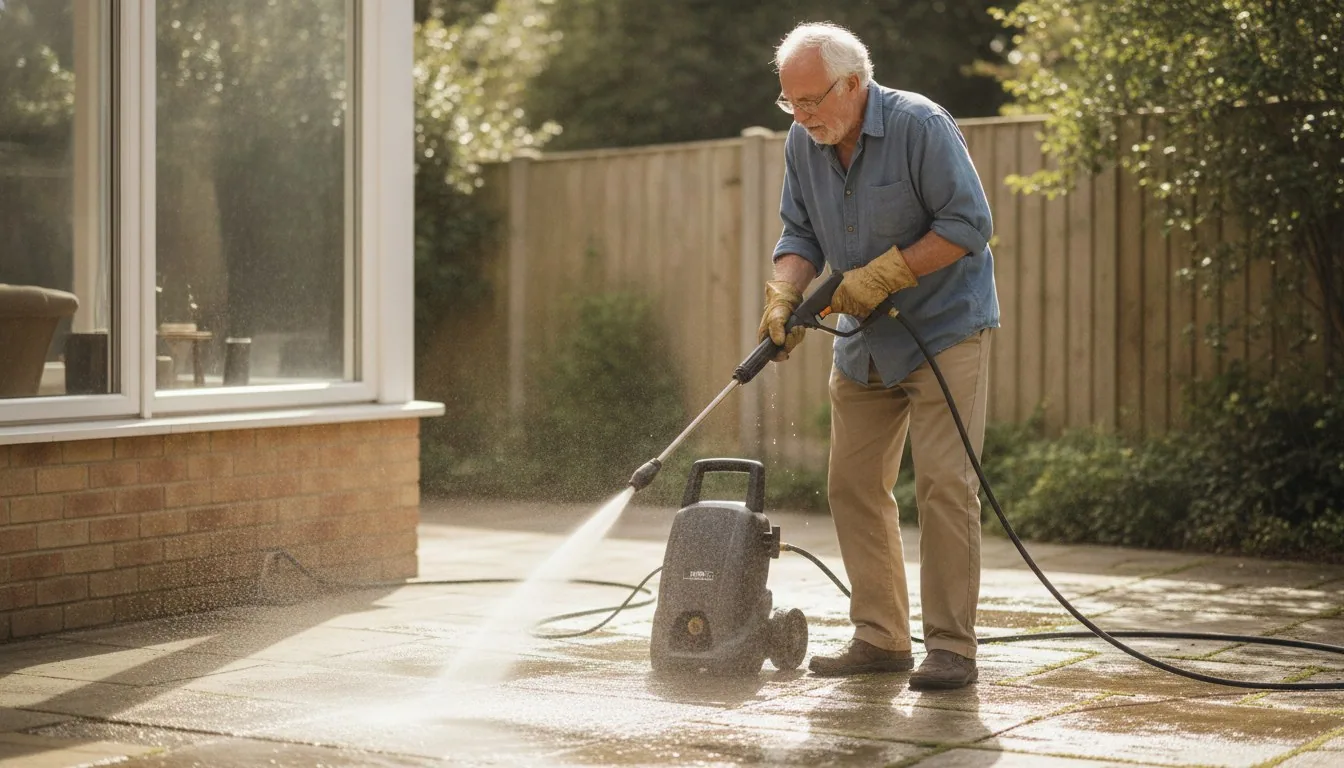
None of the gear that prevents most pressure washer injuries is exotic. The University of Kentucky's occupational health and safety guidance is refreshingly plain about it: eye protection, hearing protection, sturdy closed-toe shoes, and long sleeves and pants if you'll be standing in the spray zone for a while. Add both hands on the wand, one holding and one guiding, because a pressure washer at full trigger has real kick, and a one-handed grip is how the nozzle ends up pointed somewhere it shouldn't be.
Distance is the other half of the equation, and it's less about a fixed number of feet and more about reading the surface as you go. Start with the nozzle further back than feels necessary and the widest spray angle available, then move closer and narrow the angle only as much as the grime demands. If the surface starts chipping, gouging, or stripping paint you didn't mean to strip, that's the machine telling you it's too close or too concentrated, not a cue to push harder.
Kids and pets belong nowhere near the spray, full stop. A stream that can strip a deck doesn't discriminate between plywood and skin, and a startled dog cutting across the yard is exactly how bystanders end up hit by accident. If you're still deciding what to buy, the range of gas, electric, and specialty models on our pressure washer hub is worth a look before these habits become second nature. The right machine for the actual job is most of the battle.