| Quick Facts | |
|---|---|
| Pooled AFib detection accuracy (smart watch ECG) | 94.8% sensitivity / 95% specificity, AUC 0.96 (11 studies, 4,241 people) |
| ECG leads on a smart watch vs. a hospital ECG | 1 lead vs. 12 leads |
| First FDA-cleared watch ECG app | Apple Watch, cleared 2018 (Class II, De Novo pathway) |
| Samsung ECG feature cleared | August 2020 (510(k) pathway) |
| Fitbit ECG app cleared | September 2020 (510(k) pathway) |
| US adults projected to have AFib by 2050 | 12.1 million (CDC) |
What a smart watch ECG actually records
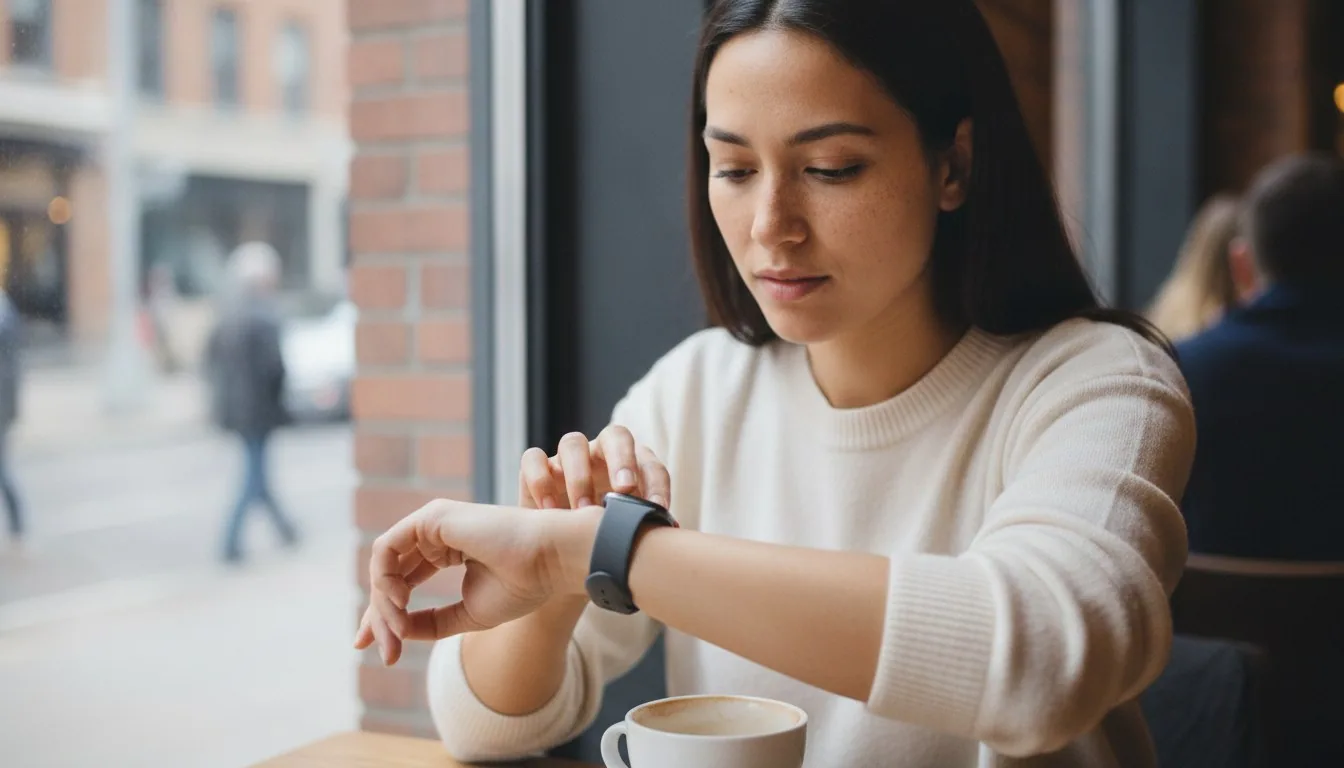
A smart watch ECG uses metal electrodes built into the case and crown to record the heart's actual electrical signal, not just its rate, the same underlying principle as a hospital ECG condensed down to a single lead.
Shopping for a specific model? See our full smart watches roundup — 10 models compared on the specs that decide it.
Most fitness trackers estimate your pulse with a green or red LED that watches blood flow through your wrist. That's photoplethysmography, and it's a decent proxy for heart rate, but it isn't measuring electricity at all. A true ECG sensor works differently. It reads the tiny voltage your heart generates with every contraction, the same signal a cardiologist's twelve-lead machine records, just from fewer vantage points. On a watch built for this, touching a finger to the crown or bezel completes a circuit between both arms, and after about thirty seconds the app renders a waveform close in shape to Lead I on a standard hospital tracing. So is a smart watch ECG a real ECG in that narrow sense? Yes. It's genuinely reading cardiac electricity, not guessing at it from blood flow.
The app then sorts that waveform into one of a few buckets: sinus rhythm, atrial fibrillation, or inconclusive, sometimes with a note that your heart rate is too high or low to classify. That output can usually be exported as a PDF and handed to a physician, which is closer to how a real diagnostic tool behaves than a typical wellness gadget. What it doesn't do is interpret the waveform the way a cardiologist would, hunting for subtle timing or shape changes a single lead can't show. The algorithm is narrow by design, not by accident. If you're just starting to shop and want the full category laid out before narrowing by feature, our smart watches hub is a reasonable place to start.
Is a smart watch ECG a real ECG, medically speaking?
Yes, medically speaking: the device captures actual cardiac electrical activity, not just a rate estimate, but it's a single-lead snapshot next to the twelve-lead picture a hospital captures, so it answers a much narrower clinical question.
A twelve-lead hospital ECG places electrodes across the chest, arms, and legs, giving a cardiologist twelve different angles on the same heartbeat, enough to spot damage localized to one wall of the heart, timing delays between chambers, or subtle ischemic changes. A smart watch ECG produces one of those twelve views, roughly equivalent to Lead I. That's genuinely useful for rhythm problems that show up throughout the heart's electrical cycle, atrial fibrillation being the obvious example, but it's nearly useless for anything that only shows up on the leads it doesn't have. That asymmetry is the honest answer to whether a smart watch ECG is a real ECG: real data, an incomplete picture.
Researchers have compared watch-generated tracings against standard clinical ECGs directly, and the waveforms hold up well for rhythm classification. Reviewers pooling data across multiple studies keep landing on high agreement for the one thing these devices were built to catch. None of that validation extends to the diagnoses a full twelve-lead exam supports, though, which is exactly the distinction regulators had to draw when they decided what a consumer version of this technology was allowed to claim.
What the FDA actually cleared it for
The FDA has cleared several watch ECG apps as Class II medical devices, a 'cleared,' not 'approved,' status, specifically to flag possible atrial fibrillation on a classifiable waveform rather than to diagnose any condition.
Apple's ECG app was the first of these to reach the market, clearing FDA review in 2018 through the agency's De Novo pathway, a route reserved for genuinely novel device types with no existing product to be measured against. Samsung followed with its own ECG feature in August 2020, and Fitbit followed that September, both using the more common 510(k) pathway, which requires showing a new device is substantially equivalent to something already cleared. None of these went through what the FDA calls full approval, the more rigorous process generally reserved for drugs and higher-risk devices. The correct word for all three is 'cleared,' a distinction that sounds like semantics until you look at what it actually requires.
That clearance came with a narrow job description. Watch ECG apps are classified to detect and sort a heartbeat into sinus rhythm or atrial fibrillation on a readable waveform, nothing broader. The data is meant for your own information and for a conversation with a clinician, not as a stand-alone diagnosis. Healthcare Dive's coverage of Fitbit's clearance carried a blunt reminder echoing what heart-rhythm specialists have argued: abnormalities flagged by smartwatches shouldn't be accepted as a diagnosis. That's not a hedge added for legal cover. A single irregular reading, even from a cleared device, is a prompt to get checked, not a result to act on by itself.
What it catches, and what it misses
Pooled research puts smart watch ECG accuracy for atrial fibrillation at roughly 94.8% sensitivity and 95% specificity, but the same single-lead limitation that helps it flag AFib makes it a poor tool for anything resembling a heart attack.
A 2025 meta-analysis published in JACC: Advances pooled eleven studies covering 4,241 people and found the Apple Watch's ECG identified atrial fibrillation with 94.8% sensitivity and 95% specificity against standard twelve-lead ECGs, with an area-under-the-curve of 0.96. The authors called that excellent diagnostic performance. It's a genuinely strong result, though the same analysis flagged real caveats: 7 of the 11 underlying studies were flagged for high risk of bias, largely because about half used case-control designs where clinicians already knew who had AFib going in, which tends to flatter accuracy figures, and the average participant was 62 years old even though most watch owners skew decades younger. Real-world accuracy in a 28-year-old with an occasional palpitation hasn't been studied nearly as thoroughly as accuracy in an older, already-symptomatic population.
Heart attacks are a different story. One study covered by Harvard Health Publishing found smartwatch-derived tracings correctly identified heart attack type in 93% to 95% of 81 suspected cases, which sounds impressive until you read the fine print: it required holding the watch against eight specific spots on the chest and abdomen, nothing like the passive, one-touch reading most people associate with a smart watch. Cardiologist Peter Libby, quoted in that coverage, called the result 'more a proof-of-principle rather than something that's clinically useful' and was blunt about chest pain specifically: don't experiment with a wrist sensor, call 911. That's the limit the FDA's clearance never claimed to cross in the first place.
Smart watches with ECG: what's actually on the market
Only a handful of mainstream platforms, Apple, Samsung, and Fitbit among them, ship a true electrode-based ECG sensor with FDA clearance behind it. Most budget smartwatches only estimate heart rate optically and skip ECG hardware entirely.
Not every smartwatch on the market can do this, and the spec sheet doesn't always make that obvious. 'Heart rate monitor' and 'ECG' get used almost interchangeably in marketing copy, but they describe different hardware. One is the optical sensor nearly every fitness watch ships with; the other requires electrodes and a completed circuit across both arms. Among mainstream smart watches with ECG capability, Apple, Samsung, and Fitbit are the names with FDA clearance behind the feature specifically, a shorter list than the sheer number of 'ECG' listings on a shopping site would suggest. If you're comparing models across price tiers and want to know which specs are worth paying for, our best smart watches guide sorts the current lineup by price and capability side by side.
Because ECG hardware adds cost, it tends to show up on flagship-tier devices rather than budget fitness trackers, so shoppers hunting for smart watches ECG features specifically should expect to pay toward the premium end of the category. That makes it worth checking the actual sensor list on a listing rather than assuming any watch marketed for health tracking includes electrodes. Case size and band fit matter here too. A watch still needs the same finger-on-the-crown motion to complete a reading regardless of its dimensions, and our women's smart watches guide is a useful stop if fit and band options matter to you as much as any single sensor.
When to trust the reading, and when to call a doctor
Treat a smart watch ECG as a screening prompt, not a verdict. Bring an unusual reading to a clinician for confirmation, and never let a normal one talk you out of seeking emergency care for chest pain.
An irregular reading is worth acting on, calmly. Save or export the tracing, note what you were doing when it happened, and bring it to a primary care doctor or cardiologist rather than trying to interpret the waveform yourself. False positives happen. A loose fit, movement during the thirty-second recording, or a naturally fast heart rate from exercise or caffeine can all produce an inconclusive or misleading result, part of why regulators insist this data supplements a clinician's judgment instead of replacing it.
A normal reading deserves even more skepticism if you're having symptoms. Chest pain, pressure, shortness of breath, or pain radiating down an arm are reasons to call emergency services, not reasons to open an app first. A single-lead ECG's blind spots are exactly the kind of thing that can make a genuine cardiac event look unremarkable on a wrist sensor. The honest takeaway on whether a smart watch ECG is a real ECG isn't a flat yes or no. It's real enough to catch a real problem, narrow enough that it shouldn't be trusted to rule one out.