Stick vacuum vs upright vacuum: how to choose
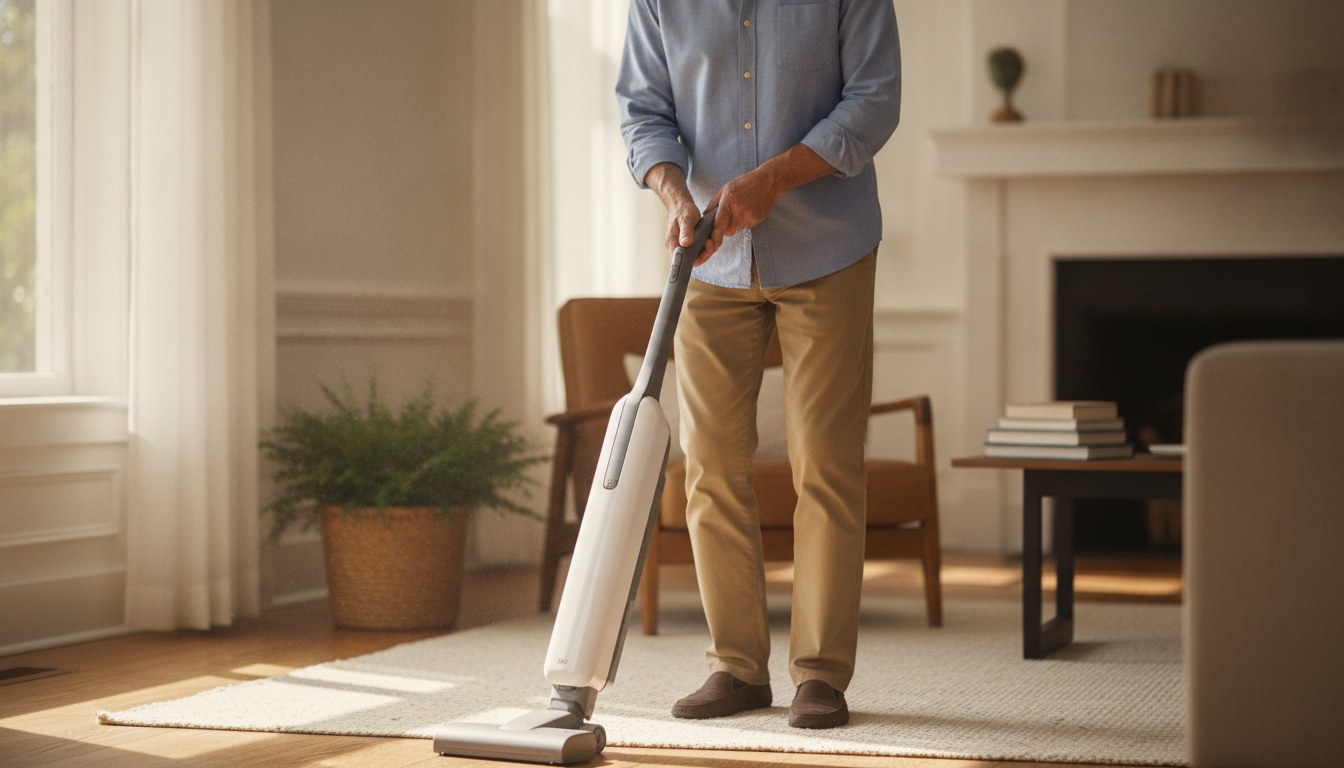
A stick vacuum and an upright vacuum can sit in the same closet and still solve completely different problems. One is built to be picked up in ten seconds for a coffee spill or a hallway of pet hair. The other is built to be pushed, slowly and thoroughly, across a living room rug until every fiber gives up its dust. Picking between them by price alone skips the part that actually matters: how you clean, not just what you spend.
In the stick vacuum vs upright vacuum choice, a stick vacuum is a light, usually cordless tool built for quick pickups and hard floors, while an upright vacuum is heavier, often corded, and built for thorough, sustained cleaning on carpet. Pick a stick for speed and small spaces, an upright for deep carpet cleaning and larger homes.
| Spec | Stick vacuum | Upright vacuum |
|---|---|---|
| Median weight (our lineup) | About 6.5 lb, easy to carry one-handed | About 12.5 lb, built to be pushed rather than carried |
| Power source | Almost entirely rechargeable battery, cordless | Mostly corded, plug-in for uninterrupted suction |
| Suction consistency | Tapers as the battery drains, strongest on a fresh charge | Stays constant the entire time it's plugged in |
| Best surface | Hard floors and low-pile carpet | Thick pile and wall-to-wall carpet |
| Dust capacity | Smaller bin, needs more frequent emptying on a big job | Larger bin or bag, fewer stops during a whole-house clean |
| Stairs and quick pickups | No cord to fight, often converts to a handheld | Bulkier and heavier to carry up and down stairs |
| Runtime limit | About 40 to 140 minutes per charge, depending on model and mode | None, runs as long as it's plugged in |
Stick vacuum vs upright vacuum: the core trade-off
A stick vacuum swaps cleaning power and capacity for light weight and portability; an upright vacuum swaps portability for a bigger motor, bigger dust bin, and deeper carpet cleaning.
Shopping for a specific model? See our full vacuums roundup — 10 models compared on the specs that decide it.
Every vacuum design is a set of trade-offs wearing a different shape, and stick versus upright is one of the clearest examples in the category. A stick vacuum is built around one priority: get it off the floor and moving in one motion. That means a slim body, a small motor mounted up near the handle, and, in almost every current model, a battery instead of a cord. Weight comes down as a direct result. Across the stick vacuum lineup we track, the median model lands around 6.5 lb, light enough to carry one-handed up a flight of stairs.
An upright vacuum takes the opposite bet. The motor sits low, over the wheels, where its weight has to be pushed rather than lifted. That lets manufacturers use a bigger, more powerful motor and a wider brush roll without punishing your arm for it. The median upright we track weighs about 12.5 lb, nearly double the stick median, and that extra mass buys a bigger dust bin, a wider cleaning path, and, for corded models, suction that never tapers as a battery drains. Neither number is a flaw. It's just what each design chose to optimize for.
Where a stick vacuum wins
A stick vacuum earns its keep on hard floors, stairs, and quick daily pickups, anywhere speed and reach matter more than raw suction.
Cordless freedom is the whole pitch, and it delivers where an upright can't follow. No cord means you're not hunting for an outlet halfway down a hallway or untangling one from a table leg every time you switch rooms. That makes a stick vacuum the better tool for stairs, where dragging a corded upright up and down each step is its own workout, and for the kind of quick-response cleanup, a dropped bag of flour or a trail of litter, that doesn't deserve a full vacuuming session.
Battery runtime varies by model and power mode. Across the stick vacuums in our lineup, listed runtimes span roughly 40 to 140 minutes on a charge, shorter on the highest suction setting and longer on eco mode, so a small apartment gets cleaned start to finish on one charge while a larger home might need a mid-clean top-up. Most current stick models also convert to a handheld unit for car interiors and upholstery, a versatility uprights don't offer without a separate attachment hose. If hard floors, stairs, and speed are the priority, our stick vacuum lineup breaks down the current options by weight, runtime, and suction.
Where an upright vacuum wins
An upright vacuum wins on carpet, in larger homes, and anywhere sustained suction and a bigger dust bin matter more than portability.
Push an upright across a thick pile carpet and the design logic clicks into place. The wider nozzle and a motorized brush roll agitate carpet fibers deeply enough to lift embedded dirt and pet hair that a lighter stick vacuum, with its narrower head, tends to skim over. Corded uprights also never lose suction mid-room the way a draining battery can, which matters most in a home with several rooms of wall-to-wall carpet that need a full pass without a mid-clean charge.
Capacity is the other advantage. A bigger dust bin or bag means fewer stops to empty the vacuum during a whole-house clean, and several upright models we track add a detachable pod for above-floor jobs like stairs, upholstery, and curtains, closing some of the versatility gap with sticks. The cost of all that is weight: at a median of about 12.5 lb, an upright is a two-handed, push-and-pull tool, not something you casually carry room to room. For a home with more carpet than hard floor, or a household managing serious pet hair, our upright vacuum guide compares current models on suction, weight, and dust capacity.
Battery life, suction consistency, and runtime
Cordless sticks run on a fixed battery charge that tapers suction as it drains, while corded uprights draw steady, unlimited power for as long as they're plugged in.
Runtime is the spec that trips up first-time stick vacuum buyers the most. A battery-powered stick vacuum's suction is strongest right after a charge and on its highest power setting; drop to eco mode and runtime stretches, sometimes past two hours, but so does the time it takes to clean the same room. In our lineup, listed runtimes range from about 40 minutes on the shorter end to 140 minutes on the longer end, and that spread depends heavily on which power mode a given model defaults to, not just battery size alone.
An upright sidesteps the whole calculation by staying plugged in. Suction stays constant from the first minute to the last, which matters more than it sounds like it should when you're deep-cleaning a room and have to move heavy furniture out of the way. The trade is reach: a corded upright is only as mobile as its cord length and the nearest outlet allow, and an extension cord for a far room is its own small inconvenience. Fast-charging batteries have narrowed the runtime gap in recent stick models, some recharging in under three hours, but a cordless tool is still, by definition, working against a clock a corded one never has to watch.
Allergies, dust containment, and filtration
HEPA filtration and a sealed system, not the stick-versus-upright shape, decide how well a vacuum keeps dust and allergens from blowing back into the room.
Filtration matters more than body style here. The American Lung Association points out that a HEPA filter traps 99.97% of particles, but that number only holds if the whole vacuum is sealed. A HEPA filter bolted onto a leaky housing still lets fine dust escape around the gaps, which is why the Lung Association recommends looking at the sealed system and the beater bar, not just the filter label, when allergies are the deciding factor. Bagged models also tend to contain dust better at emptying time than bagless ones, since a bagless bin can release a small cloud of trapped particles the moment you open it.
The EPA's guidance takes a step back from vacuum design and focuses on habit: it recommends routinely vacuuming carpets and fabric-covered furniture to keep dust mites and other biological contaminants from accumulating, and notes that people with allergies or asthma may need to clean more often than everyone else. For buyers who want a vacuum built specifically around that need, the Asthma and Allergy Foundation of America and Allergy Standards Limited jointly certify vacuums that meet seven separate criteria, among them capping how much dust escapes when the bag or canister is emptied and keeping airborne allergen levels below a set threshold during the vacuuming itself. Neither a stick nor an upright shape is inherently better here; the filtration and seal underneath the shape is what decides it.
So which one should you buy
Match the vacuum to your floors and your patience for charging, not the other way around: hard floors and quick jobs favor a stick, thick carpet and whole-house cleans favor an upright.
Start with your floors, not your budget. A home that's mostly hardwood, tile, or low-pile carpet, with a few stairs and a car to keep tidy, gets more daily use out of a light, cordless stick vacuum than a heavier upright that spends most of its life in a closet. A home with thick wall-to-wall carpet, multiple rooms to cover in one session, or a dog that sheds year-round tends to get better results from an upright's steadier suction and wider brush roll, even with the added weight.
Plenty of households end up owning both, using the upright for a weekly deep clean and the stick for the mess that happens between those cleans. That's a practical split, matching the tool to the job rather than picking one vacuum to do everything adequately. If you're still weighing options across the whole category rather than just these two shapes, our best vacuum guide rounds up top-rated picks across stick, upright, canister, and other styles side by side, a reasonable next stop before you commit to either type.
Neither shape beats the other outright; they're built for different chores. A stick vacuum wins on hard floors, stairs, and the kind of quick pickup you don't want to plan around, while an upright wins on thick carpet, pet hair, and any whole-house clean where steady suction matters more than portability. Households with a mix of flooring types often end up happier owning one of each than forcing one vacuum to do both jobs.
Frequently asked questions
Is a stick vacuum as powerful as an upright vacuum?
Do I need both a stick vacuum and an upright vacuum?
How long does a cordless stick vacuum run on one charge?
Which is better for pet hair, a stick or upright vacuum?
Are stick vacuums good for allergies?
Sources & references
- Not All Vacuums Are Created Equal: Pick the Best One for Your Health — American Lung Association
- Biological Pollutants' Impact on Indoor Air Quality — U.S. Environmental Protection Agency
- Vacuum Cleaners - asthma & allergy friendly Certification Program — Asthma and Allergy Foundation of America (AAFA) / Allergy Standards Limited (ASL)