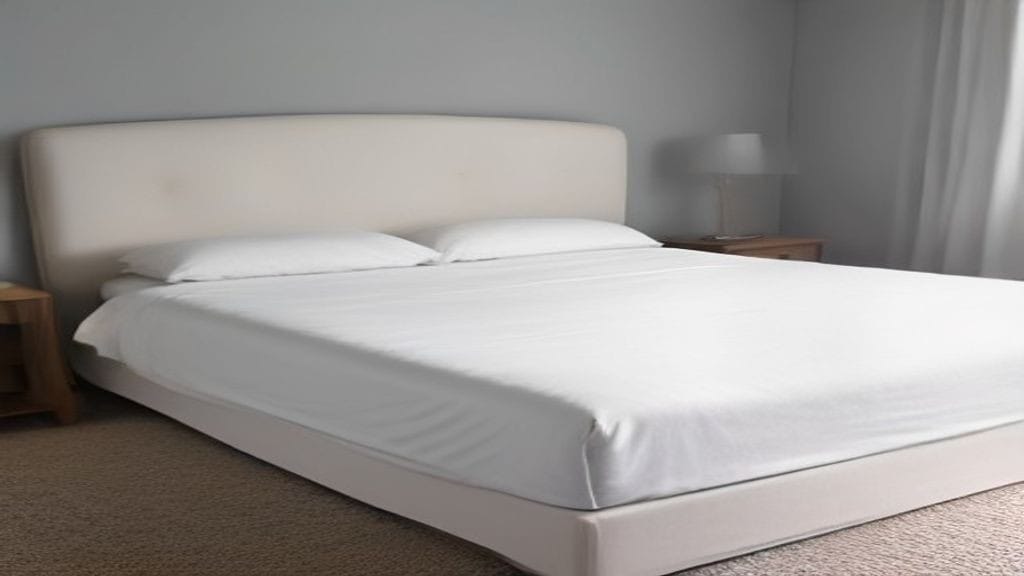
| Quick Facts | |
|---|---|
| King mattress width | About 76 inches; a California king is about 72 |
| King pillow | About 20 by 36 inches |
| Queen pillow | About 20 by 30 inches |
| Standard pillow | About 20 by 26 inches |
| Back row that fills a king | Two king pillows (~72 in) or three standard (~78 in) |
| Why two standard looks wrong | 52 inches on a 76-inch bed leaves a 24-inch gap |
| Row order | Back row upright, sleeping pillows in front, decorative last |
| Sleeping height | Side high and firm, back medium, front flat or none |
How pillows go on a king bed, front to back
Work in layers: a wide back row against the headboard, sleeping pillows in front of it, decorative pieces last.
Shopping for a specific model? See our best pillows picks — 10 models compared on the specs that decide it.
Think of it as three rows rather than a pile. The back row stands upright against the headboard and its only job is to fill the width, which on a king bed is the whole problem you are solving. The middle row is where you sleep, laid flat and pulled forward so your head lands on it rather than on the upright row behind. Anything decorative goes in front of that, closest to the foot of the bed, so it lifts off first at night and does not sit under your head. This order also survives contact with real life. When you go to bed you move one row of cushions, not a whole arrangement, and in the morning you rebuild it in the same order without thinking. If a layout takes more than a few seconds to reset, it stops being used by the second week.
Which sizes actually fill the width
Two king pillows span most of a king mattress; three standard or queen pillows do a similar job.
Bedding sizes are standardised enough to plan with. A standard pillow is roughly 20 by 26 inches, a queen about 20 by 30, and a king about 20 by 36. A US king mattress is about 76 inches wide, and a California king is narrower at around 72 but longer. Do the arithmetic and the options become obvious. Two king pillows laid end to end come to about 72 inches, which sits neatly inside a 76-inch bed with a small margin at each side. Three standard pillows add up to about 78 inches, so they slightly overlap or press together, which looks full rather than wrong. Two standard pillows total 52 inches on a 76-inch bed, and that 24-inch shortfall is the gap people are trying to fix. So the fastest solution for a bare-looking king bed is either two king pillows across the back, or a third standard one added to the pair you already own.
Choose the front row for your neck, not for looks
Only the pillows you sleep on affect your neck, so match their height and firmness to your sleeping position.
Separate the two jobs and the buying decision gets simpler. Back-row pillows are furniture. They can be cheap, firm and purely about filling space. The front row is different, because pillow support is associated with neck symptoms, so this is the one to get right. Match the height to how you sleep. Side sleepers have the widest gap between ear and mattress, so they need the loftiest, firmest pillow to keep the head level with the spine. Back sleepers need a medium height that supports the neck's curve without pushing the chin toward the chest. Front sleepers need the flattest option available, or none, since anything thick twists the neck upward all night. Fill type follows from that: foam and latex hold a set height, while down and polyester compress and need fluffing to keep it.
Why stacking two pillows usually backfires
A stack lifts the head above the line of the spine, which loads the neck for hours.
Stacking is the common fix when a single pillow feels too low, and it tends to create a worse problem than the one it solves. The aim while sleeping is a straight line from head through neck to spine. One correctly chosen pillow fills the gap between your head and the mattress and holds that line. Two pillows usually overshoot, tilting the head forward or sideways, and your neck then holds that angle for seven or eight hours. Stacks are also unstable, because the top pillow slides off the one below during the night and the height keeps changing. If a single pillow feels too low, the honest answer is that it is the wrong pillow or a worn-out one rather than that you need a second. Fluff it fully and test again, and if it still collapses under your head, replace it with a loftier or firmer one.
A simple layout that works
Two king pillows across the back, two sleeping pillows in front, and at most two decorative cushions.
Here is a setup that suits most king beds and takes seconds to rebuild. Stand two king pillows upright against the headboard, side by side, so the back of the bed is covered corner to corner. Lay your two sleeping pillows flat in front of them, one per person, chosen for your own sleeping positions rather than as a matching pair. Add no more than two decorative cushions in front of those, since anything beyond that becomes a nightly chore and ends up on the floor. If you would rather not buy king pillows, use three standard ones across the back instead and keep everything else the same. Put a zipped protector on the front-row pillows, because those are the ones absorbing sweat and oils every night, and they are the ones you actually paid for support.