| Quick Facts | |
|---|---|
| LATCH lower anchor weight limit | 65 lb combined weight of child plus car seat |
| LATCH required in vehicles and car seats since | September 1, 2002 |
| IIHS 'good' rating: lower anchor depth | no more than 0.75 in. deep in the seat bight |
| IIHS 'good' rating: anchor clearance angle | greater than 54 degrees |
| IIHS 'good' rating: force to attach a connector | less than 40 lb |
| 2015 rear-impact sled test, infant seat model (Traffic Injury Prevention) | HIC15 194-218 with seat belt install vs. 394 with LATCH install |
What LATCH actually is, and how it differs from a seat belt install
LATCH is built-in vehicle hardware, a pair of lower anchor bars plus a top tether anchor, that a car seat clips onto directly; installing with a seat belt instead uses the vehicle's existing lap-and-shoulder belt to hold the seat down.
Shopping for a specific model? See our best car seats picks — 10 models compared on the specs that decide it.
LATCH stands for Lower Anchors and Tethers for Children. It's hardware built into the vehicle itself: two metal anchor bars usually tucked into the seat bight, the crease where the cushion meets the seatback, plus a top tether anchor mounted somewhere behind the seat. Car seats with a LATCH system clip straight onto those bars, either with an adjustable strap or with rigid connectors, and forward-facing seats add a separate strap running to the tether anchor. Per the American Academy of Pediatrics, this hardware has been required in nearly every vehicle and car seat built since September 1, 2002, so a newer car almost certainly has it in at least two seating positions.
Installing with a seat belt skips that dedicated hardware and uses the belt your car already has, usually with help from a locking clip or a lock-off built into the car seat itself. It works in any position that has a seat belt, including the middle seat, where LATCH anchors are frequently missing altogether. Federal rules only ever required automakers to install lower anchors in two rear seating positions, typically the outboard ones, so the middle seat got left out more often than parents expect. That's the practical seed of the whole latch vs seat belt car seat installation decision: which hardware your particular seating position actually has.
How to install a car seat with LATCH
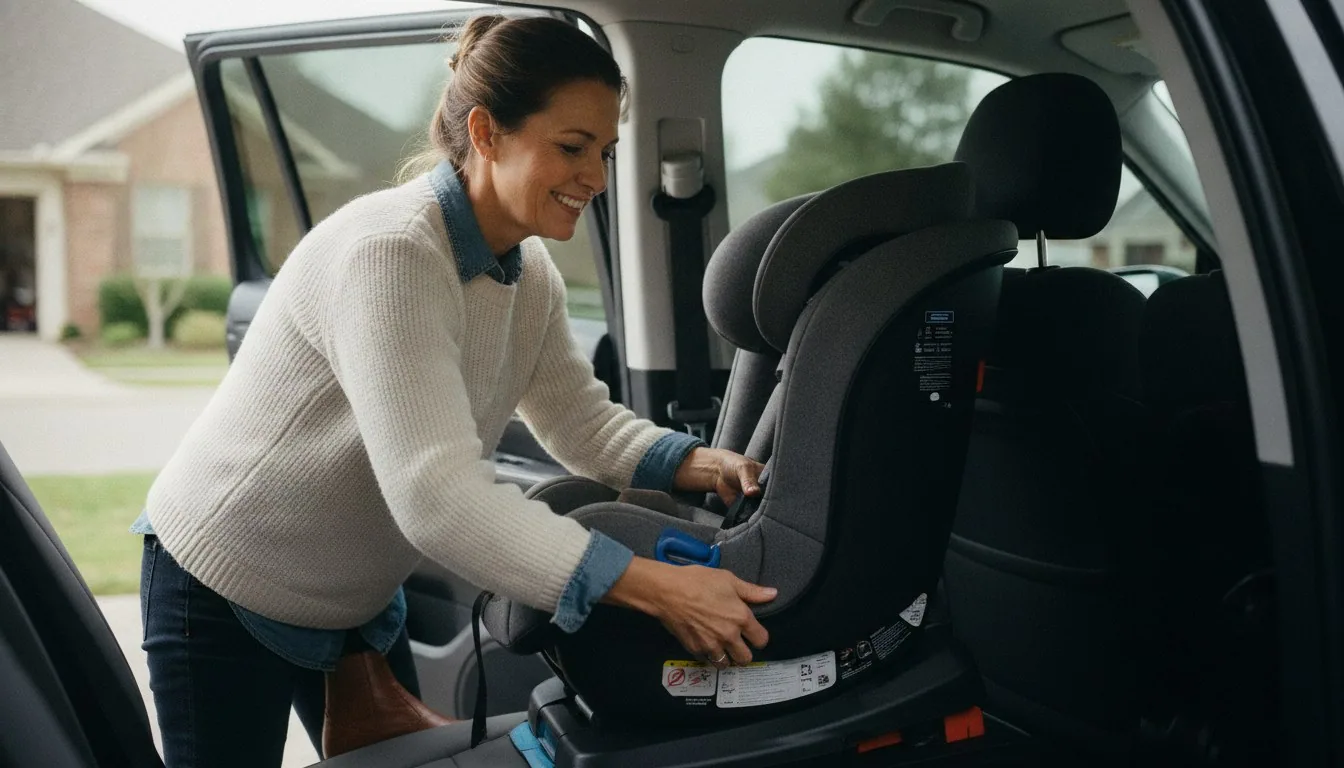
Clip the seat's LATCH connectors onto the vehicle's lower anchors, push the seat down and back to remove slack, then attach the top tether for any forward-facing install.
Car seats with a LATCH system use one of two connector styles. Strap-and-buckle connectors need you to pull the webbing tight by hand, while car seats with rigid LATCH connectors lock straight onto the anchor bars with no strap tension involved. Rigid connectors tend to hold a more consistent install over time since there's no webbing to gradually loosen, though there's no meaningful safety gap between the two styles once either is installed correctly. Either way, you're usually feeling around blind for the anchor bars before you ever actually see them.
Once both connectors are hooked on, push the car seat firmly into the vehicle seat, using a knee or your body weight, while cinching the strap or locking the rigid arms down. Then check for movement at the belt path: less than an inch of side-to-side or front-to-back give is the standard car seat technicians use. Forward-facing seats also need the top tether clipped and tightened; skipping it is one of the more common installation mistakes, since it looks optional but isn't. And keep the 65-pound ceiling in mind before leaning on the lower anchors for a bigger toddler: past that combined weight of child and seat, the anchors aren't rated to hold no matter how tight the install feels.
How to install a car seat with a seat belt
Thread the vehicle's lap-and-shoulder belt through the correct path on the car seat, lock the belt so it can't feed out, then push down to remove slack before checking for movement at the belt path.
Installing a car seat with a seat belt starts the same way whether the seat faces forward or backward: route the belt through the marked path, buckle it, then lock it so it can't loosen once it's tight. Many newer vehicles lock the belt just by pulling it all the way out and letting it retract; older cars sometimes need a separate metal locking clip instead. A lot of current car seats also build a lock-off clamp right into the shell, which pins the webbing in place without touching the vehicle's own retractor mechanism at all.
After locking the belt, lean into the seat and push down while pulling the remaining slack out, the same knee-and-body-weight technique used for a LATCH install. A properly belted seat should show the same sub-inch of movement at the belt path that a LATCH install does. The upside of the seat belt method is that it works at any weight and in any seating position, so it becomes the only option once a growing child pushes past the 65-pound LATCH ceiling, and it's frequently the only option in a crowded three-across back row regardless of weight.
LATCH vs seat belt car seat installation: which one is actually safer
Neither method has a documented safety edge over the other once installed correctly and tightened properly; the real risk in both cases is a loose or incorrect install, not the hardware itself.
The core of the latch vs seat belt car seat installation debate isn't really which hardware is more advanced, it's which one you actually tightened right. The AAP's guidance is blunt about it: seat belt and LATCH systems are equally safe, so use whichever works better for your particular seat and vehicle. IIHS research adds a real-world wrinkle, finding that restraints installed with LATCH anchors were more likely to end up correctly installed than seat-belt-only installs, mainly because well-designed anchor hardware is easier to feel and use correctly by touch. IIHS now grades vehicles good, acceptable, marginal, or poor on LATCH hardware based on criteria like whether the anchors sit no more than three-quarters of an inch deep in the seat cushion and whether attaching a connector takes less than roughly 40 pounds of force.
None of that settles the question outright, though. A 2015 sled-test study published in the journal Traffic Injury Prevention, simulating rear-end collisions with 6-month-old test dummies, found that two infant seat models produced lower head-injury scores when installed with a seat belt than when installed with LATCH, in one comparison by roughly half. The researchers noted the dummy's head struck the seatback in many of the tests, and pointed to those head strikes as the source of the higher HIC15 scores recorded across the testing. It's a narrow finding limited to one crash direction and two seat models, not a verdict against LATCH in general, but it's a fair reminder that "equally safe on average" doesn't guarantee identical outcomes in every crash configuration. If your car seat's own manual expresses a preference for one method, that instruction should outrank general advice every time.
Can you use LATCH and seat belt together
No, not normally: the car seat was crash-tested using one attachment method at a time, so combining LATCH and a seat belt on the same install isn't how the restraint was validated, unless both manufacturers explicitly say otherwise.
This is one of the most commonly searched car seat questions, and it makes sense: doubling up feels like it should be safer. In most cases it isn't. The car seat was engineered and crash-tested using one attachment method at a time, so stacking LATCH and a seat belt onto the same install can pull the shell in two directions during a crash instead of one, which isn't how the restraint was validated. The AAP's guidance is direct here too: use one system or the other, not both, unless the car seat's manual and the vehicle's manual both specifically permit it.
A small number of car seats, mostly convertible and all-in-one models built to extend rear-facing use, are engineered by their manufacturer to use both attachment points at once as part of the intended install. That's an exception written into a specific seat's manual, not a general workaround, so check your own seat's instructions rather than assuming your model qualifies. When in doubt, pick one method, install it correctly, and confirm the fit with the push-and-pull test rather than adding a second anchor point for reassurance.
Choosing a car seat built around your installation method
Convertible and all-in-one seats tend to reach the LATCH weight ceiling sooner because the seat itself weighs more, while some brands engineer their seats specifically to make the seat belt method as fast as LATCH.
If you're shopping rather than installing what you already own, the installation method is worth weighing before the color or the cup holders. Heavier convertible and all-in-one seats change the latch vs seat belt car seat installation math fast, since the seat itself weighs more, so a toddler in a heavier seat hits the 65-pound limit sooner than one in a lighter infant seat. Our convertible car seat guide breaks down current models by weight, which matters more here than most buyers expect, since it directly decides how long each seat stays LATCH-eligible before you're back to seat belt installs.
Some brands lean into making the seat belt method painless instead of just tolerable. Britax builds its ClickTight seats around a three-step seat belt install, open the seat, thread the belt, close it, specifically so families aren't fighting a stiff retractor every time the seat moves between cars. Our Britax car seat lineup lays out which models use that system. For a wider side-by-side across brands and both installation styles, our best car seats guide compares the field on installation ease along with everything else that matters, and our car seats hub rounds up every category we cover if you're starting from scratch.