Best Carbon Monoxide Detectors of 2026: 10 Compared

Carbon monoxide is colorless, odorless, and impossible to catch without help, which is exactly why the detector you pick matters more than its sticker price. The ten units in this guide land, a narrow band that hides real differences in power source, sensor type, and what each one actually watches. A few even step beyond CO into smoke and explosive gas. The trick is knowing which feature set fits your home.
Picking a carbon monoxide detector is less about finding the flashiest spec sheet and more about matching power source, sensor coverage, and placement to your home. The lineup here spans from, and the spread is not just price: some plug into a 120V outlet with battery backup, some run entirely on AA batteries you can carry room to room, and a couple combine CO sensing with smoke or explosive-gas detection in one housing. Reading the fine print on each is what separates a smart buy from a regret. To build this guide we pulled current specifications, images, and pricing for the ten most relevant models on Amazon, then ranked them on capability, value, and fit for common situations. The Kidde Carbon Monoxide Detector takes the top spot, with X-Sense and First Alert filling out the strongest budget and combo options. Below you will find quick picks, a feature-by-feature look at each unit, and honest notes on where every one falls short.
The short version: Our top pick is the Kidde Carbon Monoxide Detector, a plug-in unit with a 9V battery backup, digital LED display, 85-decibel alarm, and Peak Level Memory. For the lowest price, the Toptes PT199 Natural Gas Leak Detector is the best value, though note it sniffs combustible gas rather than carbon monoxide.
- Best overall: Kidde Carbon Monoxide Detector, plug-in with 9V battery backup and a digital LED display
- Cheapest option: Toptes PT199, but it detects combustible gas like methane and propane, not CO
- Most coverage: Kidde Carbon Monoxide + Explosive Gas adds natural gas and propane sensing
- Hands-off power: X-Sense SC07 and SC06 run on a sealed 10-year lithium battery
- Ten models compared, priced
Our Top 3 Picks

- Plugs into a standard 120V outlet
- 9-volt battery backup for power outages
- Digital LED display of CO level
- 85-decibel alarm
- Peak Level Memory of last detection or test

- Combined smoke and CO detection
- Photoelectric smoke and electrochemical CO sensors
- Sealed 10-year lithium battery
- Tested and certified to meet UL 217
- Shows real-time CO from 30-999 ppm

- One alarm for two threats
- Sealed lithium battery lasts up to a decade
- Upgraded photoelectric and electrochemical sensors
- One-button test and silence
- Loud 85 dB alarm
Full Comparison — All 10 Carbon Monoxide Detector
| Image | Product | Features | Price |
|---|---|---|---|
Editor's Choice |
| Check Price on Amazon Read Full Review | |
Best Value |
| Check Price on Amazon Read Full Review | |
Premium Pick |
| Check Price on Amazon Read Full Review | |
 |
| Check Price on Amazon Read Full Review | |
 |
| Check Price on Amazon Read Full Review | |
 |
| Check Price on Amazon Read Full Review | |
 |
| Check Price on Amazon Read Full Review | |
 |
| Check Price on Amazon Read Full Review | |
 |
| Check Price on Amazon Read Full Review | |
 |
| Check Price on Amazon Read Full Review |
How They Compare
Top picks — strengths at a glance
Brands compared
All 10, Reviewed
This plug-in Kidde tops our ranking of ten detectors. It slots into a standard 120V outlet and falls back to a 9-volt battery during outages, while a digital LED display reports the CO level the alarm is sensing. Peak Level Memory logs the last detection or test, so you are never guessing what happened.
- Plugs into a standard 120V outlet
- 9-volt battery backup for power outages
- Digital LED display of CO level
- 85-decibel alarm
- No notable drawbacks in the listed feature data
- Heavier than most at about 3 lb
X-Sense's SC07 lands and rolls smoke and CO into a single unit, using a photoelectric smoke sensor alongside an electrochemical CO sensor. It is tested and certified to meet UL 217, and a sealed lithium battery delivers 10 years of continuous power. The display reads real-time CO levels from 30 to 999 ppm along with battery and working status.
- Combined smoke and CO detection
- Photoelectric smoke and electrochemical CO sensors
- Sealed 10-year lithium battery
- Tested and certified to meet UL 217
- Standalone unit with no wireless interconnection or Wi-Fi
- Cannot be used with a base station
The X-Sense SC06 runs and guards against two dangers with one alarm, pairing upgraded photoelectric and electrochemical sensors for faster response and fewer false alarms. It is battery-operated, installs without an electrician, and runs on a sealed lithium battery good for up to a decade. One button handles both testing and silencing.
- One alarm for two threats
- Sealed lithium battery lasts up to a decade
- Upgraded photoelectric and electrochemical sensors
- One-button test and silence
- No notable drawbacks in the listed feature data
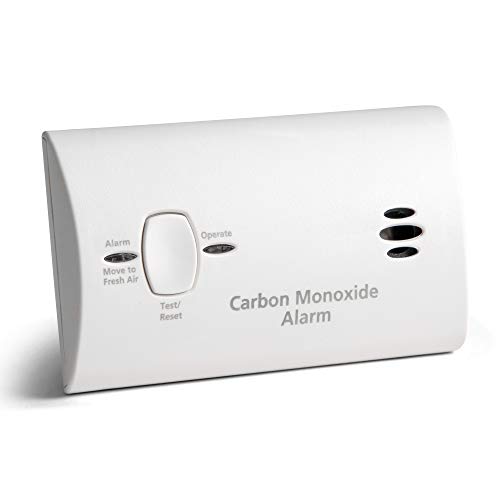
, this AA-powered Kidde skips wiring entirely and runs on two included AA batteries, so it keeps watching even during a power failure. An electrochemical sensor detects CO gas, a green LED confirms power, and a red LED plus 85-decibel alarm flag a problem. Event Memory keeps a record of the last detection or test.
- Runs on two included AA batteries
- No wiring needed; wall or tabletop
- Electrochemical sensor detects CO gas
- Green and red LED status indicators
- No notable drawbacks in the listed feature data
- No digital level display
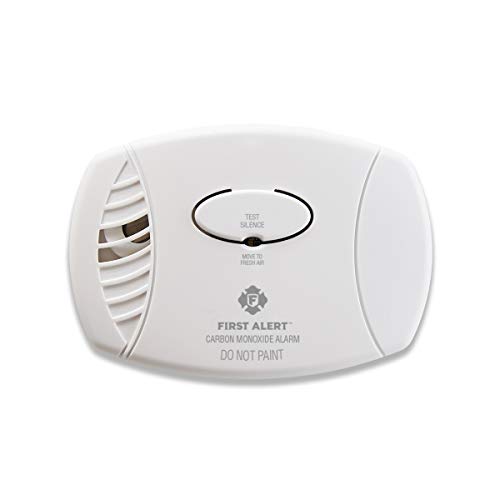
First Alert's CO606 is the budget plug-in, working in any standard outlet with a battery backup for continuous monitoring. An advanced electrochemical CO sensor reads levels wherever the unit sits in the room, and a single test/silence button keeps operation simple. It ships with a 7-year limited warranty and an end-of-life chirp.
- Works in any standard outlet with battery backup
- Advanced electrochemical CO sensor
- Single test/silence button
- Loud 85-decibel alarm
- No digital CO-level display
- No notable drawbacks in the listed feature data
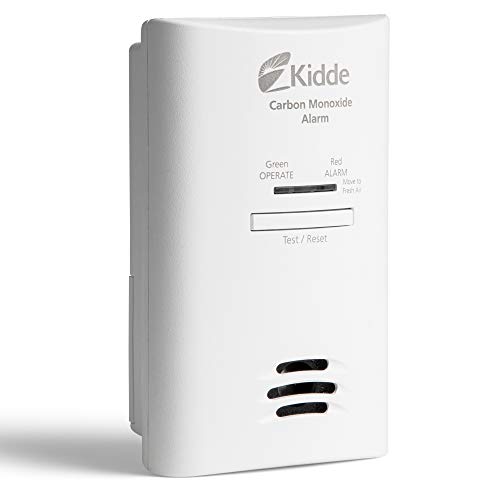
This Kidde sits and plugs into a standard 120V outlet, switching to a 2-AA battery backup if the power drops. An 85-decibel alarm announces CO, Peak Level Memory logs the last detection or test, and a Test-Hush button makes checks and silencing false alarms painless. It is a straightforward plug-in without the digital display of the top pick.
- Plugs into a standard 120V outlet
- 2-AA battery backup for outages
- 85-decibel alarm
- Peak Level Memory of last detection or test
- No digital CO-level display
- No notable drawbacks in the listed feature data
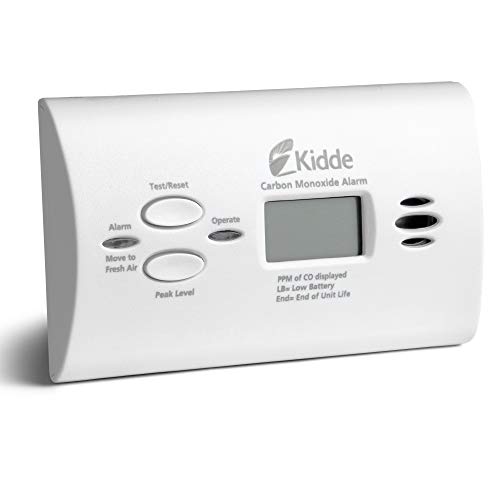
, this Kidde runs on two included AA batteries and needs no wiring, so it keeps detecting through a power failure. It mounts on a wall or sits on a tabletop, and an electrochemical sensor handles CO detection. A green LED shows power while a red LED and 85-decibel alarm flag carbon monoxide; Peak Level Memory tracks the last event.
- Electrochemical sensor detects CO gas
- No wiring; wall or tabletop placement
- Conveniently designed and portable
- Green and red LED indicators with 85-decibel alarm
- No digital CO-level display
- No notable drawbacks in the listed feature data
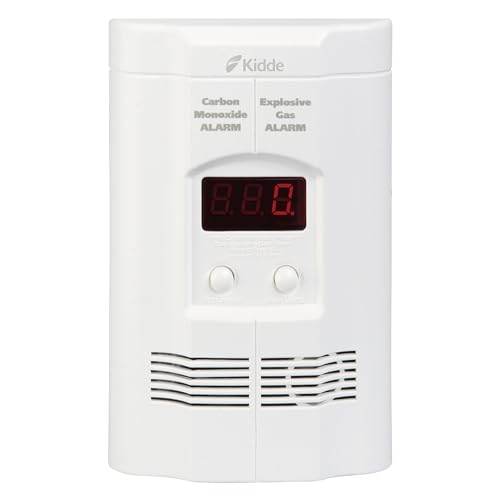
this is the priciest pick, and it earns the tag by watching for more than CO: it adds natural gas and propane sensing on top of carbon monoxide. The plug-in unit uses a 9V battery backup for outages, and its digital LED display shows the CO level or states "GAS" when explosive gas is present. Peak Level Memory rounds out the package.
- Detects CO plus natural gas and propane
- Plugs into a standard 120V outlet
- 9-volt battery backup for outages
- Digital LED display shows CO level or "GAS"
- No notable drawbacks in the listed feature data
- No notable drawbacks in the listed feature data
The Model COB Kidde and is built to travel, with a compact, lightweight design you can take to hotels or vacation rentals. It runs on two included AA batteries without wiring and keeps working through outages. It is tested to UL 2034 5th Edition, is ETL, and carries a 10-year limited warranty, with an 85 dB alarm and Test/Hush button.
- Detects carbon monoxide with an 85 dB alarm
- AA battery powered, no wiring
- Compact and travel-ready
- Tested to UL 2034 5th Edition and ETL Listed
- No digital CO-level display
- No notable drawbacks in the listed feature data
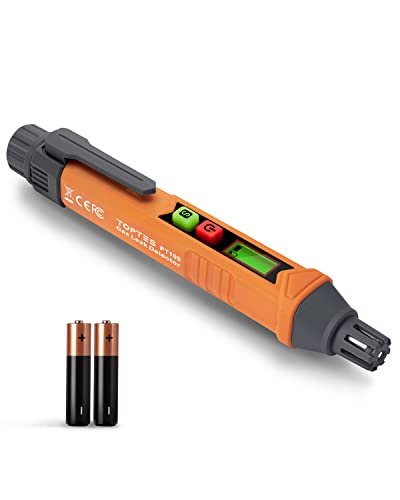
The Toptes PT199 is the cheapest item here, but it plays a different role: it is a portable natural gas leak detector that locates combustible sources like methane, propane, butane, and LPG. Visual and audio alarms fire within 0.5 seconds of detection, and it is ready after a 30-second warm-up. It ships pocket-sized with two AAA batteries and a storage bag.
- Detects natural gas, methane, propane, butane, and LPG
- Visual and audio alarms within 0.5 seconds
- Includes 2 AAA batteries
- Pocket-sized with storage bag
- Detects combustible gas, not carbon monoxide
- No notable drawbacks in the listed feature data
8 Things to Consider Before Buying Carbon Monoxide Detector
Before you add anything to your cart, think about where the detector lives and how it draws power, since that drives almost everything else. The factors below cover the decisions that actually change which model is right for you, from sensor type to whether you want smoke or gas coverage bundled in.
Our Final Verdict
If you want one detector that covers the bases, the Kidde Carbon Monoxide Detector is the pick, pairing plug-in convenience and a 9V backup with a digital LED display and Peak Level Memory. On a tight budget, the Toptes PT199 Natural Gas Leak Detector is the cheapest option, but be clear-eyed: it detects combustible gas like methane and propane, not carbon monoxide, so it suits a different job. For the widest coverage in a single unit, the Kidde Carbon Monoxide + Explosive Gas is the premium choice, adding natural gas and propane alarms on top of CO. The X-Sense SC07 and SC06 are the smart middle ground if you also want smoke detection and a 10-year sealed battery.
Frequently Asked Questions
What is the best carbon monoxide detector?
The Kidde Carbon Monoxide Detector is our top pick of the ten models compared. It plugs into a standard 120V outlet, keeps a 9V battery backup for outages, shows CO levels on a digital LED display, and sounds an 85-decibel alarm.
How much should I spend on a carbon monoxide detector?
These ten models run. You can get a capable battery-powered Kidde, while the priciest option, the Kidde Carbon Monoxide + Explosive Gas, adds natural gas and propane detection. Spend more only if you need that extra coverage.
Should I get a plug-in or battery-powered detector?
Plug-in units like the top Kidde draw from a 120V outlet with a 9V battery backup for power outages, which is ideal for fixed wall placement. Battery-only models such as the AA-powered Kidde install without wiring and can move room to room or travel with you.
Do any of these detect more than carbon monoxide?
Yes. The X-Sense SC07 and SC06 combine carbon monoxide and smoke detection in one unit. The Kidde Carbon Monoxide + Explosive Gas adds natural gas and propane sensing and displays "GAS" when explosive gas is present.
Which detector has the longest battery life?
The X-Sense SC07 and SC06 use a sealed lithium battery rated for up to 10 years of continuous power, so you never swap batteries during the unit's life. Plug-in Kiddes instead rely on a replaceable 9V or AA backup that activates only during outages.
Is the Toptes PT199 a carbon monoxide detector?
No. The Toptes PT199 is a portable natural gas leak detector that sniffs out combustible sources like methane, propane, butane, and LPG, triggering visual and audio alarms within 0.5 seconds. If you specifically need carbon monoxide protection, choose a CO-rated unit instead.


