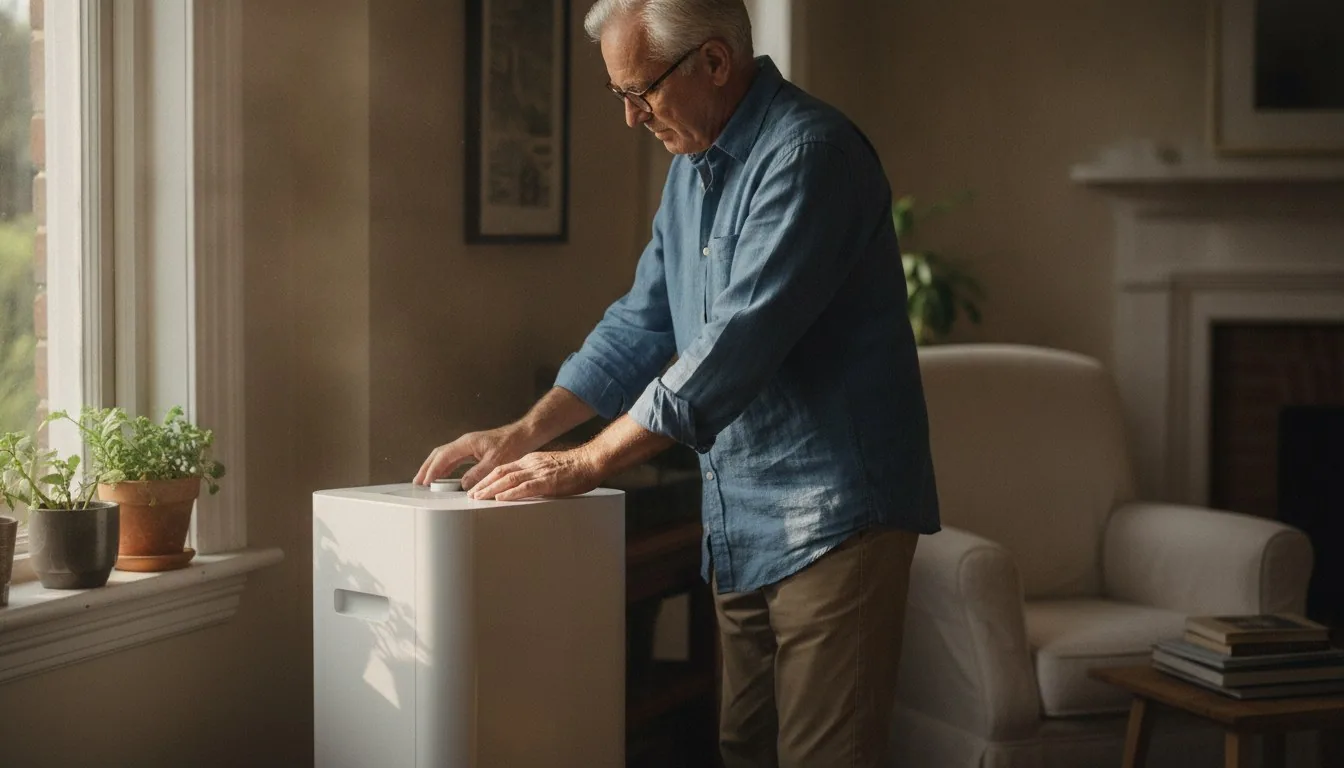
| Quick Facts | |
|---|---|
| EPA ideal indoor humidity | 30-50% relative humidity, with 60% as the ceiling before mold risk climbs |
| CDC humidity ceiling | 50% relative humidity, held all day |
| ENERGY STAR sizing, small-to-medium room, slight-to-moderate dampness | about 20-30 pints per day |
| ENERGY STAR sizing, large or very damp room | 40+ pints per day |
| ENERGY STAR certified efficiency | uses about energy than a conventional model |
Where to place a dehumidifier: start with the room that's actually damp
Pick the room with visible condensation, a musty smell, or a hygrometer reading above the 30-50% range the EPA calls ideal, then worry about the exact spot inside it.
Shopping for a specific model? See top-rated dehumidifiers models — 10 models compared on the specs that decide it.
Most people default to the room that looks the most cluttered, or the one closest to an outlet, which is a convenience decision dressed up as a placement decision. The better starting point is evidence: condensation on a window, a musty smell that doesn't fade with a candle, warped baseboards, or a hygrometer reading above the range the U.S. Environmental Protection Agency calls ideal, 30% to 50% relative humidity, with 60% as the ceiling before mold risk climbs meaningfully. That's the first real answer to where to place a dehumidifier: start with proof, not the nearest wall outlet.
Once you've picked the room, resist the urge to make one unit do the work of three. A closed door stops airflow completely, so a dehumidifier running in a damp laundry room does nothing for a musty bedroom down the hall, no matter how strong its compressor is. Matching capacity to square footage matters here too: ENERGY STAR's own sizing guidance runs roughly 20 to 30 pints a day for a small-to-medium room that's only slightly to moderately damp, climbing to 40 pints or more for a larger space that stays wet most of the year. If you're still comparing models rather than repositioning one you already own, our dehumidifier hub breaks down current options by that same coverage math.
Give it clearance on every side, corners choke the airflow
A dehumidifier pulls air in on one side and pushes it out the other, so open space around the whole unit matters more than the exact spot in the room.
A dehumidifier works by pulling room air across a cold coil, wringing the moisture into a tank or hose, and pushing drier air back out. Block either side of that path and the unit still runs, the compressor still hums, and the display still ticks over, but it starts recycling the same small pocket of half-dried air instead of pulling from the room. Corners are the worst offenders, since two walls restrict airflow at once instead of just one, and stagnant corner air rarely reaches the intake in the first place.
Practically, that means keeping the unit off the wall and out of the recliner-and-side-table corner nobody vacuums, which, not coincidentally, is exactly where a lot of dehumidifiers end up. A rough foot of open space on every side is a reasonable target for most portable units, more if the intake or exhaust sits on the back or sides rather than the front. Where you place a dehumidifier relative to open floor space, not just relative to the room's dimensions, decides how much of that room's air the unit actually processes in a day.
Basement placement: floor level, but not just any floor level
Cool, damp air settles low, so floor-level placement is standard in a basement, with the exact spot chosen by where moisture actually collects and how the drain hose reaches an outlet.
Basements are the one room where floor placement is the right call rather than a compromise. Cooler, denser, moisture-heavy air sinks, and a basement rarely gets enough natural air movement to mix it back up with drier air near the ceiling, so a unit sitting on the concrete works with the air that's actually the wettest. Central placement in an open basement covers the most ground, though an obviously damp wall, an old water stain, or a corner near a sump pump is a reasonable exception. The EPA's own mold-prevention guidance points at water seepage into basements as something to stop quickly, with sump pumps and regrading around the foundation as the standard fixes for the source itself, not just the symptom.
In a basement, where you place a dehumidifier also comes down to where the water goes once the tank fills, a detail that trips people up more than airflow does. A unit set up for continuous draining needs its hose running downhill to a floor drain or sump, so the exact spot sometimes gets decided by plumbing rather than airflow alone. For a closer look at models built around basement-specific demands, coverage large enough for an open floor plan and drainage options that skip daily tank emptying, our basement dehumidifier picks compare current options side by side.
Crawl space placement runs into a different set of constraints
A crawl space limits the choice for a dehumidifier, so central positioning with real clearance and easy access to the tank or drain usually wins over an exact spot chosen for airflow alone.
Crawl spaces flip the placement problem around. There's rarely more than a few feet of headroom, framing and ductwork cut through what would otherwise be open floor space, and the ground itself is often bare dirt rather than a sealed slab. The EPA's own mold-prevention guidance singles out crawl spaces as one of the areas most often overlooked in a home's moisture control plan, which tracks with how rarely anyone actually crawls in to check on one. Central placement, roughly equal distance from the accessible openings, still beats tucking a unit into the far corner nobody can reach, since the same clearance rules apply even when the space itself is cramped.
In a crawl space, where you place a dehumidifier is dictated as much by access as by airflow. A unit you can't reach without crawling past ductwork is a unit whose tank won't get emptied, which is exactly why continuous drainage or a pump-equipped model earns its keep down there. A vapor barrier over the dirt floor cuts down how much moisture the unit has to fight in the first place, and pairing that barrier with a correctly placed dehumidifier is standard practice rather than overkill. Our crawl space dehumidifier picks are sized and drained specifically for this kind of low-clearance, hard-to-access setup.
Bathrooms, kitchens, and laundry rooms: near the source, not inside it
A dehumidifier belongs just outside a bathroom door rather than inside it, and close to a kitchen sink, dishwasher, or laundry machine rather than centered in those rooms.
Bathrooms produce more humidity per square foot than almost any other room in a house, but they're also small, wet, and full of outlets, which makes them a genuinely bad spot for a plugged-in appliance. Running the dehumidifier just outside the door, or in an adjoining hallway with the door left open after a shower, catches the moisture as it spreads without putting the unit somewhere it could get splashed. Kitchens and laundry rooms are more forgiving, since the moisture source there is usually one specific appliance, a sink, a dishwasher, a washing machine, rather than the whole room, so placing the unit within a few feet of that appliance beats centering it on the floor plan.
The CDC's guidance on limiting household mold growth points at exactly these rooms, recommending exhaust fans that vent outside in both the kitchen and the bathroom, and a clothes dryer vented outdoors rather than into the house, alongside keeping humidity at or below 50% all day. A dehumidifier handles the humidity that's already in the air; venting handles the humidity before it gets there, and running both covers more of the problem than either one alone.
Placement mistakes that quietly cut performance
Hiding the unit in a closet, undersizing it for the room, and ignoring the drain path are the mistakes that look harmless day to day but leave humidity right where it started.
A handful of habits undo an otherwise good placement choice. Tucking a dehumidifier into a closet or cabinet to keep it out of sight traps the drier air it just produced in a space nobody's actually trying to dry. Running it only after a smell shows up, instead of keeping it going while humidity climbs, means it's playing catch-up rather than staying ahead of the problem. And buying a unit sized for a bedroom, then expecting it to keep pace with an open, uninsulated basement, sets up a machine to run constantly while barely moving the needle, since ENERGY STAR's own sizing bands roughly double in capacity between a small damp room and a large wet one.
Efficiency matters here too, not just capacity. ENERGY STAR-certified dehumidifiers use about energy than conventional models doing the same job, which adds up over a unit that might run for months in a damp basement. Getting where you place a dehumidifier right the first time, the correct room, real clearance, a drain path that actually reaches somewhere, saves you from most of the mistakes above before they start.