Best Grills (2026)
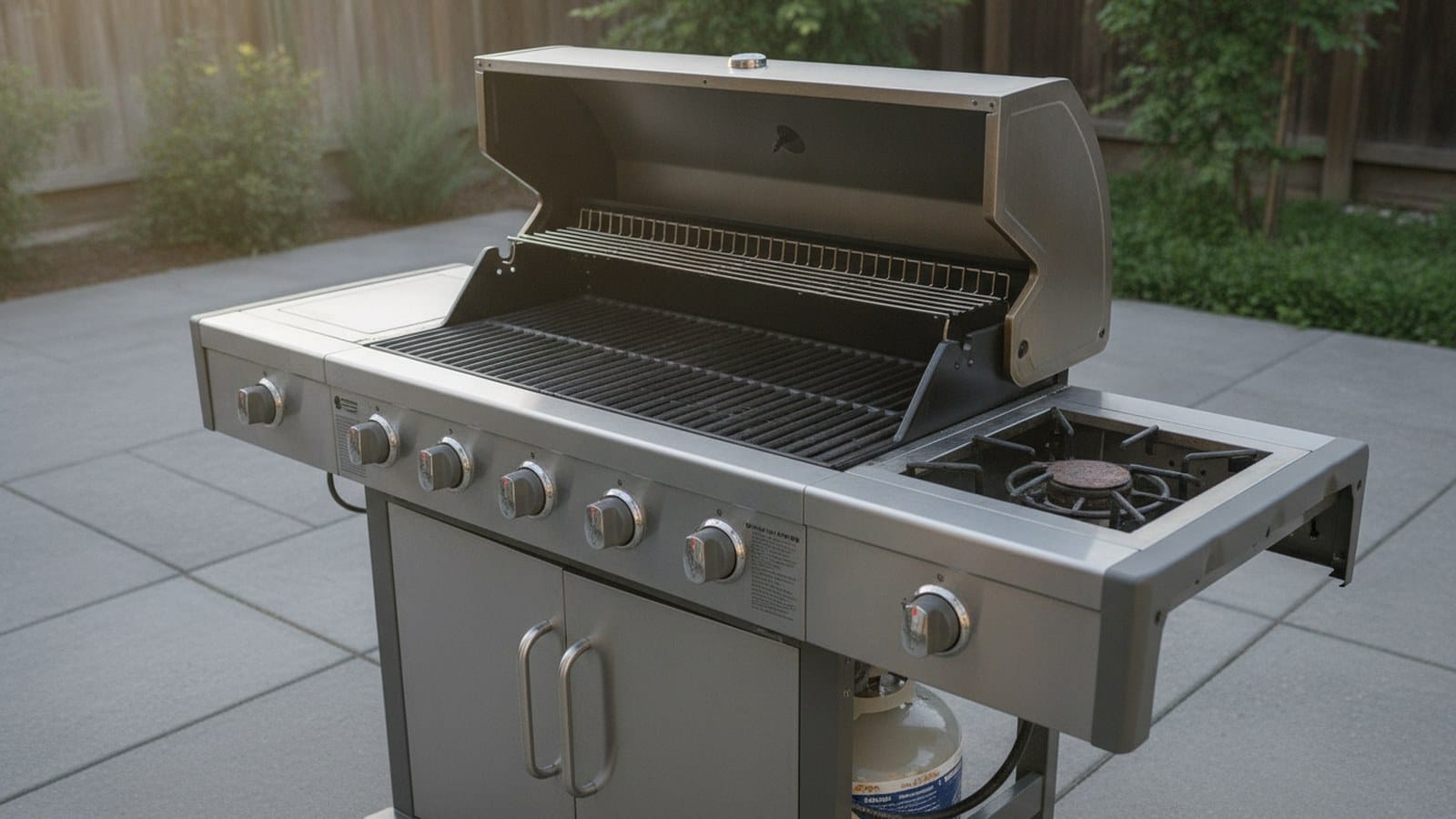
Every grill box shouts a BTU number. It is close to meaningless on its own, and it is not what decides whether you still own a working grill in three years.
Ten propane grills sit in this feed. All ten burn gas, so if you came for charcoal or pellets the charcoal and pellet guides are the better stop. What follows compares them on what their own listings state, and then on the thing listings never mention: how these grills actually fail. At this end of the market they do not wear out. They rust out, usually starting in the second season, and the warranty almost certainly will not cover it.
The short version: The Monument Grills Mesa Series is the pick because it states 450 square inches of primary cooking area plus 180 of warming rather than one flattering total. Judge heat by BTU per square inch, not total BTU. And expect to fight rust before you ever wear anything out.
- Divide BTUs by primary cooking area before comparing anything. The Veralune and the Monument 4-burner both state 36,000 BTU, but the heat lands roughly 28 percent thinner on the larger grill.
- Rust is the failure mode at this price, often inside the first year, and warranties routinely exclude corrosion caused by humidity, salt air or fumes. A cover is not optional.
- Grade matters: 430 stainless buys a few seasons, 304 buys considerably more, and a carbon steel firebox is effectively disposable.
- Holding a low temperature is where budget grills fail. Owners report being unable to get below roughly 400°F, so test that in the first week.
- The Usda sets doneness, not the recipe: 145°F for steaks and chops with a 3-minute rest, 160°F for ground meat, 165°F for poultry.
Our Top 3 Picks

- States its primary and warming area separately instead of hiding both in one total.
- Dedicated sear zone with front-facing fire holes puts the heat where you actually work.
- Porcelain-enamelled cast iron grates hold heat well and resist the rust bare iron suffers.

- The 10,500 BTU side burner is the strongest here and genuinely useful for sauces.
- Three stainless main burners light reliably from cold.
- Simple layout with fewer parts to corrode than the more elaborate grills here.

- Names both steel grades, 304 lid and 201 body, so you know exactly where the cost was saved.
- Four heavy-duty wheels with two locking casters make it genuinely easy to move under cover.
- The 10,000 BTU side burner is powerful enough to actually boil a pan.
Full Comparison — All 10 Grills
| Image | Product | Features | Price |
|---|---|---|---|
Editor's Choice |
| Check Price on Amazon Read Full Review | |
Best Value |
| Check Price on Amazon Read Full Review | |
Premium Pick |
| Check Price on Amazon Read Full Review | |
 |
| Check Price on Amazon Read Full Review | |
 |
| Check Price on Amazon Read Full Review | |
 |
| Check Price on Amazon Read Full Review | |
 |
| Check Price on Amazon Read Full Review | |
 |
| Check Price on Amazon Read Full Review | |
 |
| Check Price on Amazon Read Full Review | |
 |
| Check Price on Amazon Read Full Review |
How They Compare
Top picks — strengths at a glance
Brands compared
All 10, Reviewed
Monument splits the Mesa's 630 square inches into 450 for cooking and 180 for a warming rack. That split is the useful part, because most listings hand you one combined number and leave you guessing. The grates are porcelain-enamelled cast iron. The sear zone uses fire holes at the front of the burner rather than along the sides, which aims flame at the front of the grate where you tend to work. A lid gauge lets you watch temperature without opening up and losing it.
- States its primary and warming area separately instead of hiding both in one total.
- Dedicated sear zone with front-facing fire holes puts the heat where you actually work.
- Porcelain-enamelled cast iron grates hold heat well and resist the rust bare iron suffers.
- Rust becomes a real problem within the first year or two, and the warranty excludes corrosion from humidity and salt air.
- The glass viewing window smokes over on the first cook and is stubborn to clean afterwards.
- Holding a genuinely low temperature is difficult once the lid is closed.
Three stainless main burners and a 10,500 BTU side burner, the highest side-burner rating in this feed. Stainless construction is claimed for rust resistance, though no grade is named, so it is not comparable to the Electactic 34's stated 304 and 201. Neither the main burner output nor the cooking area appears on the listing. That leaves this grill impossible to place on heat or size, which is a real drawback when everything else here gives you at least one of the two.
- The 10,500 BTU side burner is the strongest here and genuinely useful for sauces.
- Three stainless main burners light reliably from cold.
- Simple layout with fewer parts to corrode than the more elaborate grills here.
- Stainless is claimed without a grade, and it discolours and pits faster than 304 does.
- The lid fits loosely enough to leak heat, which hurts it on longer cooks.
- Grease collection is basic compared with the pull-out trays on the Cowsar and Veralune.
Three 8,000 BTU main burners and a 10,000 BTU side burner. The main burners come to 24,000 BTU across a stated 489 square inches, which works out near 49 BTU per square inch. That is low for hard searing, and worth knowing before you buy. What earns this grill its place is candour elsewhere: it states 304 stainless for the lid and 201 for the body rather than saying stainless steel and stopping. Four wheels with two locking casters make it the easiest here to move and park.
- Names both steel grades, 304 lid and 201 body, so you know exactly where the cost was saved.
- Four heavy-duty wheels with two locking casters make it genuinely easy to move under cover.
- The 10,000 BTU side burner is powerful enough to actually boil a pan.
- Around 49 BTU per square inch from the main burners, the weakest searing heat in this lineup.
- The 201 stainless body corrodes noticeably faster than the 304 lid above it.
- Assembly is fiddly and the instructions leave several steps ambiguous.
This is a combo unit: grates on one side, a flat griddle on the other, 442 square inches across both. A griddle does things grates cannot, like eggs, onions and smash burgers. The catch is arithmetic. Splitting 442 square inches between two surfaces leaves less grate than any dedicated grill here offers. Buy it because you want a flat top, not because you want a grill with a bonus. The burners are described as parallel and H-shaped for spreading heat evenly.
- The griddle handles eggs, onions and smash burgers that would fall through grates.
- Parallel and H-shaped burners spread heat more evenly than a single straight tube.
- One unit replaces a grill plus a separate flat top, which saves patio space.
- Splitting 442 square inches across two surfaces leaves the least grate space in this lineup.
- The griddle plate warps with repeated heat cycling and then sits unevenly.
- Grease finds its way under the griddle section, where it is awkward to clean out.
525 square inches, four burners and a side burner for pans. The grease handling is what stands out. A pull-out tray and a large-capacity cup together mean fat has somewhere to go and somewhere to stay, which matters for cleaning and for fire risk. The grates are porcelain-coated cast iron, so they hold heat well. No BTU figure appears on the listing, so heat per square inch cannot be checked here either.
- Pull-out grease tray paired with a large-capacity cup, the most thorough grease handling here.
- Four burners give real scope for building hot and cool zones.
- Porcelain-coated cast iron grates retain heat well for the money.
- Firebox and flame tamers rust early, and rust is excluded from the warranty.
- Cooks unevenly across the surface once the tamers begin to corrode.
- Struggles to hold a low steady temperature with the lid down.
Veralune states both numbers, 36,000 BTU and 445 square inches, and that is what makes it useful. Divide and you get about 81 BTU per square inch, at the bottom edge of the band where searing works properly. It is the only grill in this feed where you can check the maths without assuming anything. The drip tray runs the full width and pulls out. The listing leans on rust-proof language without naming a steel grade, so treat that claim as marketing rather than a spec.
- Around 81 BTU per square inch, the strongest heat density you can actually verify here.
- Sears convincingly because the heat is concentrated rather than spread thin.
- Full-size pull-out drip tray makes clearing grease quick enough that it gets done.
- Rust protection is claimed but no steel grade backs it, and corrosion shows early in damp air.
- Three burners give fewer heat zones than the four-burner options.
- Flame tamers perforate before anything else fails, bringing hot and cold spots with them.
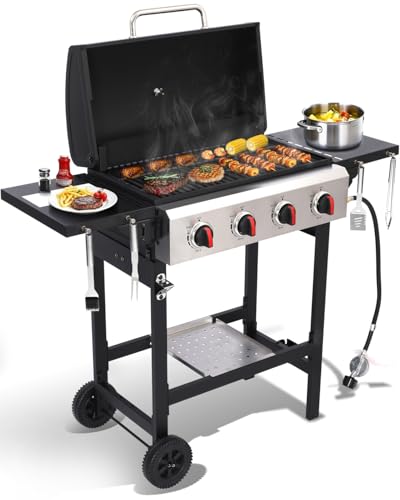
Four burners at 10,000 BTU each, 40,000 BTU in total, each one adjustable on its own. That independence is the point: four separate dials means four possible temperatures. The kit includes a perforated griddle pan alongside porcelain-enamelled cast iron grates, so small food that would drop through the bars has somewhere to sit. The listing suggests it suits two to four people but gives no cooking area, so the 40,000 BTU figure cannot be turned into a ratio.
- Four independently adjustable burners at 10,000 BTU each give four separate temperatures.
- Ships with a perforated griddle pan as well as cast iron grates, so small food has somewhere to sit.
- Folding side tables and wheels make it easier to store than its size suggests.
- Two wheels rather than four, so one end has to be lifted every time it moves.
- Thin-gauge panels flex and discolour around the firebox after a season of heat cycling.
- Burner tubes need cleaning often to avoid uneven flame across the four zones.
Captiva quotes 545 square inches of cooking space and puts porcelain-enamelled cast iron on the main grates. Underneath there is a bottom shelf for storage, which is where a spare tank or tools usually end up. The full-size pull-out drip tray follows the same sensible pattern as the Cowsar and Veralune. As with several others here, no BTU figure is published, so how hard it drives that 545 square inches is not something the listing lets you check.
- 545 square inches, second only to the Monument 4-burner among stated areas.
- Porcelain-enamelled cast iron on the main grates sears well from cold.
- Bottom shelf takes a spare tank and the full-size drip tray pulls straight out.
- Rusts through at the firebox seams sooner than the stainless exterior suggests.
- Heat runs hotter at the centre than the edges, so food needs rotating.
- The enamel coating on the grates chips with hard brushing, and rust starts at the chip.
Gas One's GP-1030S keeps it simple. Three main burners across a heavy-duty steel body, finished in high-temperature paint, on built-in wheels. It is the plainest unit here and the listing makes no numerical claims at all, no BTU rating and no cooking area. That honesty about having few features is fine. It does mean the only thing you can judge is the build description, so treat it as the small-space option rather than one you compare on paper.
- Compact enough for a balcony or small patio where the larger grills will not fit.
- Built-in wheels make it easy to move under cover, which matters for its lifespan.
- Straightforward build with high-temperature paint over heavy-duty steel.
- Painted steel rather than stainless, so the finish blisters and rust follows at the seams.
- Small cooking surface means batch cooking for more than three people.
- The lightweight frame moves when you scrub the grates.
Four burners in 304 stainless, rated together at 36,000 BTU, under 570 square inches of cooking surface. Do the division and it lands near 63 BTU per square inch, which is thinner than the Veralune's 81 from the identical BTU figure. That is the trade you are making: more room, less heat in each part of it. The 304 grade on the burners is worth noting, because burners sit in the heat and 304 handles corrosion better than 201. Two shelves, one fixed and one folding.
- 570 square inches is the largest stated cooking area in this group.
- Burners are 304 stainless, the grade that copes far better with damp and coastal air.
- Right-hand shelf folds down, so it takes less room when stored.
- The same 36,000 BTU spread across much more surface means noticeably weaker searing than smaller grills here.
- Rust appears early on the firebox and flame spreaders in wet climates.
- Low-temperature control is coarse, which makes gentle cooking awkward.
11 Things to Consider Before Buying Grills
Work through it in this order. How much cooking room you need, how hard the grill drives heat into that room, and how long the metal will survive your weather. The first two are on the spec sheet. The third is what owners find out later, and it is the one that decides value.
Our Final Verdict
The Monument Grills Mesa Series is the pick, and the reason is honesty as much as hardware. It publishes its cooking area as 450 primary plus 180 warming instead of one flattering total, and pairs porcelain-enamelled cast iron grates with a dedicated sear zone. Expect its glass window to smoke over and stay that way. If you want the most cooking room stated on any listing here, the Monument 4-burner claims 570 square inches, though spreading 36,000 BTU across that much surface means noticeably less heat per inch than the smaller Veralune, which is the better choice if searing is the point. The Electactic 34 earns a look for telling you exactly where the cheaper steel went and for being the easiest to wheel under cover. For a small patio the Gas One three-burner is the compact option. Buy the Captiva griddle combo only if you genuinely want a flat top, because the griddle costs you grate space you cannot get back. Whichever you choose, buy a cover at the same time. At this price the grill that lasts is the one that stays dry.
Frequently Asked Questions
How many BTUs do I need in a gas grill?
Stop asking for a total and ask for a ratio. Divide the stated BTUs by the primary cooking area, and look for roughly 80 to 100 BTU per square inch. A grill spreading 36,000 BTU over 570 square inches sits well under that and will feel slower to preheat than the headline number suggests.
How long will a grill at this price actually last?
Three to five seasons is a realistic expectation, and rust decides it rather than anything wearing out. Owners commonly report significant corrosion within the first year, including burner tubes perforating and flame spreaders rusting away. Keeping it covered and dry does more for its lifespan than anything else you can do.
Does the warranty cover rust?
Usually not, and this is worth reading before you buy. Warranties in this category typically exclude rust and oxidation caused by environmental factors such as humidity, salt air and industrial fumes, which covers most of the reasons a grill rusts in the first place. A long warranty on the box does not protect you from the failure you are most likely to see.
How much cooking area do I need for a family of four?
Roughly 70 to 80 square inches per person, so about 450 to 500 square inches of primary surface. Watch what is being counted. If a listing quotes one figure that folds in a warming rack, the part you actually cook on is smaller than it looks.
Why does my grill cook unevenly?
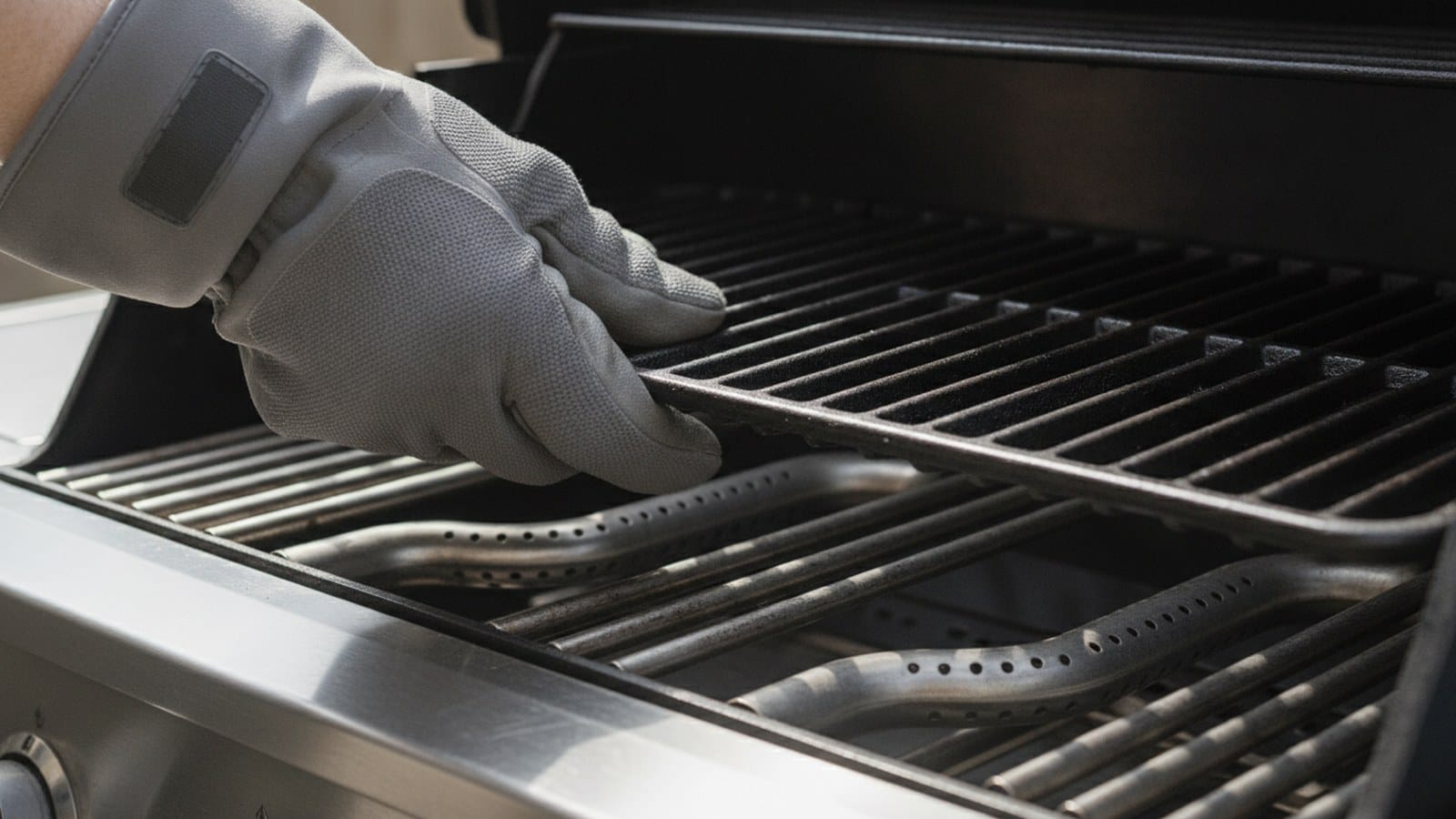
Usually the flame tamers above the burners have corroded. Heat then shoots up through the holes, making hot spots, while fat drips through the same holes and clogs burner ports, making cold spots. Warped deflectors add dead zones. Clean the burner tubes every three to four months in season and replace perforated tamers; both are inexpensive parts.
Are cast iron or stainless steel grates better?
Cast iron holds heat, so it sears harder and leaves darker marks. Stainless heats faster and resists rust with less care. Most grills here use porcelain-enamelled cast iron, which tries to give you both. Keep the coating intact and it works well. Chip it and the iron underneath starts rusting from that point.
Are more burners better?
More burners give you control, not more heat. Two zones let you sear over high heat then finish over low without burning the outside. If you mostly cook chicken or thick cuts, that control is worth more to you than a higher total BTU figure.
How do I check a propane grill for a leak?
The Cpsc method is soap and water. Open the gas valve fully, brush a soapy solution over the connection, and watch. Bubbles mean gas is escaping. Tighten the tank connection and try again. If it still bubbles, shut the valve and have it repaired by a professional rather than lighting it.
What temperature does the meat need to reach?
The Usda gives 145°F for beef, pork, lamb and veal steaks, chops and roasts, then a 3-minute rest before cutting. Ground meat goes to 160°F and poultry to 165°F. Grilled food browns outside long before it is safe inside, so use a thermometer rather than colour.
Related Guides


