| Quick Facts | |
|---|---|
| Percussion motor speed (TOLOCO Massage Gun) | up to 3,200 rpm |
| Percussion penetration depth (TOLOCO Massage Gun) | 12 mm |
| Percussion RCT result, 2025 | 40-min sessions at 53 Hz beat static stretching and 25-min sessions for 48-hour recovery (Frontiers in Public Health) |
| Heat range, back massager (Comfytemp Cordless Heating Pad) | 3 heat levels, 3 vibration modes |
| Heat range, foot massager (RENPHO Foot Massager Machine) | up to about 131°F |
| Dual heat/cold range (RENPHO Active Thermacool 2 Massage Gun) | up to 113°F heat, down to 46°F cold |
| NCCIH evidence rating, chronic low-back pain | low-strength, short-term relief only |
How to choose a massager: start by naming the body part and the problem
Massagers are built around a body part and a use case, not a single universal design, so the fastest way to narrow the field is to say exactly what hurts and when.
Shopping for a specific model? See the best massager we tested — 10 models compared on the specs that decide it.
Walk into this category assuming one massager does everything and you will end up disappointed with an otherwise well-reviewed product. A cordless heating pad built for lower-back tension is not the tool for plantar fasciitis, and a handheld massage gun is overkill for someone who just wants to unwind after a desk shift. The categories split cleanly by body part and use case: back and neck devices for posture-related tension, foot massagers for standing-all-day soreness or circulation complaints, hand massagers for grip fatigue or stiff fingers, and full-body handheld guns for muscle recovery after exercise.
Once you know the body part, the next question is timing. Do you need relief during the day at a desk, before bed to unwind, or right after a workout while muscles are still warm? Each answer points toward a different form factor: a wearable cordless pad for at-desk use, a shiatsu pillow for the couch, or a handheld gun for the fifteen minutes after a run. Our massager hub sorts the whole category this way, which beats scrolling a single long list and guessing which model actually matches your situation.
Percussion massagers: built for muscle recovery, not everyday tension
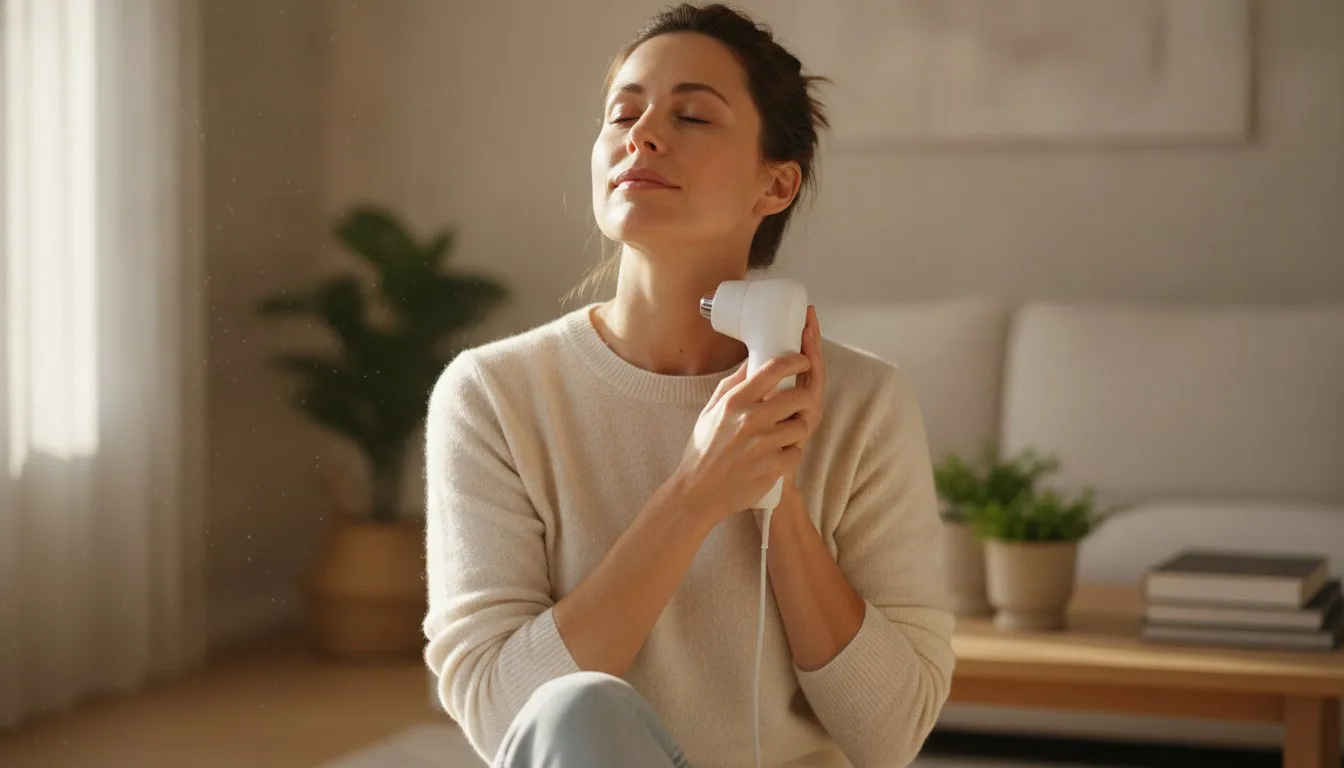
Percussion massage guns strike the muscle in short, rapid pulses measured in strikes per minute, and research on the mechanism favors longer sessions for post-exercise soreness over passive stretching.
A percussion massager, usually sold as a massage gun, drives an attachment head in and out of the muscle at speed, and the hardware specs matter more here than in most categories of this kind. The TOLOCO Massage Gun in our lineup runs up to 3,200 rpm with a stated 12 mm penetration depth and a 40 to 50 decibel motor, which lands on the quieter end for this format. The AERLANG Massage Gun covers a similar speed range using seven interchangeable heads and a heated head with its own on/off switch, while the RENPHO Active Thermacool 2 Massage Gun adds both heat, up to 113°F, and cooling down to 46°F on the same device.
The research backs up what these devices are actually good for. A 2025 randomized controlled trial published in Frontiers in Public Health tested percussion massage on physically active young men after squats induced delayed-onset muscle soreness, comparing static stretching against 25-minute and 40-minute percussion sessions at 53 Hz. The 40-minute group recovered better at the 48-hour mark, with lower pain ratings and greater jump-height recovery than either the stretching group or the shorter session. That is a real, measured advantage for longer sessions on already-sore muscle, not a case for running a massage gun on everything.
What percussion massagers are not built for is joints, bone, the spine, or areas with existing inflammation or injury, since the same repetitive force that loosens a tight hamstring can aggravate something more delicate. If deep, targeted muscle recovery after training is the actual goal, our best massager guide breaks out the percussion models by speed, heads included, and noise level so you can compare specs side by side.
Shiatsu and heat-based massagers for everyday back and neck tension
Shiatsu cushions rotate paired nodes to knead soft tissue in a slower rhythm than percussion, and heat is the feature that does more for chronic, low-grade tension than raw motor power.
For the kind of tightness that builds up from sitting at a desk or sleeping at an odd angle, a gentler mechanism usually beats a more aggressive one. Shiatsu devices, named for the Japanese finger-pressure technique they mimic, rotate two or more nodes against each other to squeeze and release muscle rather than striking it. The Zyllion Shiatsu Back and Neck Massager in our feed pairs that rotating-node design with heat and a contoured shape meant to sit against the neck, shoulders, or lower back, and the RESTECK Massagers pillow follows a similar layout with four control buttons for adjusting intensity. If you spend most of the day in a desk chair, our best chair back massager guide narrows this same rotating-node format to models built to strap onto or sit inside office and car seats, rather than the standalone cushions and pillows covered here.
Heat is doing more work in this category than the spec sheets suggest. The Comfytemp Cordless Heating Pad, our top-ranked pick in the massager comparison, runs three heat levels alongside three vibration modes and straps around the waist or lower back at 47.24 by 7.87 inches, which is a genuinely different use case from a handheld gun: it is meant to be worn while you move, not held against one spot. Warmth relaxes tissue before any kneading or vibration starts, which is part of why heated cushions get reached for daily use rather than saved for after a hard workout.
One caution worth taking seriously: sustained contact heat can irritate or burn skin even when it does not feel alarmingly hot at first, so a device that seems comfortable can still cause trouble over a long session. Keep sessions to the manufacturer's recommended time, and never fall asleep with a heat setting running.
Foot and hand massagers: matching compression to a specific complaint
Foot and hand massagers mostly rely on compression, air bladders that squeeze rather than strike, often combined with rotating nodes and heat for circulation and stiffness complaints.
Feet and hands get a different mechanism than backs and shoulders, mainly because compression works better on extremities than percussion or plain vibration does. The RENPHO Foot Massager Machine in our foot-focused lineup heats to about 131°F and separates its massage functions into off, low, medium, and high settings, aiming squarely at standing-all-day soreness and circulation complaints rather than muscle recovery. Feed listings for this category are explicit about the plantar fasciitis use case, which tracks with why compression and heat, not percussion, dominate foot-specific devices.
Hand massagers borrow the same logic on a smaller scale. Instead of striking or rotating, they wrap around the hand and inflate to squeeze rhythmically, which suits grip fatigue, stiff fingers after repetitive work, or general hand tension better than a percussion head ever could, since a massage gun is simply too blunt an instrument for fingers and knuckles. The practical filter for this category is circulation and stiffness versus deep-tissue recovery: if the complaint is tired, achy extremities rather than a knotted muscle, compression is the mechanism to shop for, and our best foot massagers guide and best hand massager guide both sort current models by exactly that distinction.
What the evidence actually supports, and when to check with a doctor
NIH's National Center for Complementary and Integrative Health rates massage therapy's evidence for chronic low-back pain as low-strength and short-term, so treat a massager as tension relief rather than a treatment, and skip it if you have a clotting disorder, recent fracture, or unexplained pain.
It is worth being honest about what a home massager can and cannot do. The National Center for Complementary and Integrative Health, part of the National Institutes of Health, reviews massage therapy research and concludes that for chronic low-back pain the evidence is weak. Investigators have described having very little confidence that massage meaningfully treats chronic back pain, and clinical guidelines generally support it for acute or subacute pain rather than long-standing cases. For neck and shoulder pain, NCCIH's review found massage beat doing nothing but did not outperform other active treatments, and any benefit tends to be short-lived rather than lasting.
None of that makes a massager useless. It means the honest framing is relief, not repair: a heated pad or shiatsu cushion can ease the tension that builds up over a day, and a percussion gun can speed how sore muscle feels the next morning, but neither rebuilds tissue or fixes a structural problem. NCCIH also notes that massage therapy's risk of harm is generally low, though rare complications, including nerve injury and, with vigorous pressure, bruising or fractures in vulnerable people, do occur. If you have a bleeding or clotting disorder, a recent fracture or surgery, deep vein thrombosis, or pain you have not had evaluated, talk to a doctor before using any massager, heated or otherwise, and never use one over broken skin, a tumor, or an area of active infection.
Spend on the feature that actually matches your problem rather than the highest sticker price. Within any category here, budget options handle the basics, mid-range models add more intensity settings or heat, and premium picks add extras like dual heat-and-cold control, but the underlying mechanism, not the price tier, is what decides whether the device fits your complaint.