Best Piano Keyboards for Beginners of 2026: 10 Compared
By Buyer Reports Editorial Team·Last updated August 2026·Independently researched, no paid placements
A first keyboard sets the tone for whether practice sticks or stalls. We lined up 10 beginner-friendly models and looked past the spec sheets at what actually shapes those early months: how the keys respond under your fingers, what arrives in the box, and whether the thing follows you to a friend's place or anchors a corner. The gap between a weighted 88-key digital piano and a fold-up 61-key travel board is wide, and the right answer depends entirely on who's sitting down to play.
Beginner keyboards split into two camps, and our lineup of 10 makes that clear. On one side sit full 88-key digital pianos with weighted or semi-weighted action, like the Yamaha P71 and the Alesis Recital, built to mimic the resistance of an acoustic instrument. On the other are the 61-key starter bundles from Best Choice Products, RockJam, Aqniegep, and Jikada, which lean on lighted keys, teaching modes, and a stand-plus-bench kit to get a true novice playing fast. The Rhymo even folds in half for travel. None of these is wrong; they answer different questions about space, budget, and how serious the player intends to get. To rank them, we pulled the live Amazon listings for each model and scored them on key action, the sounds and learning tools on board, what's bundled, and portability against the asking price. Weighted 88-key action carried weight at the top because it transfers best to a real piano, while the 61-key kits competed on how complete and beginner-coaching their packages are. The result is an ordering that should help you skip the wrong category entirely before you ever compare two boards head to head.
The short version: The Yamaha P71 88-Key Weighted Action Digital Piano is our top overall pick, earning the highest score in the group for its weighted touch-sensitive keys, 10 Voices, and included sustain pedal. For the best value, the Rhymo Folding Piano Keyboard packs slightly weighted 61 keys, Bluetooth Midi, and a 10-hour battery into a fold-away frame.
How to use this guide: In a hurry? The Quick Verdict below names the top pick in seconds. Want to compare? The full comparison table and charts line up all 10 piano keyboards side by side. For the details, every model has a full review with key features, honest pros and cons, and who it is best for.
Key takeaways
We compared 10 beginner keyboards spanning full 88-key digital pianos and 61-key starter bundles.
The Yamaha P71 ranks first on weighted touch-sensitive keys, 10 Voices, and an included sustain pedal.
The Rhymo Folding Piano Keyboard is the value pick, folding small with Bluetooth Midi and a 10-hour battery.
Two models, the Yamaha P71 and Alesis Recital, carry a full 88 keys; the other eight are 61-key boards.
Bundle picks from Best Choice Products, RockJam, Aqniegep, and Jikada add stands, benches, headphones, and guided teaching modes.
Buyer Reports is reader-supported. When you buy through links on our site we may earn an affiliate commission, at no extra cost to you. This never affects our rankings.
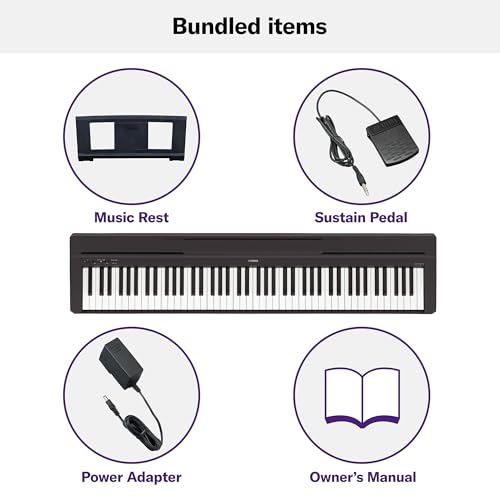
Why we liked it: Weighted, touch-sensitive keys are the headline here, giving the Yamaha P71 the dynamic, expressive response that transfers cleanly to an acoustic piano. It pairs that action with 10 Voices, including a Yamaha grand piano tone, and Dual Mode that layers two sounds such as piano and strings. A sustain pedal and power supply come in the box, and the one-button control keeps the interface out of your way. It earns the top score for being a genuine instrument first and a beginner board second.
Pros
Weighted, touch-sensitive keys for true dynamics
10 Voices including a Yamaha grand piano tone
Dual Mode layers two sounds at once
Sustain pedal and power supply included
Cons
Heaviest pick here at about 25 lb
No bundled stand, bench, or headphones like the 61-key kits
2
#2 · Absolute beginners who want everything in one box
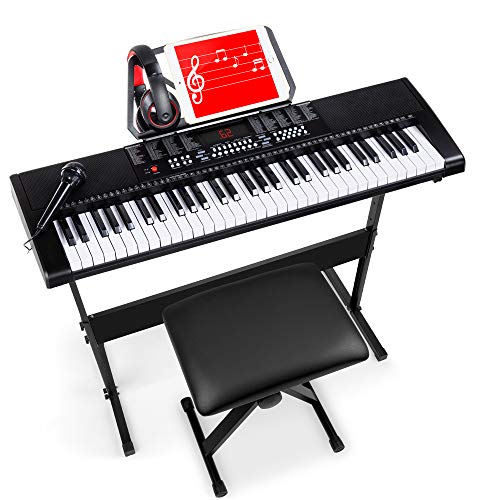
Why we liked it: This Best Choice Products 61-key set is built around coaching someone who has never played. Its 3-Step Intelligent Teaching walks you through One-Key, Follow, and Ensemble modes, and the package leaves nothing to buy separately: an H-style stand, music stand, padded stool, LED screen, headphones, and a recorder all ship together. You can plug in a USB to play along with songs and sing through the included microphone headset. For value among the bundle sets, it sits near the top of our list.
Pros
3-Step Intelligent Teaching with One-Key, Follow, and Ensemble modes
Complete kit: H-style stand, music stand, padded stool, headphones
LED screen and built-in recorder
USB playback plus microphone headset for singing along
Cons
61 keys rather than a full 88-key span
No weighted action listed, unlike the Yamaha P71's weighted keys
Why we liked it: The Rhymo is the travel-and-budget answer. It folds down to a slim 45x11x19cm and weighs about 2.3kg, ships with a padded gig bag, and runs up to 10 hours on an integrated lithium battery for cordless playing anywhere. Despite folding, it keeps standard 61-key dimensions with 2.2cm-wide keys, adds slightly weighted touch-sensitive action, and includes Bluetooth Midi for pairing with learning apps. That combination of portability and connectivity at the lowest price makes it our value pick.
Pros
Folds to a slim 45x11x19cm and weighs about 2.3kg
Up to 10-hour battery for cordless play
Bluetooth Midi for learning apps
Standard 61-key dimensions with slightly weighted, touch-sensitive keys
Cons
61 keys rather than a full 88-key span
Only slightly weighted, short of the Yamaha P71's full weighted action
4
#4 · Beginners who want a feature-loaded starter set
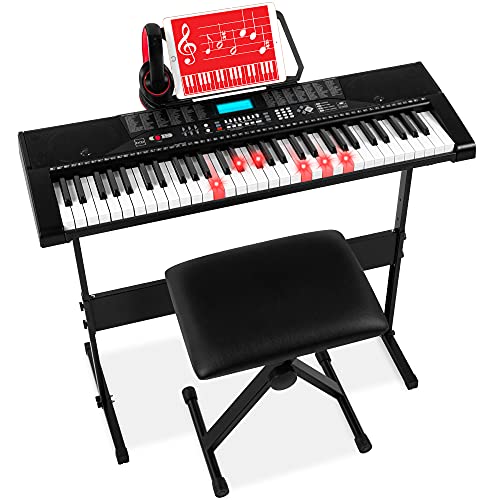
Why we liked it: This Best Choice Products complete set leans hard into variety and presentation. It carries 61 keys with 255 timbres, 255 rhythms, 50 demo songs, 32 keyboard percussion types, and a 120 BPM starting tempo, plus lighted keys and an LCD screen. One-Key, Follow, and Ensemble modes coach new players, and the H-style stand, music stand, padded stool, and headphones round out a package built to land as a birthday or holiday present. USB playback lets you layer your own melodies over background tracks.
Pros
61 keys with 255 timbres, 255 rhythms, and 50 demo songs
Lighted keys and LCD screen
One-Key, Follow, and Ensemble teaching modes
Complete kit with H-style stand, stool, and headphones
Cons
61 keys rather than a full 88-key span
No weighted key action listed, unlike the Yamaha P71
Why we liked it: The Aqniegep 61-key set targets a brand-new player on a budget. Its lighted keyboard switches between modes to vary the sound, and two high-quality speakers push stereo sound with heavy bass and warm tones. Two teaching modes, including a follow-play mode, guide early practice, and the box arrives complete with an adjustable bench, stand, headphones, piano bag, and note stickers. With 70 demos and 200 rhythms and tones on board, it gives a beginner room to explore without spending much.
Pros
Light-up keys with switchable sound modes
Two stereo speakers with heavy bass and warm tones
Two teaching modes including follow-play
Full kit: adjustable bench, stand, headphones, piano bag, note stickers
Cons
61 keys rather than a full 88-key span
Two teaching modes versus the three on the Best Choice Products sets
Why we liked it: Identical in capability to its black sibling but finished in white, this Best Choice Products set offers 61 keys, 255 timbres, 255 rhythms, 50 demo songs, and 32 keyboard percussion types at a 120 BPM start tempo. Lighted keys, an LCD screen, and One-Key, Follow, and Ensemble modes coach the novice, while the H-style stand, music stand, padded stool, and headphones complete the package. USB playback lets a player add melodies over stored tracks. Pick it over the black model purely on color preference.
Pros
61 keys with 255 timbres, 255 rhythms, and 50 demo songs
Why we liked it: RockJam's 5061 super kit gives a beginner 61 full-size keys for that traditional piano feel in a portable body, plus a feature most starter boards skip: a pitch-bend kit. An LED panel manages its 200 rhythms, 200 tones, and teaching function, and record-and-playback with an aux input lets you build layered sound and play along to your own tracks. The kit includes a sturdy adjustable stand and a thick padded folding seat, headphones, the Simply Piano app, and keynote stickers.
Pros
61 full-size keys with a pitch-bend kit
LED panel with 200 rhythms and 200 tones
Record and playback plus aux input
Includes stand, padded seat, headphones, and the Simply Piano app
Cons
61 keys rather than a full 88-key span
Full-size keys, but no weighted action like the Yamaha P71
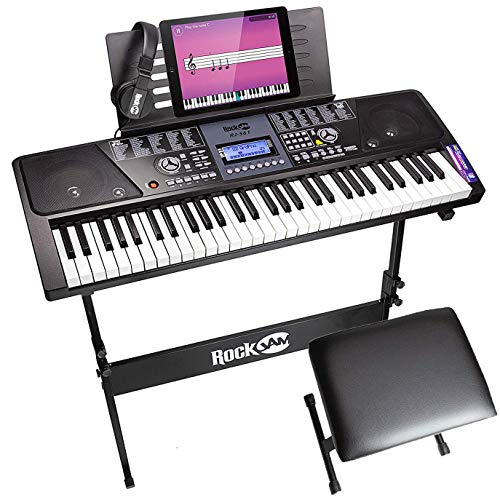
Why we liked it: This RockJam kit keeps things straightforward with 61 full-size keys, a sturdy adjustable stand, and a padded bench. It carries 100 rhythms, 50 tones, and 30 demo songs, and its built-in record-and-playback function lets a learner review performances and sharpen technique. Note stickers and access to the Simply Piano app round out the learning side. It's a capable, well-bundled starter, just edged out by higher-scoring picks in our ranking.
Pros
61 full-size keys for traditional piano feel
100 rhythms, 50 tones, and 30 demo songs
Record and playback to review your practice
Includes stand, bench, headphones, stickers, and Simply Piano access
Why we liked it: The Jikada set packs in the extras: 61 light-up full-size keys, two built-in stereo speakers, 255 tones and 255 rhythms, and a control panel with master and accompaniment volume, tempo, single-finger and fingered chords, sustain, vibrato, split, and transposition. Three teaching modes guide a step-by-step start. The box includes an X-stand, soft stool, headphones, microphone, music rest, and power adapter, with the keyboard itself measuring 36.4 x 13.4 x 3.5 inches. It's feature-rich, sitting toward the back of our ranking but well-equipped.
Pros
61 light-up full-size keys with two stereo speakers
255 tones and 255 rhythms
Deep controls: chords, sustain, vibrato, split, transposition
Includes X-stand, stool, headphones, microphone, and music rest
Cons
61 keys rather than a full 88-key span
Light-up keys, but no weighted action like the Yamaha P71
10
#10 · Beginners who want 88 keys with built-in speakers
Why we liked it: For the full-piano span without the P71's price or heft, the Alesis Recital delivers 88 semi-weighted full-size keys with adjustable touch response. It runs five voices, Acoustic Piano, Electric Piano, Organ, Synth, and Bass, through 2x20W built-in speakers, layers in Chorus effects, and offers standard, split, layer, and lesson modes. A 1/4-inch sustain pedal input is on board, and it powers from the included adapter or 6 D-cell batteries for play anywhere. It rounds out our list as the second 88-key option.
Pros
88 semi-weighted full-size keys with adjustable touch response
5 voices: Acoustic Piano, Electric Piano, Organ, Synth, Bass
2x20W built-in speakers with Chorus FX
Runs on adapter or 6 D-cell batteries
Cons
Semi-weighted keys, not the full weighted action of the Yamaha P71
Sustain pedal not included, unlike the Yamaha P71
Things to consider
7 Things to Consider Before Buying Piano Keyboards
Before comparing model to model, settle the questions that eliminate half the list. Key count and key action decide how the instrument feels and what skills transfer; the bundled extras decide how soon a brand-new player can actually start. Weigh those against where the keyboard will live and how often it travels.
Key count: 88 vs. 61
The Yamaha P71 and Alesis Recital both carry a full 88 keys, the same span as an acoustic piano, so nothing in the sheet music falls off the edge. The rest of the field, including the Best Choice Products sets, RockJam kits, Aqniegep, Jikada, and the Rhymo, run 61 keys. Sixty-one is plenty for early lessons and pop songs, but a student aiming at classical repertoire will eventually want the full keyboard.
Key action and touch response
How the keys push back matters more than any feature count. The Yamaha P71 uses weighted action with touch-sensitive keys for true dynamic expression, and the Alesis Recital offers 88 semi-weighted keys with adjustable touch response. The Rhymo describes slightly weighted, touch-sensitive keys, while most 61-key bundles don't list weighted action at all, so they feel lighter at first but transfer less directly to an acoustic piano.
Built-in teaching modes
Several picks are built around coaching a complete beginner. The Best Choice Products sets, Aqniegep, and Jikada include lighted or light-up keys plus teaching modes such as One-Key, Follow, and Ensemble. RockJam pairs its kit with the Simply Piano app and keynote stickers. These guided systems shorten the gap between unboxing and playing a recognizable tune.
What's in the box
A bundle decides if you play the first night or spend a week hunting down accessories. The Best Choice Products 61-key sets, Aqniegep, Jikada, and both RockJam kits arrive with a stand, bench or stool, and headphones; some add a music rest, microphone, or note stickers. The Yamaha P71 keeps it focused with a sustain pedal and power supply, and the Rhymo includes a padded gig bag.
Sounds, voices, and rhythms
Variety keeps practice from going stale. The Yamaha P71 offers 10 Voices including a Yamaha grand piano tone plus Dual Mode layering, and the Alesis Recital has 5 voices (Acoustic Piano, Electric Piano, Organ, Synth, Bass) with built-in FX. The bundle keyboards trade refined tone for sheer count, with the Best Choice Products sets listing 255 timbres and 255 rhythms and Aqniegep citing 200 rhythms and tones.
Portability and power
Where the keyboard lives shapes the pick. The Rhymo folds to a slim 45x11x19cm, weighs about 2.3kg, and runs up to 10 hours on its lithium battery, so it travels easily. The Alesis Recital can run on its power adapter or 6 D-cell batteries for play away from an outlet. The Yamaha P71, at roughly 25 lb, is the heaviest here and better suited to a permanent spot.
Connectivity and recording
Plug-in options extend what a beginner can do. The Rhymo includes Bluetooth Midi for pairing with learning apps, while both RockJam kits offer record and playback to review your performances, and the 5061 adds an aux input for playing along to songs. The Best Choice Products sets support USB playback so you can perform over stored tracks. Match these to whether you plan to use lesson apps or record your progress.
Verdict
Our Final Verdict
The Yamaha P71 88-Key Weighted Action Digital Piano takes the top spot, and it earns it: weighted touch-sensitive keys, 10 Voices, Dual Mode layering, and an included sustain pedal make it the closest thing here to a real piano. The Rhymo Folding Piano Keyboard is the value choice for anyone tight on cash or space, folding away with Bluetooth Midi and a 10-hour battery. If you want the full-piano feel without the P71's price or weight, the Alesis Recital is the premium alternative, with 88 semi-weighted keys, 2x20W speakers, and split, layer, and lesson modes. Beginners who'd rather be coached than handed a bare board should look hard at the Best Choice Products bundles, which arrive with a stand, bench, headphones, and One-Key, Follow, and Ensemble teaching modes.
FAQ
Frequently Asked Questions
What is the best beginner piano keyboard?
The Yamaha P71 88-Key Weighted Action Digital Piano is our top pick of the 10 beginner keyboards we compared. Its weighted, touch-sensitive keys allow true dynamic expression, and it ships with 10 Voices, Dual Mode for layering two sounds, and a sustain pedal. For shoppers who want to spend less, the Rhymo Folding Piano Keyboard is the best value.
Do beginners need 88 keys or are 61 keys enough?
Sixty-one keys cover early lessons and most pop songs, which is why most of our bundle picks, including the Best Choice Products and RockJam kits, use that layout. But the Yamaha P71 and Alesis Recital offer a full 88 keys, the same range as an acoustic piano, so a student working toward classical pieces won't run out of notes. Choose 88 if you're serious about transferring to a real piano.
What does weighted action mean and does it matter?
Weighted action means the keys push back the way an acoustic piano's hammers do, which builds proper finger strength and control. The Yamaha P71 uses weighted touch-sensitive keys, the Alesis Recital uses 88 semi-weighted keys with adjustable touch response, and the Rhymo describes slightly weighted keys. Many 61-key bundles don't list weighted action, so their lighter keys feel easier at first but transfer less directly to a real piano.
Which beginner keyboard comes with a stand and accessories?
If you want everything to start the first night, look at the bundle sets. The Best Choice Products 61-key kits, Aqniegep, and Jikada include a stand, bench or stool, and headphones, with some adding a music rest, microphone, or note stickers. Both RockJam kits also include a stand, seat, headphones, and the Simply Piano app. The Yamaha P71 keeps it minimal with a sustain pedal and power supply.
Is there a beginner keyboard good for travel or small spaces?
The Rhymo Folding Piano Keyboard is built for it. It folds to roughly 45x11x19cm, weighs about 2.3kg, includes a padded gig bag, and runs up to 10 hours on its built-in lithium battery, so you can play cordless. The Alesis Recital is another portable option since it runs on its power adapter or 6 D-cell batteries.
Which keyboards help an absolute beginner learn fastest?
The picks built around guided learning are the Best Choice Products sets, Aqniegep, and Jikada, all of which pair lighted keys with teaching modes like One-Key, Follow, and Ensemble. RockJam adds the Simply Piano app and keynote stickers. These coaching features walk a brand-new player through songs step by step rather than leaving them to figure out a bare keyboard.