| Quick Facts | |
|---|---|
| Incline correction for outdoor-equivalent effort | about 1 percent grade |
| CDC weekly moderate-activity benchmark | 150 minutes |
| AHA brisk-walking pace benchmark | about 3 mph or faster |
| Typical walking pad top speed | about 5 mph |
| Typical walking pad weight | 30-50 lb |
| Daily step count linked to leveling-off of mortality risk (under 60) | 8,000-10,000 steps |
Is walking on a treadmill as good as walking outside
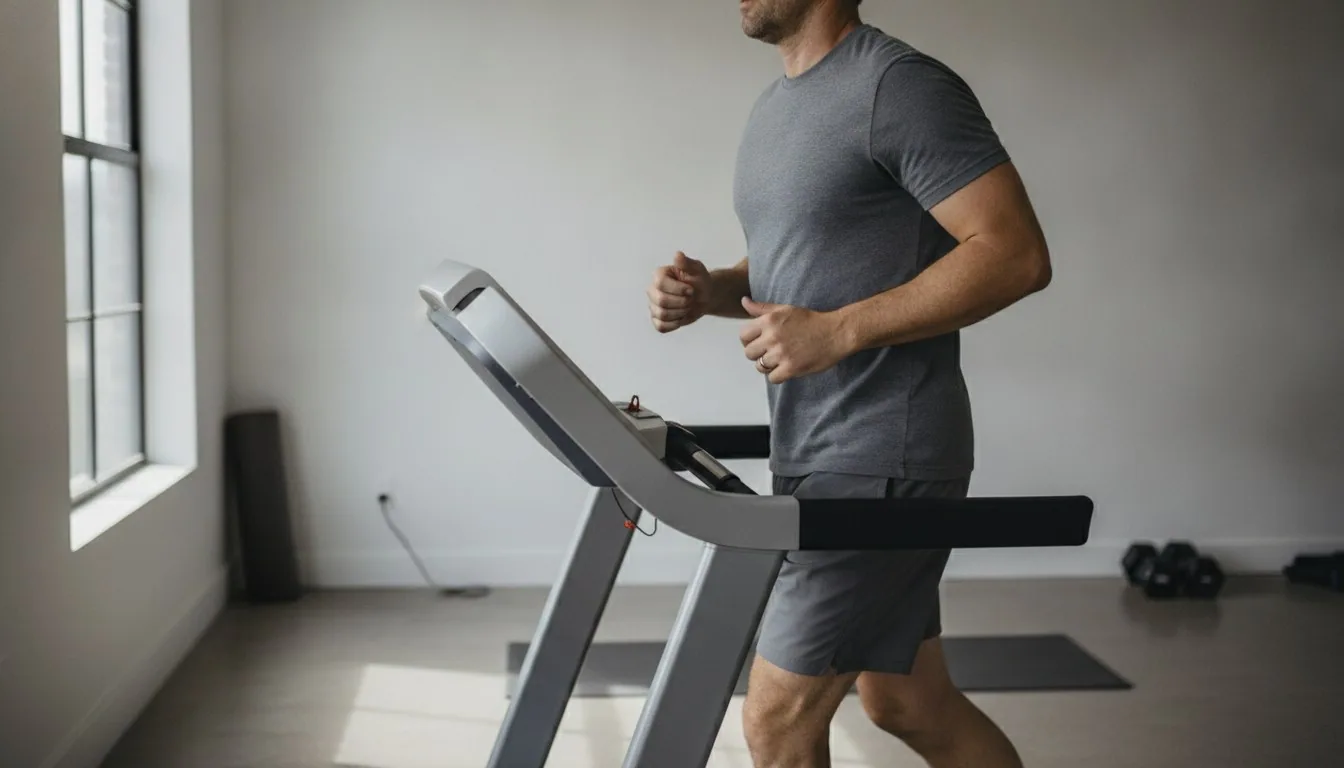
Physiologically, yes - a treadmill walk and an outdoor walk at matching pace and incline produce comparable heart rate and calorie effects.
Shopping for a specific model? See our treadmills buying guide — 10 models compared on the specs that decide it.
Start with the number that actually settles whether walking on a treadmill is as good as walking outside. A 1996 study in the Journal of Sports Sciences, led by exercise physiologists Andrew Jones and Jonathan Doust, found that setting a treadmill to a 1 percent grade most closely reproduces the energy cost of moving across level outdoor ground. The reasoning is straightforward: outdoors you're pushing against still air and absorbing small variations in surface, and a dead-flat treadmill belt removes both of those costs. Add back roughly 1 percent of incline and the metabolic bill evens out.
That's the whole mechanical story. Below that resistance detail, your heart doesn't know or care whether the floor under it is moving or you are. The CDC defines moderate-intensity aerobic activity the same way regardless of location: you're breathing harder, your heart rate is up, and you can hold a conversation but couldn't sing along to a song. Hit that threshold on a treadmill and you've done the same category of exercise as hitting it on a sidewalk.
Where the two start to diverge is everything the incline number doesn't capture. Outdoor ground is rarely perfectly flat - camber, potholes, grass, a curb cut - and each of those micro-adjustments asks your ankles, hips, and core to stabilize in ways a treadmill belt never demands. None of that shows up on a calorie counter, but it's real work your body is doing that a flat indoor walk skips.
What treadmills vs running outside actually changes about your workout
For running specifically, treadmills still need that same incline correction, plus runners lose the wind resistance and constant micro-corrections of outdoor terrain.
Treadmills vs running outside is a slightly different question than treadmills vs walking outside, because pace changes how much the missing air resistance matters. At faster running speeds, wind resistance is a bigger share of total effort, so some coaches push the incline correction closer to 1 to 2 percent for runners rather than the 1 percent baseline that works for a walking pace. The direction is the same either way: a dead-flat belt slightly undercooks the effort compared with the same pace outside.
There's a second difference that has nothing to do with calories. Outdoor running varies pace by nature - you slow for corners, surge on a downhill, adjust for wind gusts - while a treadmill locks you to a fixed belt speed until you change it yourself. Some runners find that consistency useful for interval work. Others find it monotonous compared with a route that changes under their feet. Neither preference is wrong; it's just a different kind of session.
If your main goal is training for an outdoor race, some coaches recommend a percentage of your weekly mileage stay outside so your body relearns the terrain variability and camber that a treadmill can't reproduce. That's a training-plan decision more than a fitness-equivalence one, and it doesn't change whether the treadmill miles themselves "count."
What outdoor walking gives you that a treadmill can't
Sunlight, varied terrain for balance training, and the mental-health lift of being outside are real advantages that a treadmill session doesn't replicate.
A treadmill is excellent at reproducing pace and incline, which is most of what decides whether walking on a treadmill is as good as walking outside for fitness purposes. It's not going to give you sunlight. Vitamin D synthesis requires actual UV exposure on skin, and a walk on a machine in a spare bedroom doesn't provide that regardless of how hard you're breathing. If getting outside for daylight exposure is part of why you walk, that benefit only shows up when you're actually outside.
Terrain is the other piece. Grass, gravel, a sloped trail, a curb - each surface forces small stabilizing corrections that a flat treadmill belt doesn't ask for. Over months, that difference can matter for balance and ankle strength, particularly for older adults where fall prevention is a real concern. A treadmill walk is safer in the sense that the surface is predictable and shock-absorbing; an outdoor walk is more demanding in the sense that the surface keeps you honest.
There's also the plain mental-health angle that shows up across walking research generally, separate from any calorie math: time outside is associated with mood and stress benefits that an indoor session on a belt facing a wall doesn't reliably deliver. None of this means the treadmill workout was wasted. It means outdoor walking is doing a few extra jobs at the same time.
Is a walking pad the same as a treadmill
No - a walking pad is a stripped-down treadmill built for walking pace only, without the incline range, handrails, or top speed of a full treadmill.
Is a walking pad the same as a treadmill? Not quite. A walking pad is a treadmill with the extras removed: no handrails, usually no adjustable incline, and a top speed that tops out around a brisk walking pace rather than a running speed. What's left is a compact 30-to-50-pound deck that slides under a desk, which is exactly the point - it's built for walking meetings and step-count maintenance during a workday, not for training runs.
Can you run on a walking pad? Technically some higher-end models tolerate light jogging, but most walking pads are built around lighter motors and shorter belts than a full treadmill, and pushing them to running speeds risks both your footing and the machine's motor. If running is part of your routine, that calls for a treadmill with a running-rated motor and a belt long enough for a full stride, not a walking pad.
Is a walking pad worth it, then? For someone whose main goal is breaking up sitting time and hitting a daily step count while working, yes - it does that job well within its speed range. For someone who wants incline training, handrail support, or the option to run, a standard treadmill is the better fit, and our home treadmill guide walks through what to look for if that's the direction you're leaning.
How to make treadmill walking count as much as an outdoor walk
Set roughly a 1 percent incline, hold a pace where talking is possible but not easy, and keep sessions consistent - the same rules that make an outdoor walk effective.
The fix for the energy-cost gap is simple: dial in about a 1 percent incline before you start, rather than leaving the belt flat. That single adjustment addresses the wind-resistance difference the Jones and Doust research measured, and it costs you nothing except reaching for the incline button. Do this consistently and the debate over whether walking on a treadmill is as good as walking outside mostly stops mattering.
Pace matters more than location. The American Heart Association points to roughly 3 miles per hour or faster as a starting point for a brisk pace that produces real cardiovascular benefit, though the more reliable gauge is the same talk test the CDC uses: you should be able to speak in sentences but not comfortably sing. That test works identically on a belt or a sidewalk.
Consistency is where the real gains come from, not the surface under your feet. The CDC's federal benchmark is 150 minutes of moderate-intensity activity a week, and research the agency cites has tied daily step counts of roughly 8,000 to 10,000 to a meaningfully lower risk of early death compared with far less active groups. A treadmill session that happens every day beats an outdoor walk that gets skipped because of weather - and if a full treadmill doesn't fit your space, our under-desk treadmill guide covers compact options built for exactly that kind of daily consistency.