| Quick Facts | |
|---|---|
| Heating element power, forensic teardown example | 600 watts (Dr. Ray Franco, PE, Electrical-Forensics.com) |
| In-tube water temperature during brewing | about 242°F, per forensic analysis of a drip machine's thermosiphon |
| Thermal cutoff trip point required under UL 1082 | 216°C / 421°F, engaged only if the main thermostat fails |
| What a coffee maker's marked "cup" equals | about 5 fl oz, not the 8 fl oz of a standard measuring cup (feed: coffee-maker/pot) |
| Keurig K-Duo reservoir size | 72 oz, shared between single-serve and full-carafe brewing (feed: coffee-maker/pot) |
| CPSC Kidisle single-serve recall (2026) | at least 107 incident reports and 27 burn injuries tied to blocked, non-shut-off heating |
| SCA published home-brewer testing standard | SCA-310, Home Coffee Brewers: Specifications and Test Methods |
How a drip coffee maker actually heats and moves water
A drip coffee maker boils a small amount of water inside a heating tube, and that boiling action pushes the water upward to the grounds without any pump at all.
Shopping for a specific model? See our full coffee maker roundup — 10 models compared on the specs that decide it.
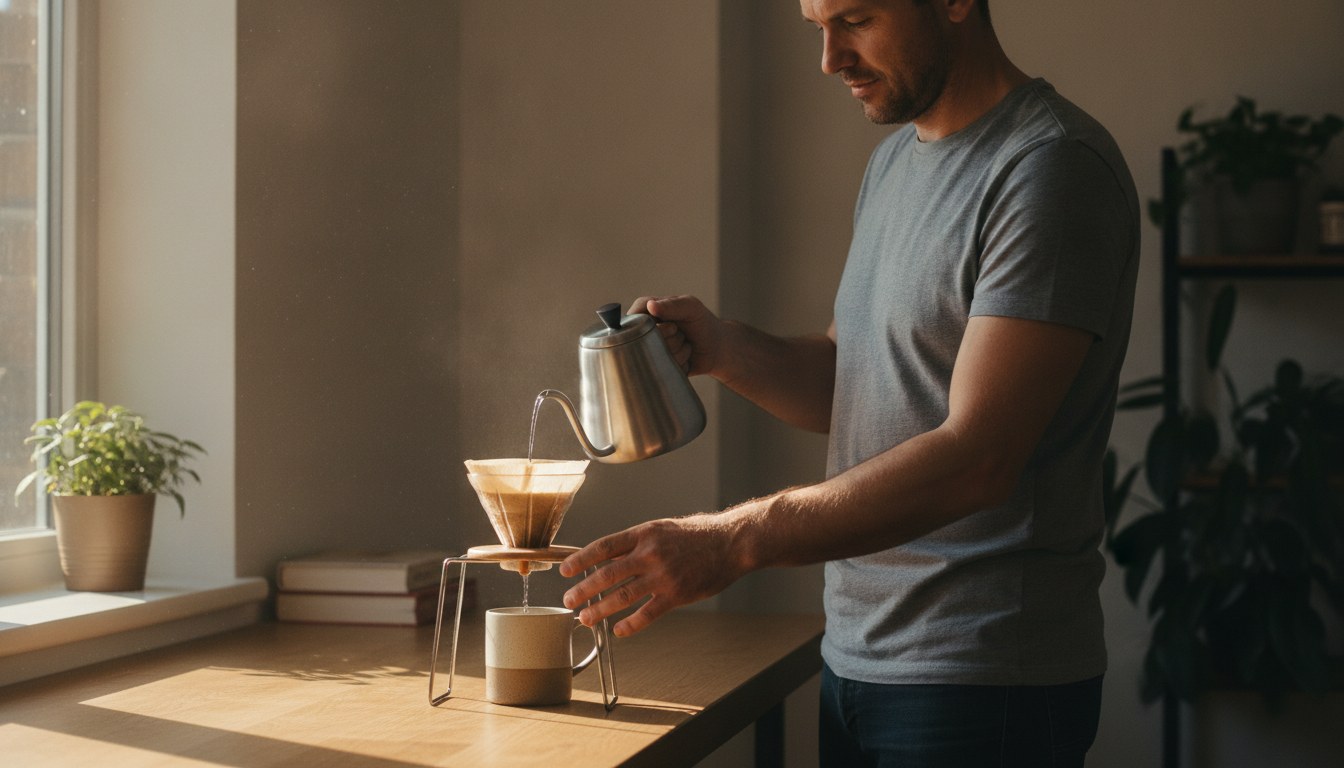
Water starts in the reservoir at the back of the machine and drops through a one-way check valve into a narrow tube sitting against the heating element. That's the whole trick behind how a drip coffee maker works: instead of pumping water uphill, the machine boils it in place. Bubbles form inside the tube, and a column of water rides up on top of that boiling action, a plumbing effect called a thermosiphon. No moving parts, no pump motor, just heat and physics doing a job a motor would otherwise have to do mechanically.
A forensic engineering teardown of one older drip machine found the heating element running at 600 watts and the water inside the tube reaching roughly 242°F during a brew cycle, well above sea-level boiling point, before it cools slightly on its way through the spray head and into the grounds. That number matters more than it sounds like it should. It's hot enough to extract flavor quickly, and the trip through the showerhead and filter basket brings the temperature down closer to a drinkable range by the time coffee reaches the carafe. Machines like SHARDOR's 10-Cup Programmable model layer a timer and an LCD touchscreen on top of that same mechanism, but the electronics only decide when the heating element switches on. They aren't doing anything to the water that a basic switch-and-heat design wasn't already doing decades ago.
The reservoir, filter basket, and carafe: where the real design differences live
Once the shared heating mechanism is out of the way, the parts that actually vary between drip coffee makers are the reservoir, the filter basket, and the carafe, not the core brewing physics.
If every drip machine boils water the same way, what changes when one model costs more than another? Mostly it comes down to three parts. The reservoir can be a plain fill line or, as on BLACK+DECKER's 12-Cup Digital model, a front-facing water window that shows the exact volume going in before brewing starts. The filter basket splits into permanent mesh filters, like the gold-tone one built into Cuisinart's 14-Cup Coffee Maker, versus paper-filter baskets that need a fresh disc every brew. Permanent filters cut the ongoing cost of buying paper, but they usually need a more thorough manual clean after each pot.
Then there's the carafe and warming plate, which is also where drip coffee earns its reputation for turning bitter if it sits too long: the plate keeps applying direct heat to coffee that's already brewed, slowly cooking it rather than just holding it warm. Cuisinart's PerfecTemp system manages that with adjustable keep-warm temperature control, and other machines add a pause-and-serve feature, marketed on the BLACK+DECKER model as Sneak-A-Cup, that briefly stops the flow so you can steal a cup mid-brew without flooding the counter. None of this changes how the machine works internally. It changes how much attention it needs afterward. Our pot coffee maker guide breaks down which carafe and filter combinations show up most often if you're comparing full-pot models directly.
Why the "cup" printed on a coffee maker isn't a real cup
Coffee makers commonly define one "cup" as about 5 fluid ounces, not the 8-ounce cup used everywhere else in cooking, so a "12-cup" machine holds roughly 60 ounces, not 96.
This trips up almost everyone the first time they read the fine print. BLACK+DECKER's own spec sheet for its 12-Cup Digital model spells it out directly: a cup equals approximately 5 ounces, and the figure varies slightly by brand. So a "12-cup" carafe runs closer to 60 fluid ounces than the 96 ounces you'd expect from twelve standard 8-ounce measuring cups. It isn't quite a bait and switch, more an inherited industry convention nobody bothered to rename once everyone else's idea of a cup moved on.
The convention sticks around because a smaller serving size holds up better against the coffee-to-water ratio the industry actually cares about. Brew the same scoop of grounds against a full 8-ounce serving and the coffee comes out weaker than the machine is calibrated to produce. The Specialty Coffee Association publishes a formal testing standard for home brewers, SCA-310, which is a sign that consistent extraction gets treated as an engineering question worth certifying, not just a matter of taste. If you've ever wondered why a "12-cup" pot barely fills four actual mugs, that's the whole answer.
Drip vs. pod, espresso, percolator, and cold brew: how the other types of coffee makers work
Drip machines use gravity and a thermosiphon; pod machines pierce a sealed cup and push hot water through under light pressure; espresso forces water through fine grounds at high pressure; percolators cycle boiling water repeatedly; cold brew skips heat entirely.
Understanding drip explains most of how coffee makers work in general, because the other common types of coffee makers each swap out one piece of that same basic idea. Pod and K-Cup machines still heat water and push it through grounds under gravity or light pressure, but the "basket" is a sealed, pre-measured pod pierced by a needle rather than a reusable filter you fill yourself. Hybrid machines blur the line entirely. Keurig's K-Duo Hot & Iced Single Serve & Carafe model brews from either K-Cup pods or your own grounds out of a 72-ounce reservoir, which makes it genuinely a drip machine and a pod machine sharing one housing.
Espresso is a different animal mechanically, not just a stronger drip. It forces near-boiling water through very finely ground coffee at high pressure, extracting in under a minute instead of several, which is why espresso and drip taste and feel so different even from identical beans. A stovetop percolator takes the opposite approach: it repeatedly boils water up through a stem and lets it cycle back down through the grounds, over and over, until it's strong enough for whoever's watching the stove, which is also why percolated coffee tends to taste harsher than drip. Cold brew skips heat altogether, steeping coarse grounds in room-temperature or cold water for many hours and leaning on time instead of temperature to pull flavor out. None of these methods is strictly better. They're different trade-offs between speed, strength, and how much equipment you're willing to own. Our best coffee maker guide compares picks across every one of these styles if you're deciding between formats rather than just models.
Auto shut-off and the thermal cutoffs that keep a drip machine from becoming a hazard
Most drip coffee makers include an auto shut-off timer plus a hardware backup: thermal cutoffs that physically break the circuit if the electronic controls fail.
An auto shut-off feature, like the one SHARDOR advertises on its programmable model, turns the machine off automatically after brewing so a warming plate doesn't run unattended for hours. That's a genuinely useful software-level safety net, and coffee makers have earned it: the U.S. Consumer Product Safety Commission's 2026 recall of a single-serve model from Kidisle documented at least 107 incident reports and 27 injuries, including first- and second-degree burns, after internal blockages let hot liquid and steam build up and release without warning. That recall wasn't about a drip machine specifically, but it's the exact failure mode auto shut-off and overheat protection exist to prevent across the category.
Drip machines carry their own hardware backup on top of any electronic timer. Underwriters Laboratories' safety standard for these appliances, UL 1082, requires a limiting device, and in the drip machines examined during one forensic engineering review, that meant two thermal cutoffs wired in series, each rated to break the circuit permanently at around 216°C (421°F) if the main thermostat sticks. It's a deliberately low-tech backup: no sensor logic, just a component that melts open at a set temperature and never resets. That kind of redundancy is exactly what shows up after a design fails in the field once, and it's easy to take for granted until you learn it's doing real, unglamorous work every single brew cycle.
What actually separates a budget drip coffee maker from a premium one
Once the shared heating mechanism is understood, the gap between a bare-bones drip machine and a premium one comes down to programmability, filter type, carafe design, and safety extras, not a fundamentally different way of making coffee.
A budget-tier drip machine and a premium one are boiling water the same way. Nobody has reinvented the thermosiphon lately, and there isn't much reason to. What changes as you move up in tier is mostly around the edges: a programmable timer instead of a single on-off switch, a permanent filter instead of paper, a water-level window instead of a fill line you squint at, a pause-and-serve feature, or a display that tracks brew strength across two settings the way SHARDOR's model does. Mid-range machines tend to add one or two of these extras. Premium tiers stack most of them together, along with sturdier carafes and more thorough keep-warm temperature control.
None of that changes the honest answer to how does a drip coffee maker work: hot water, a thermosiphon, gravity, a filter, and a pot underneath. If you're shopping and trying to figure out which extras are worth paying for versus which ones just add a line to the spec sheet, our coffee maker hub rounds up picks across every price tier and use case, so you can compare full feature sets instead of guessing from a listing photo.