Heat vs vibration for muscle pain relief?
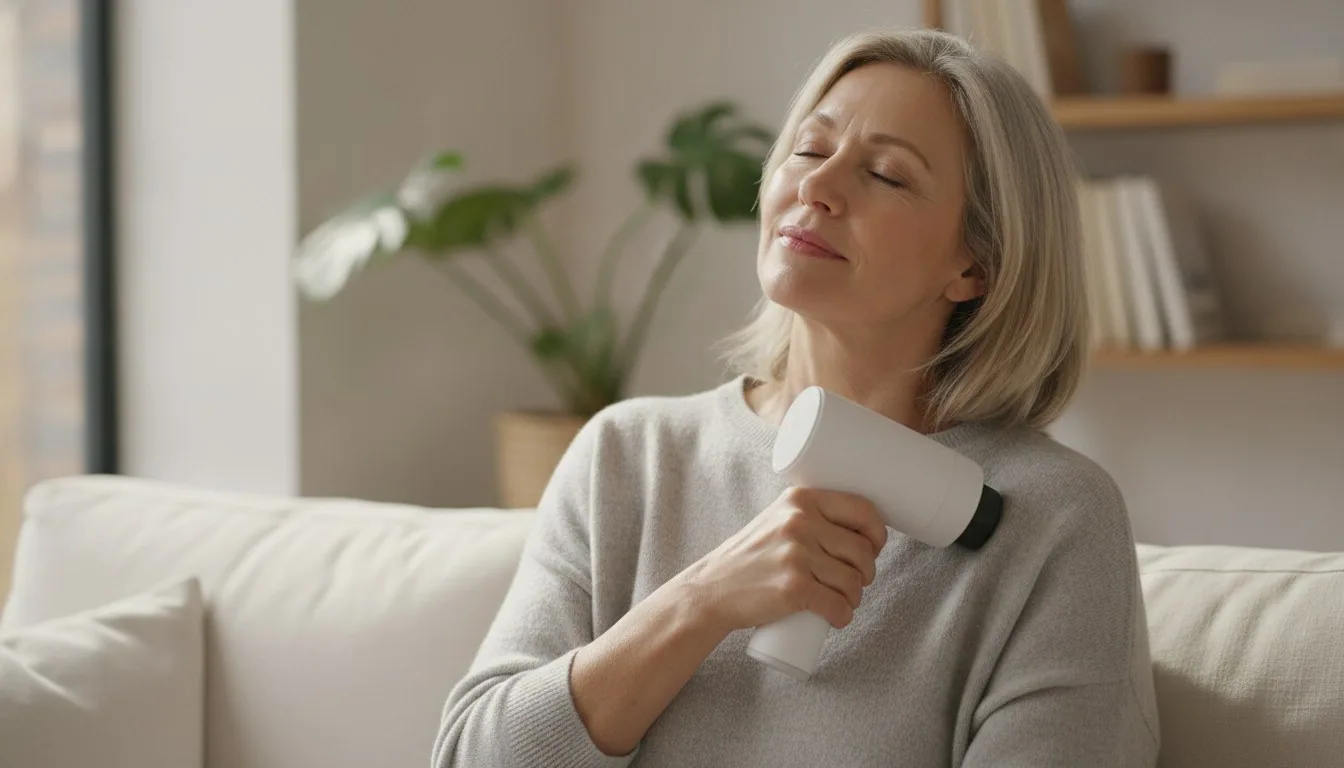
Sore muscles rarely wait for a convenient moment, and the drawer of home remedies usually has two obvious options staring back: something warm, or something that buzzes. Both have a real physiological case behind them, and the honest answer is less about crowning a winner than about matching the tool to what's actually wrong with the muscle.
In the heat vs vibration debate for muscle pain, neither beats the other outright. Heat raises tissue temperature to relax stiff muscle and improve blood flow, while vibration stimulates nerve fibers that dampen pain signals and reduces soreness in exercise-recovery studies. A randomized trial found combining both gave the largest pain drop of all three options.
| Spec | Heat | Vibration |
|---|---|---|
| Primary mechanism | raises tissue temperature to boost blood flow and metabolism | stimulates mechanoreceptors that modulate pain signaling at the spinal cord |
| Best-supported use case | low back pain and general muscle stiffness/tension | post-exercise delayed-onset muscle soreness (DOMS) |
| Strength of clinical evidence | larger trials (371 and 176 participants), longer research history | smaller trials (258 participants across 10 pooled studies), authors call evidence quality relatively poor |
| Speed of felt relief | gradual, builds over minutes as tissue warms | often felt faster, more immediate nervous-system response |
| Safety profile | minor adverse events (transient skin pinkness) in trials; avoid on swelling or fresh injury | generally well tolerated; avoid near fractures, clots, or implants per standard device cautions |
| Effect on soreness biomarkers (creatine kinase) | not measured in the cited heat trials | significantly lower CK at 24-48 hours in DOMS meta-analysis |
| Combined with the other therapy | combined with vibration, outperformed heat alone in a head-to-head RCT | combined with heat, outperformed vibration alone in the same RCT |
| Quick Facts | |
|---|---|
| Tissue metabolism increase per 1°C of heating | 10-15% |
| Standard clinical heat protocol | about 40°C for 8 hours/day, 2-5 days |
| Combined heat+vibration pain reduction (RCT, 3rd visit) | 23 mm on a 100 mm scale |
| Heat-alone or vibration-alone pain reduction (same RCT, 3rd visit) | about 10 mm each |
| Clinically meaningful pain change threshold (same RCT) | 10 mm on a 100 mm VAS |
How heat and vibration actually work on a sore muscle
Heat works by raising tissue temperature to boost local blood flow and metabolism, while vibration works through the nervous system by stimulating touch and pressure fibers that can crowd out pain signals headed to the brain.
Shopping for a specific model? See the best massager we tested — 10 models compared on the specs that decide it.
Heat's mechanism is the more straightforward of the two. Warming a muscle dilates the blood vessels feeding it, which pushes more oxygen and nutrients into the tissue and helps carry metabolic waste back out. A narrative review published on PMC puts a number on this: raising tissue temperature by just 1°C is associated with a 10-15% jump in local metabolism. That's a meaningful shift for a knot of muscle that's been sitting tight and under-supplied for hours. Heat also acts directly on thermoreceptors that appear to interfere with pain signal processing in the spinal cord, on top of the simple loosening effect most people feel first.
Vibration takes a different route entirely. Rather than changing the chemistry of the tissue, it stimulates mechanoreceptors, the nerve endings that register touch, pressure, and movement. Under the classic gate control model of pain, first tested experimentally and still cited today, activity in these faster, larger-diameter nerve fibers can reach the spinal cord ahead of slower pain signals and partially block their processing there. It's worth being straight about the caveats: the original gate control theory from the 1960s is now considered oversimplified by pain researchers, who've since found the fiber interactions involved are messier than the original model proposed. The practical effect on perceived pain, though, is still observed in trials, even if the textbook explanation has been revised.
Neither mechanism is exotic or unproven quackery, and neither is a cure. They're two different levers on the same nervous and circulatory systems, which is a large part of why combining them tends to outperform using just one.
What the research says about vibration and delayed-onset muscle soreness
A 2019 meta-analysis of 10 trials found vibration therapy meaningfully reduced DOMS pain scores at 24, 48, and 72 hours post-exercise, with the strongest effect at the 48-hour mark.
Delayed-onset muscle soreness, the ache that shows up a day or two after unfamiliar or intense exercise, is where vibration has its best-documented evidence. A meta-analysis and systematic review pooling 10 randomized controlled trials and 258 participants found vibration significantly reduced pain scores compared with no treatment at three separate checkpoints: 24 hours, 48 hours, and 72 hours after the triggering exercise. The 48-hour mark showed the largest effect, which lines up with when DOMS pain typically peaks for most people.
The same review tracked creatine kinase, a blood marker that rises when muscle fibers are damaged, and found vibration groups had significantly lower CK levels at 24 and 48 hours, though that gap closed by 72 hours. The authors were candid about the review's limits, though, flagging small sample sizes across the included trials and describing the overall evidence quality as relatively poor. That's not a reason to dismiss the finding, but it is a reason to hold it as promising rather than settled. A separate study on whole-body vibration platforms, for what it's worth, found no soreness benefit at 30 Hz with 2-4 mm amplitude in young women doing high-intensity exercise, which suggests the frequency and amplitude of the vibration matter as much as the fact that vibration is happening at all.
What this means for a handheld or wearable massager with heat and vibration is that the vibration half of the equation has a real, if imperfect, evidence base specifically for the kind of soreness that shows up after a hard workout or an unusually physical day.
What the research says about heat for muscle pain
Superficial heat therapy has stronger, more consistent trial evidence than vibration, particularly for low back pain, with measurable pain and disability improvements over several days of use.
Heat has a longer and more consistent research trail behind it, largely because it's been studied as a treatment for low back pain specifically. One frequently cited trial with 371 participants found that heat wrap therapy outperformed both acetaminophen and ibuprofen on pain relief, by margins of 33% and 52% respectively, with heat's advantage holding across stiffness, flexibility, and disability measures through the first four days of an acute episode. A separate trial pairing heat with exercise found functional improvement running 84% to 175% higher than heat alone, exercise alone, or no treatment by day seven, which suggests heat works best as a warm-up act for movement rather than a passive substitute for it.
Safety data backs heat up too. A review pooling nine studies and more than a thousand participants found only minor adverse events from superficial heat therapy, mostly transient skin pinkness that resolved on its own. Standard clinical protocols run heat at around 40°C for roughly eight hours a day across two to five consecutive days, which is a far gentler exposure than a consumer heating pad cranked to its highest setting for a quick session, and it's a reminder that more heat isn't automatically more relief.
The honest gap in this literature is that almost all of it studies low back pain specifically, not general muscle soreness elsewhere in the body. It's a reasonable extrapolation that a warm shoulder or calf behaves similarly to a warm lower back, since the underlying physiology of blood flow and thermoreceptors doesn't change by location, but that's an inference, not something these particular trials tested directly.
Heat vs vibration for muscle pain: head-to-head evidence
A randomized controlled trial testing heat alone, vibration alone, and combined heat-plus-vibration on nonspecific back pain found the combination produced the largest pain reduction of the three, though vibration alone edged out heat alone at the earlier follow-up.
Most of the literature studies heat and vibration separately, which makes a small but genuinely head-to-head trial worth singling out. A prospective, randomized, controlled study assigned 59 patients with nonspecific back pain into three groups: heat only, vibration only, and combined heat-plus-vibration. Using a 100 mm visual pain scale, the trial set its threshold for a clinically meaningful improvement at a 10 mm drop, and all three groups cleared that bar.
The combined group came out ahead by a clear margin, reducing pain by 17 mm at the second visit and 23 mm by the third. Vibration alone reduced pain by 15 mm at the second visit before flattening out at 10 mm by the third, while heat alone stayed steady around 10-11 mm at both checkpoints. In other words, vibration looked like it worked faster early on, but the combined approach kept improving where the single-therapy groups plateaued. The trial also tracked heart rate and blood oxygen changes and found vibration alone produced a small heart rate drop, while the combined group showed a slight, statistically noted dip in oxygen saturation, a detail worth mentioning for completeness even though the study didn't flag it as clinically concerning.
This single trial isn't the final word. Fifty-nine people split three ways is a modest sample, and it studied back pain, not sore muscles generally. But it's the closest thing available to a direct comparison, and its main finding tracks with what the separate heat and vibration literatures already suggest: each one helps on its own, and together they help more than either does alone.
Which one should you actually reach for
Reach for heat when a muscle feels tight, stiff, or achy without recent trauma; reach for vibration when soreness follows exercise or you want a nervous-system-driven jolt of relief; use both when you have access to a combined device.
The practical decision usually comes down to what triggered the soreness. Tightness that builds up from sitting at a desk, sleeping wrong, or general muscle tension responds to heat's blood-flow boost in a way that's well supported by the low back pain trials above. A stiff neck at the end of a long day, a tense shoulder from stress, or general achiness without a specific triggering event are all reasonable heat-first situations.
Soreness that shows up a day or two after a hard workout, a long hike, or unusual physical activity is closer to the DOMS pattern the vibration research actually tested, and that's where vibration has its clearest evidence. If you're chasing a specific knot rather than general soreness, vibration's more targeted mechanoreceptor stimulation may register as more immediately noticeable than heat's slower-building warmth.
For anyone who doesn't want to pick, a massager with heat and vibration built in removes the decision, and the combined-therapy trial above is a real, if modest, data point suggesting that's not just a marketing bundle. Buyer Reports's massager hub lays out current models across styles and price tiers, and if you specifically want a device to lean on the back and neck where a lot of this research is concentrated, our chair and back massager picks compare current options built for that job. Either way, neither tool addresses a herniated disc, a torn muscle, or a fracture, and pain that's sharp, radiating, or getting worse rather than better over a few days is a reason to see a doctor rather than reach for a warmer or buzzier gadget.
Heat has the deeper, larger-scale evidence base and suits general stiffness and tension, while vibration has good targeted evidence for post-workout soreness and tends to feel faster. The one trial that tested them head-to-head found combining both beat either alone, which is the honest takeaway: this isn't really a competition, it's two complementary tools.
Frequently asked questions
Is heat or vibration better for lower back pain?
Can you use heat and vibration massage at the same time?
Does vibration therapy actually help sore muscles after a workout?
How long should you use a heat massager for muscle pain?
Is a massage gun the same as vibration therapy?
Can heat or vibration make muscle pain worse?
Sources & references
- A Role for Superficial Heat Therapy in the Management of Non-Specific, Mild-to-Moderate Low Back Pain in Current Clinical Practice: A Narrative Review — PMC (National Center for Biotechnology Information)
- Does vibration benefit delayed-onset muscle soreness?: a meta-analysis and systematic review — PMC (National Center for Biotechnology Information)
- Influence of heat therapy and/or vibration on nonspecific back pain: A prospective, open, randomized, controlled, parallel-group clinical study — PubMed (National Library of Medicine)
- Pain modulation in the spinal cord — PMC (National Center for Biotechnology Information)