Foam vs pillow-top mattress topper
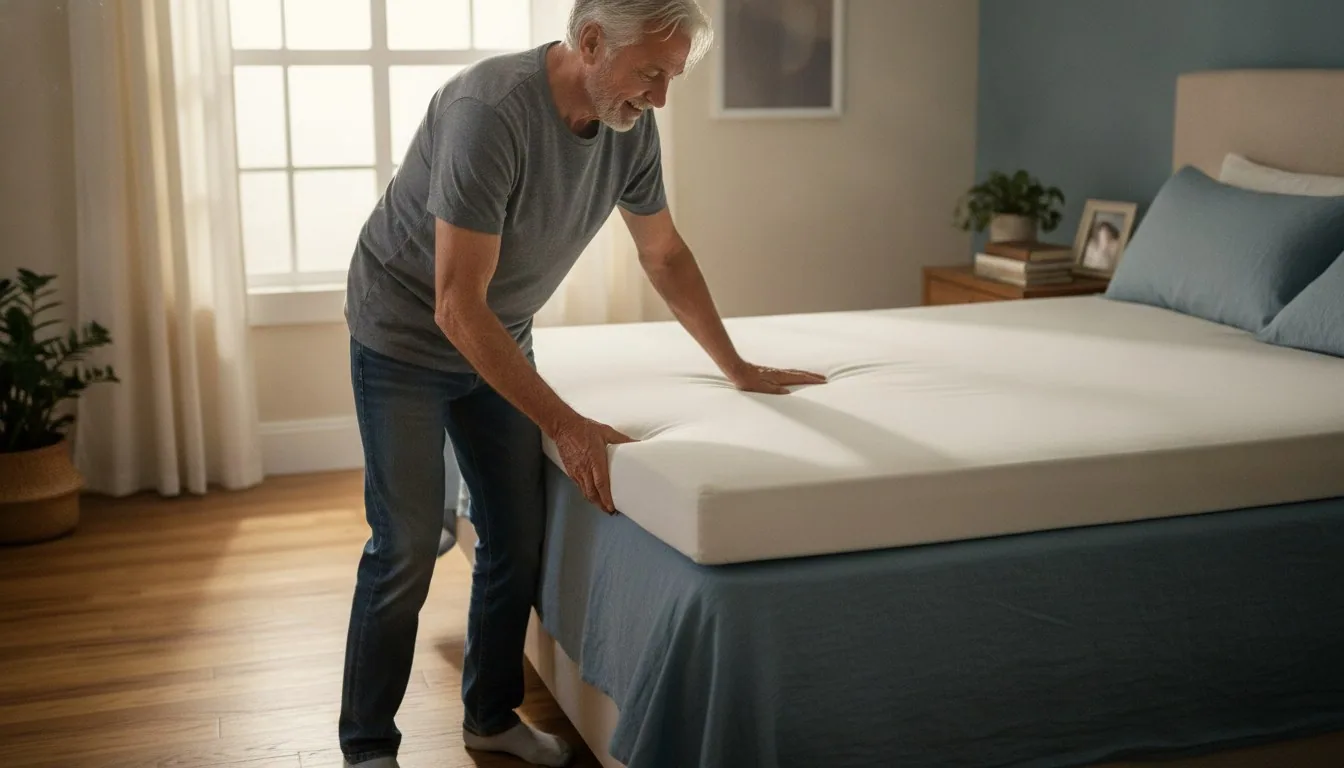
Two toppers can sit on the same bed and do almost opposite jobs. A foam slab sinks in, cradles the hips and shoulders, and quietly rewrites how firm the whole mattress feels. A quilted pillow-top pad barely touches the support underneath; it lays a soft, airy cushion across the surface and stops there. Buy the wrong one and you either add plush to a bed that needed firmness, or add sink to a bed that needed a little loft. The label rarely spells out which is which, and the two look nearly identical in a listing photo.
A foam vs pillow-top mattress topper choice comes down to feel and function. A foam topper is a solid slab of viscoelastic or firmer polyurethane that contours to your body and changes how supportive the bed is. A pillow-top topper is a quilted, fiber- or down-filled pad that adds surface softness without altering the support beneath it.
| Spec | Foam topper | Pillow-top topper |
|---|---|---|
| Construction | Solid slab of viscoelastic (memory) or firmer polyurethane | Quilted mattress-pad cover with a sewn-in plush fill |
| Main job | Changes the bed's firmness and pressure relief | Adds a soft surface layer without changing support |
| Typical thickness | About two to four inches of foam | A thin quilt; adds loft, not height |
| Temperature | Denser, tends to trap more heat | Lofted fill breathes and sleeps cooler |
| Off-gassing | Faint VOC smell for a few days when new | Little to none |
| Cleaning | Spot clean and air dry only | Often fully machine washable |
| Content certification | CertiPUR-US signals tested foam | No exact equivalent; check fill and cover |
| Best for | A bed that is too firm or unsupportive | A supportive bed that feels too hard on top |
Foam vs pillow-top mattress topper: the core difference
A foam topper is a solid contouring slab that can make a bed firmer or softer; a pillow-top topper is a quilted pad that adds a plush surface layer without changing the support beneath it.
Shopping for a specific model? See the best mattress topper we tested — 10 models compared on the specs that decide it.
The two categories share a shelf and almost nothing else. A foam topper is exactly what it sounds like: a continuous block of polyurethane, either the slow-sinking viscoelastic kind marketed as memory foam or a firmer, springier formulation. Set it on the bed and its whole job is to intercept your weight before the mattress does, so it changes the effective firmness of everything underneath. A pillow-top topper works from the opposite direction. It is built like a thick mattress pad: two layers of fabric quilted around a soft fill, sewn into channels or boxes so the padding stays put. That construction adds a cushioned surface you sink into slightly, but it rests on top of the mattress rather than restructuring how the mattress carries you. One tool reshapes support; the other dresses the surface. Knowing which problem you actually have is most of the decision here, because the two are not interchangeable even though they look alike in a photo.
What a pillow-top mattress topper actually is
A pillow-top mattress topper is a quilted, mattress-pad-style cover with a plush fill sewn into its top, made to add softness while sitting on top of an existing mattress.
If a foam topper is a slab, a pillow-top is a quilt. The defining trait is construction, not one single fill material. Makers stitch a soft layer, often polyester fiberfill and sometimes down or a down-and-feather blend, between fabric panels, then quilt it into baffles so the fill cannot migrate into one lumpy corner. Many are cut as fitted covers with an elastic skirt, which is part of why the CPSC files them under the same category as a mattress pad: a cushion 'for use on top of a mattress.' The payoff is a gentle, cloud-like surface and, usually, easy laundering, since a fiber-filled pad behaves like bedding. The limit is support. A pillow-top adds a plush ceiling to the bed, but the springs or foam core below still decide how your spine is held. If a mattress sags or feels rock hard through the pad, a pillow-top softens the touch without fixing the underlying shape, and that gap trips up a lot of buyers.
How each one feels and supports you
Foam toppers change pressure relief and firmness because your body settles into them; pillow-top toppers add surface plushness but leave the mattress core support essentially unchanged.
Lie on a memory-foam topper and it gives way in stages. The viscoelastic foam softens with body heat and pressure, letting the hips and shoulders settle while filling the gap at the lower back, which is why side sleepers and anyone chasing pressure relief tend to reach for it first. Firmer, non-memory foam does the reverse for a bed that has gone too soft, adding a supportive deck that keeps you from bottoming out. Either way, the foam is doing structural work. A pillow-top pad feels different the instant you touch it, plush and yielding at the very top, but press through that inch of fill and you meet the same mattress you started with. That makes a pillow-top a fine fix for a bed that supports you well yet feels harsh on the skin or too firm at the surface. It is a poor fix for a bed whose support has failed, because softness and support are separate problems, and a quilt only solves the first one.
Heat, off-gassing, and cleaning
Foam toppers trap more heat, can smell for a few days as they off-gas, and need spot cleaning; quilted pillow-top pads breathe better and are often machine washable.
Comfort across a full night comes down to airflow, and here the quilt has an edge. A solid foam slab is dense by design, so body heat has fewer paths to escape, and warm sleepers often notice it even with gel or ventilation tweaks. A fiber-filled pillow-top moves air through its loft more freely and tends to sleep cooler. New foam brings a second quirk: a faint chemical smell for the first few days. That is off-gassing, the release of volatile organic compounds from fresh polyurethane. The EPA reports that indoor VOC levels already run about 2 to 5 times higher than outdoors and can climb briefly around new products, so unrolling a foam topper and letting it breathe in a ventilated room before use is a reasonable habit. Cleaning splits the same way. Most quilted pillow-top pads go in the washing machine like a sheet. Solid foam cannot: soak it and water lodges deep in the cells where it will not dry, so spot cleaning and full air drying are the safe route.
Safety, certifications, and what to check
Both toppers fall under the CPSC mattress-pad flammability rule, and for the foam side a CertiPUR-US mark signals the foam was tested for content and emissions.
Neither topper is unregulated, which surprises some buyers. Because both sit on the bed as a pad, they fall under the U.S. Consumer Product Safety Commission's Standard for the Flammability of Mattresses and Mattress Pads, 16 CFR 1632. To pass, a pad tested against a lit cigarette must keep the char length to no more than 2 inches, about 5.1 cm, from the nearest point of the cigarette. That rule governs fire behavior, not what is inside the foam. For that, the useful signal on the foam side is CertiPUR-US, a program run by the nonprofit Alliance for Flexible Polyurethane Foam. A certified foam has been tested to be made without certain flame retardants and ozone depleters, and to keep lead within the CPSC toy standard. A pillow-top pad has no exact equivalent, so with quilted pads the things worth checking are the fill type, the quilting pattern, and whether the cover is machine washable.
So which topper should you buy
Choose a foam topper to change how supportive or pressure-relieving the bed feels, and a pillow-top topper to add plush softness to a bed that already supports you well.
Start from what the bed gets wrong. If the mattress is too firm, digs into your shoulders, or has stopped relieving pressure, that problem is structural, and a foam slab is the tool that changes it; the picks broken down in our foam mattress topper guide sort themselves by thickness and firmness for exactly that reason. If the support is fine and you only want the surface to feel softer and more cushioned, a quilted pad does it with less heat and easier washing, which is the case our pillow-top mattress topper guide is built around. Thickness matters more on the foam side, where a couple of inches versus four changes the feel a lot, than on the quilted side, where loft is gentler by nature. Budget and premium versions exist in both camps, so the material should follow the problem rather than the other way around. If you would rather compare the strongest options across both styles in one place, our best mattress topper guide lines them up side by side.
In the foam vs pillow-top mattress topper decision, pick foam to change how supportive or cushioning the bed actually is, and a pillow-top to soften a surface on a mattress that already holds you well. They answer different complaints, so match the topper to the problem: structure calls for foam, surface feel calls for a quilted pad.
Frequently asked questions
What is a pillow-top mattress topper?
Is a foam or pillow-top topper better for back pain?
Do foam mattress toppers smell when new?
Can you machine wash a mattress topper?
Are mattress toppers covered by fire-safety rules?
Sources & references
- Forty-Year-Old Foam Springs Back With New Benefits — NASA Spinoff
- 16 CFR 1632.1 - Definitions (Standard for the Flammability of Mattresses and Mattress Pads) — U.S. Consumer Product Safety Commission, via Cornell Law School Legal Information Institute
- 16 CFR 1632.3 - General requirements (mattress and mattress pad cigarette-ignition test) — U.S. Consumer Product Safety Commission, via Cornell Law School Legal Information Institute
- Volatile Organic Compounds' Impact on Indoor Air Quality — U.S. Environmental Protection Agency (EPA)
- About CertiPUR-US — CertiPUR-US / Alliance for Flexible Polyurethane Foam