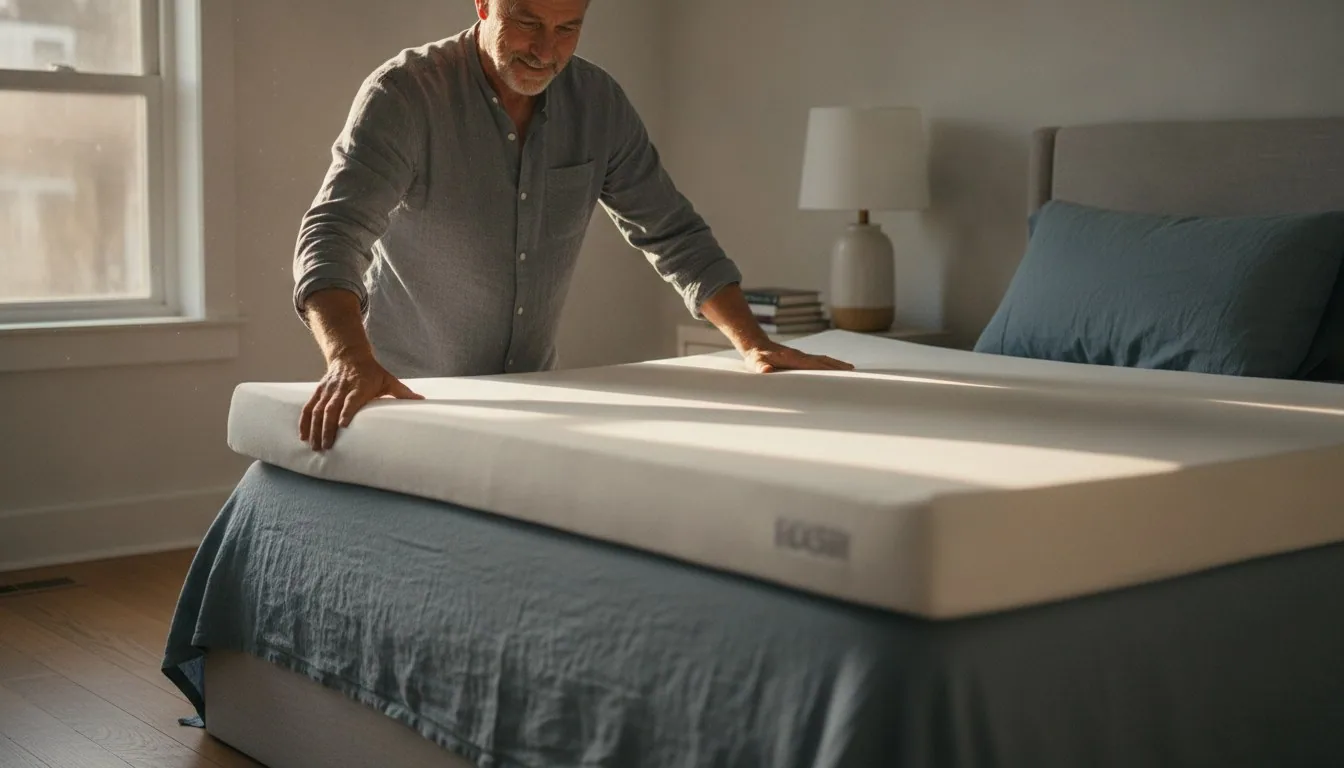
| Quick Facts | |
|---|---|
| Twin mattress footprint | 39 x 75 inches |
| Twin XL mattress footprint | 39 x 80 inches, 5 inches longer than Twin |
| Bunk-bed guardrail clearance required above the mattress | at least 5 inches (130 mm), per 16 CFR 1213.3(a)(6) |
| Thickness range among dorm-labeled toppers compared | 3 to 5 inches |
| Kovacs et al. (2003) trial sample size | 313 adults with chronic low-back pain, 90-day follow-up |
| Medium-firm vs firm disability odds ratio (Lancet trial) | 2.10, 95% CI 1.24-3.56 |
| Pressure-injury incidence, viscoelastic vs pyramidal overlay (ICU trial, n=62) | 32.2% vs 80.6% |
What a dorm mattress topper actually fixes
Dorm mattresses are built for durability and easy cleaning rather than comfort, and a topper is the fastest way to change how the surface feels without replacing anything the school owns.
Shopping for a specific model? See our mattress topper buying guide — 10 models compared on the specs that decide it.
University-owned mattresses are institutional-grade for a reason: they need to survive years of move-ins, move-outs, and whatever gets spilled on them, and comfort tends to lose that trade-off. The result is usually a mattress that's thinner and firmer than what most people sleep on at home, wrapped in a vinyl or plastic-backed cover that traps body heat overnight. A dorm mattress topper doesn't fix the mattress underneath it, but it changes the surface you actually feel each night. For a lot of students, that's the single purchase that moves the needle most on sleep quality without touching the frame or running into a housing policy about altering university furniture.
Among the dorm-labeled toppers we looked at while building this guide, thickness ran from about 3 to 5 inches. That range matters more than it sounds: too thin, and the topper barely changes how the mattress feels; too thick, and it fights with fitted sheets, bunk-bed guardrails, and the anchor straps meant to keep it from sliding off at 2 a.m. Material matters as much as thickness - gel-infused memory foam and shredded-foam fills show up more at the thicker end, while quilted fiber-fill pads stay thinner. Our full dorm mattress topper comparison ranks the specific models by material, thickness, and how they held up in listed reviews.
Twin, Twin XL, or double: matching the topper to your frame
Twin XL, at 39 by 80 inches, is the standard U.S. college dorm bed size and five inches longer than a plain Twin, so a topper sized for one will not sit flush on the other.
Twin XL is the size that matters most here: at 39 by 80 inches, it's five inches longer than a standard Twin at 39 by 75 inches, and that gap is exactly where fit problems start. Buy a Twin topper for a Twin XL frame and the extra fabric has nowhere to go - it bunches at the foot of the bed and pulls the fitted sheet loose. The reverse happens too: a Twin XL topper on a plain Twin frame overhangs the edge instead of tucking under it. If you've confirmed your dorm bed is Twin XL, our picks for the best twin XL mattress toppers break down thickness and material for that size.
Not every dorm bed is Twin XL, though. Some older residence halls and off-campus apartments still use a standard Twin, and grad housing or apartment-style dorms occasionally step up to a full or double bed, with "double" being the more common term in UK sizing and roughly equivalent to a US full. If you're on a standard Twin frame, our twin mattress topper guide walks through the same sizing and thickness trade-offs scaled for that mattress. Whatever the frame, measure the actual mattress before ordering rather than trusting the label on whatever topper you're replacing, since sizing consistency across brands is looser than it should be. Search listings use inconsistent labels for the same idea: mattress topper twin bed, mattress topper twin, mattress topper dorm, and mattress topper dorm bed all describe ordinary size variants, and mattress topper double bed or mattress topper double just means a full-size topper under its UK name - none of it is a different product category.
A mattress topper thickness guide for bunk and loft frames
Federal bunk-bed regulation requires guardrails to clear the mattress top by at least 5 inches, so a thick topper on a lofted dorm frame can eat directly into that safety margin.
Federal safety regulation is oddly specific about this. 16 CFR 1213.3(a)(6), the Consumer Product Safety Commission's entrapment-hazard standard for bunk beds, requires a guardrail's upper edge to sit at least 5 inches above the top of the mattress when the bed carries a mattress of the manufacturer's maximum specified thickness. That rule technically covers commercially sold bunk beds rather than university-installed loft frames, which don't always carry the same labeling - a limitation worth being honest about. But the physics doesn't care who manufactured the frame: stack a 5-inch topper on an already-thick mattress on an upper bunk, and you've used up most or all of that clearance.
The practical version of this mattress topper thickness guide is simple: find out what clearance your actual loft or bunk frame has above the mattress before you buy, and lean toward the thinner end of the 3-to-5-inch range if you're sleeping on top. A 3-inch topper adds noticeably less height than a 5-inch one, which matters more on an upper bunk than on a standard dorm bed set on the floor. If your school's housing office publishes a maximum topper thickness for lofted beds, that number overrides anything in a shopping guide, this one included. When in doubt, thinner and denser tends to beat thicker and softer on a bunk, since it firms up a saggy mattress without eating as much vertical space.
Can a topper make a dorm bed firmer or softer?
Yes to both - it depends on what you buy, not on toppers as a category: dense foam firms up a soft mattress, and plush or higher-loft foam softens a hard one.
This is probably the most-searched question about dorm mattress toppers, and the honest answer is that it depends on the product, not the category. A dense foam layer, roughly 2 inches thick and firm to the touch, makes a saggy dorm mattress noticeably firmer. A plush pillow-top or softer, higher-loft foam does the opposite, adding give on top of a mattress that already feels unforgiving. The wording varies - can a mattress topper make a bed firmer, mattress topper to make bed firmer, mattress topper to make mattress firmer, mattress topper to make bed softer, can mattress toppers make bed firmer, can a mattress topper make a mattress softer - but the answer is the same either way: check density, not the marketing copy on the package.
A mattress topper can make a bed firmer, and one can make a mattress softer too - the number to check is firmness or density, not thickness alone. There's real research behind favoring medium-firm over rock-hard: a randomized, double-blind trial in The Lancet followed 313 adults with chronic low-back pain for 90 days and found medium-firm mattresses produced significantly less disability than firm ones, with an odds ratio of 2.10 (95% CI 1.24-3.56). That trial tested full mattresses rather than toppers specifically, but the mechanism, distributed support instead of a hard surface, carries over reasonably well.
If your dorm mattress already feels like a shelf, maximum firmness on top of it may not be the fix your back wants - medium-firm is the safer default unless you run hot and prefer firm. Does a mattress topper make a bed more comfortable overall? Usually, yes, but only when firmness matches the actual complaint.
Sofa beds, hospital beds, and adjustable frames: same logic, different stakes
Toppers help thin, uncomfortable surfaces everywhere, but a sofa bed needs a low-loft option that still folds, a hospital bed needs pressure-relief performance more than plushness, and an adjustable frame needs a topper flexible enough to bend with the base.
The dorm-bed logic mostly carries over to other thin, shared, or temporary sleep surfaces, with a few adjustments. A mattress topper for a sofa bed runs into a mechanical problem dorm beds don't have: the mattress has to fold around a metal bar, and thick memory foam resists folding cleanly. A lower-loft topper, closer to 2 inches, works better on a sofa bed than the plush 4- or 5-inch options built for a stationary dorm frame. Regardless of how it's searched - mattress topper for sofa bed, mattress topper hospital bed, or mattress topper for hospital bed - the question is the same: does this surface need more cushioning, more pressure relief, or both?
Hospital beds are a different category, and the stakes are higher than comfort alone. A randomized clinical trial in Critical Care Research and Practice compared support surfaces in 62 critically ill patients and found pressure injuries developed in 32.2 percent of patients on a viscoelastic foam surface, versus 80.6 percent on a standard pyramidal foam overlay. That study tested purpose-built medical support surfaces, not consumer dorm toppers, and the gap is worth taking seriously. A topper for a hospital bed does pressure-relief work, not just comfort work, so anyone using one for a person at risk of skin breakdown should check with clinical staff before choosing a retail product over a medical-grade support surface.
Adjustable beds sit in between. Memory foam and latex toppers flex along with the base as it inclines, while rigid or very high-density foam is more likely to crease or crack at the hinge point with repeated use. Deep-pocket sizing and anchor straps matter even more here, since an adjustable base moves the mattress more than a flat dorm frame ever will.
Caring for a dorm mattress topper and moving it out at the end of the year
Machine-washable covers and a quick airing-out after unboxing keep a dorm topper fresh for the school year, and most foam toppers pack down smaller for the trip home than the box that shipped them - not larger.
A dorm mattress topper that lives under a fitted sheet in a shared room needs less babying than people expect, but a few habits extend its life. Removable, machine-washable covers make the biggest practical difference in a dorm, since laundry access is often shared and spot-cleaning a foam core directly is slow and imperfect. New memory foam can carry a faint off-gassing smell for the first day or two after unboxing, and unrolling it in a ventilated room before making the bed cuts that down. None of this is complicated, but it's the kind of maintenance that gets skipped during a hectic move-in week.
At move-out, foam toppers that shipped compressed usually don't shrink back to their original vacuum-sealed size, so budget more suitcase or storage-bin space for the trip home than the box took up on the way in. If you're not keeping it for next year, check your hall's move-out guide first, since some buildings have specific rules about what goes in a dumpster versus what needs to go to a donation bin. Either way, plan for the extra bulk before the last day of finals week, not during it.