| Quick Facts | |
|---|---|
| Typical adjustable heat range across current models | 280°F to 450°F |
| Fastest logged heat-up time to styling temperature | about 15 seconds |
| Common auto shut-off window | 60 minutes |
| Peer-reviewed thermal damage threshold for hair protein | above roughly 200°C (392°F) |
| Lab-tested straightening sweet spot for least damage | about 154°C (309°F) |
| Time for a hot iron to reach burn-risk temperature on contact | about 5 seconds to 450°F |
How to choose a flat iron for your hair type, starting with texture
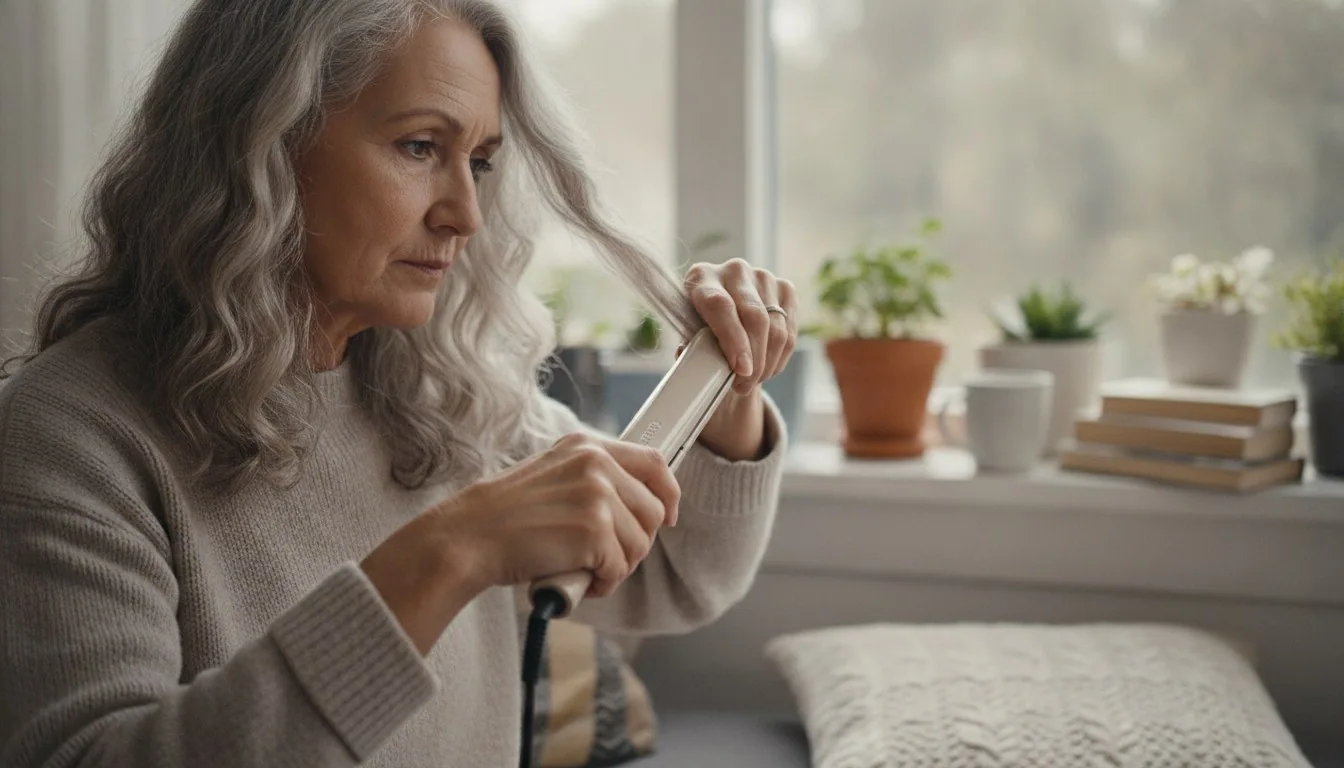
Match plate material and heat ceiling to whether your hair is fine, medium, or coarse and curly before you look at any other spec, since texture decides how much heat your hair can absorb without drying out.
Shopping for a specific model? See our best flat irons picks — 10 models compared on the specs that decide it.
Fine, straight hair is the easiest to damage and the easiest to overheat. If you're wondering how to pick a flat iron for straight, easily-styled hair, gentle and even is the goal, not maximum heat: a flat iron for straight hair rarely needs to run above the low-to-medium settings, and a plate that distributes heat evenly, ceramic or tourmaline, will finish the job without leaving your ends brittle by Friday.
Curly, coily, or chemically relaxed hair asks for more from the tool. A flat iron for curly hair generally needs a higher heat ceiling and a plate that holds its temperature under pressure, since coarse or tightly curled strands resist the first pass and often need a second one to fully set. Titanium plates hold heat more consistently than ceramic across repeated passes, which is part of why they show up more often on irons marketed at thicker or curlier hair.
Most people sit somewhere between those two extremes, with hair that is medium in thickness and mixed in texture from root to end. If that describes you, look at the full flat iron lineup before narrowing down by material or size, since a mid-range temperature range and a mid-width plate will cover more situations than a specialist tool built for one extreme or the other.
Ceramic, titanium, or tourmaline: what the plate is actually doing
Ceramic and tourmaline plates heat evenly and gently, with tourmaline specifically cutting static and frizz through ion output, while titanium plates run hotter and hold that heat more consistently pass after pass.
Knowing what to look for in a flat iron often starts and ends with the plate, since everything else is secondary to how the surface handles heat. Ceramic plates are the default for a reason: they distribute heat evenly across the surface instead of concentrating it in hot spots, which is exactly what fine or previously colored hair needs to avoid patchy, over-processed sections. The trade-off is that ceramic alone tends to run a touch cooler and recover heat more slowly between passes than titanium.
Titanium plates solve that recovery problem. They conduct heat fast, hold a set temperature under repeated contact, and can be pushed to the higher end of the range without the plate itself losing consistency, which is why coarse, thick, or curly hair tools lean on titanium more often. The downside, documented in a 2011 Journal of Cosmetic Science study on thermal damage from hot flat ironing, is that hair protein structure starts measurably breaking down above roughly 200°C (392°F), so titanium's higher ceiling is only an advantage if you actually use the lower half of its range most days.
Tourmaline is the plate material built around ion output rather than raw heat. Crushed into the plate coating, it generates negative ions as the iron glides through hair, which closes the cuticle and cuts static and frizz more aggressively than ceramic alone. CHI built much of its catalog around this idea, pairing tourmaline or titanium-infused ceramic with digital temperature displays, and the Chi flat irons guide is a reasonable next stop if that combination sounds like what your hair actually needs.
Plate width and shape decide how long styling actually takes
Plates near 1 inch suit short, fine, or fringe-heavy styling, while plates from 1.5 inches up move faster through thick or long hair by covering more surface per pass.
Narrow plates, anywhere from about six-tenths of an inch to just under an inch, exist for precision rather than speed. They're built for short hair, pixie cuts, bangs, and edges, where a wide plate would catch skin or scalp before it caught hair. If most of your styling time goes into baby hairs and face-framing pieces rather than full-length passes, a narrow plate will outperform a standard one no matter how good its heat settings are.
Standard and wide plates, from about 1 inch up to 1.75 or 2 inches, exist for coverage. A wider plate clamps more hair per pass, which sounds like more heat exposure but often works out to less: fewer total passes at a lower cumulative dwell time, versus many narrow passes needed to cover the same head of long or thick hair.
Plate shape adds a second layer to the decision. Flat, straight-edged plates are built for one job, straightening, and do it with the least fuss. Curved or rounded plates, the kind found on several 2-in-1 tools built to curl as well as straighten, trade a little straightening precision for the ability to rotate the iron and set a wave or curl without switching tools.
Temperature settings: matching heat to hair, not habit
The safest approach is starting on the lowest setting that gets the job done and moving up only if needed, since research shows most of the damage from flat ironing happens well before you reach the top of the dial.
Most flat irons on the market today offer some form of adjustable heat, typically stepping from around 280°F up to 450°F across five or more presets, sometimes shown on a digital display rather than a dial. That range exists because no single temperature works for every hair type: fine or fragile hair styled at 450°F isn't getting better results, it's getting closer to the point where keratin protein starts to break down.
A 2013 Journal of Cosmetic Science study on automated flat ironing tested a working range of 120°C to 175°C (about 248°F to 347°F) and found the best balance of straightening effectiveness against structural damage sat close to 154°C, or roughly 309°F. That number lines up with what's generally recommended for fine to medium hair: work in the 300°F to 350°F band first, and reserve anything above 400°F for coarse, resistant, or very curly sections that genuinely won't set otherwise.
Heat-up speed is a smaller but real factor in the decision. Some irons reach styling temperature in as little as 15 seconds, others take closer to a minute, and that gap matters if you're straightening on a schedule rather than in a leisurely bathroom routine. A digital display that shows the actual number, rather than a low-medium-high dial, also makes it easier to stay in the range your hair actually needs instead of guessing.
Features that matter beyond the first straightening pass
Auto shut-off, dual voltage, and steam or floating-plate technology don't change how straight your hair gets, but they change how safely and conveniently you get there day to day.
An automatic shut-off, commonly set around 60 minutes on the models we've compared, is worth having even if you're careful, because it's there for the day you get pulled away mid-style and forget the iron is still hot on the counter. Dual voltage matters for a narrower group of people, mainly anyone who travels internationally, but it costs little in a design and saves you from either a bulky plug adapter or a fried motor.
Floating plates, which shift slightly under pressure instead of staying rigid, show up across a range of price points because they solve a real problem: rigid plates can pinch or snag thicker sections of hair, while floating plates flex to the hair's thickness as it passes through and reduce pulling.
Steam and hybrid tools are the newest wrinkle in this category, and they're worth understanding even if you don't end up buying one. Instead of just dry heat, these tools push a light steam through the plates or bristles as they glide, which several manufacturers position as a way to hydrate hair while straightening rather than drying it out further. The hair straightener flat irons guide covers where these hybrid and multi-styling tools land against traditional flat irons on price and performance, useful context before you decide whether the added complexity is worth it. Whatever plate or feature set you land on, treat the iron itself with some caution: a 2019 study in Annals of Burns and Fire Disasters found these tools reach up to 450°F within about five seconds of accidental contact, and pediatric burns from styling irons averaged roughly 0.30% of total body surface area in that sample, a reminder to keep a hot iron off the counter edge and away from curious hands, not just off your hairline.
Budget tiers: what changes as you spend more
Entry-level irons usually cover basic ceramic plates and a couple of heat presets, mid-range models add titanium or tourmaline plates with digital temperature control, and premium tools add technology like sonic plates or memory settings where the gains get smaller for the money.
Every flat iron buying guide eventually comes down to budget, and here's how the tiers actually break down in practice. At the entry tier, expect ceramic plates, a small number of fixed heat presets rather than a fine-grained dial, and a basic on/off switch instead of a digital display. That's not a knock on these tools: for straight to wavy hair that just needs a clean pass now and then, an entry-level iron does the actual job of straightening hair just as well as something far pricier.
Mid-range tools are where titanium or tourmaline plates start showing up alongside digital temperature displays, auto shut-off, and dual voltage as standard rather than optional. This tier is also where floating plates and multiple heat presets become common, which is the practical sweet spot for anyone straightening a few times a week across mixed hair texture.
Premium tools add things like sonic vibration, infrared heat, or memory settings that recall your last-used temperature, and the honest take is that the improvement here is real but incremental rather than transformative. You're paying for a smoother glide and slightly less cumulative wear over months of use, not a fundamentally different straightening result on any single day. Our best flat irons roundup compares specific models across all three tiers side by side if you want to see exactly where the jump in features happens and whether it's worth it for your routine.