Cross cut vs micro cut shredder
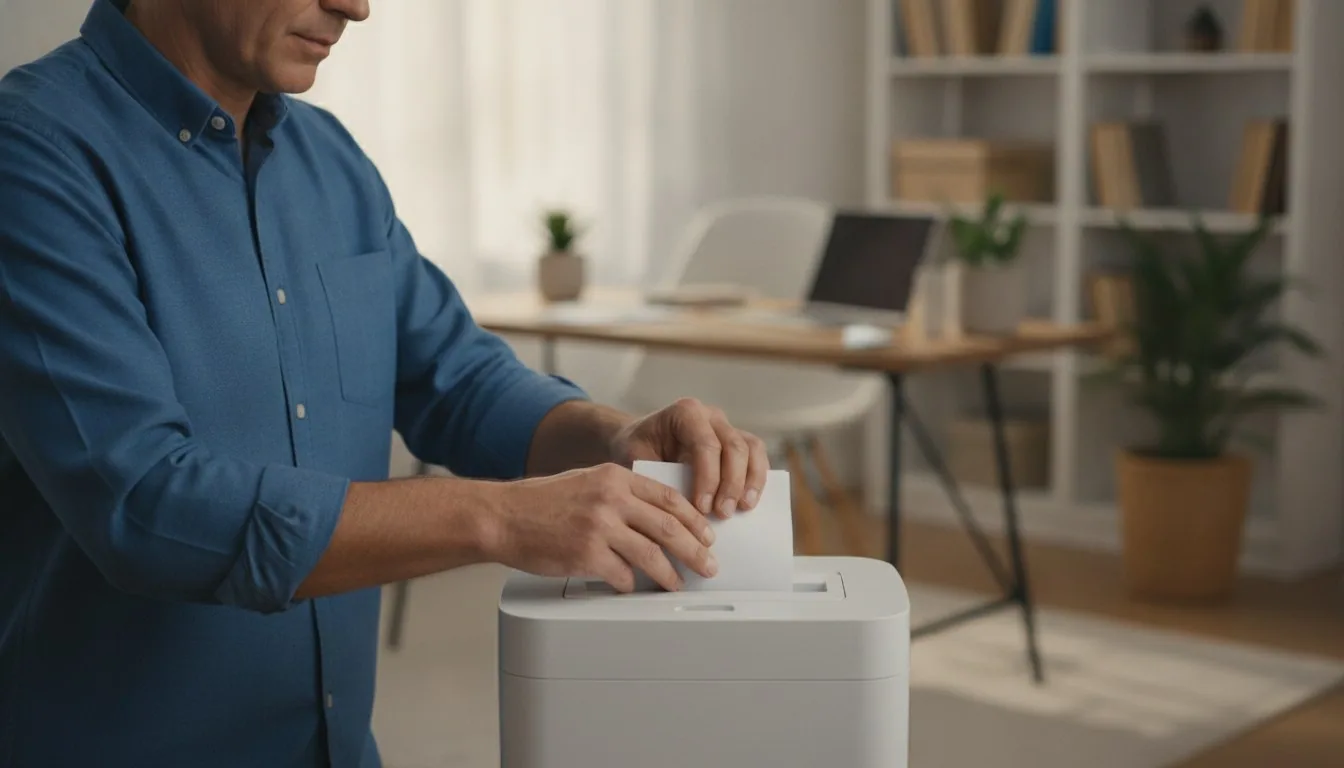
Shredder marketing loves to make micro-cut sound like the responsible adult choice and cross-cut sound like you're cutting corners. Really it's two settings on the same idea: how small the confetti gets, and how much that actually matters for the specific pile of paper on your desk. Most of what people shred at home never needed the finer setting in the first place.
Cross cut vs micro cut shredder comes down to particle size: cross-cut slices paper into confetti rectangles rated P-4 on most models we checked, while micro-cut cuts it finer, sometimes reaching P-5, for documents that need a wider security margin, like tax forms or medical records.
| Spec | Cross-cut | Micro-cut |
|---|---|---|
| Particle size (models we compared) | About 0.16-0.2 x 0.7-1.4 in (4-5 x 18-35 mm) confetti rectangles | About 0.16 x 0.47 in down to 5/64 x 15/32 in (2-4 x 12 mm) |
| Typical security rating | P-4 on every cross-cut model in our data | P-4 on most models, P-5 on the highest-security unit |
| Continuous run time (feed range) | 3 to 6 minutes on compact units, up to 60 minutes on the flagship auto-feed model | Similar spread; the flagship 200-sheet auto-feed unit is rated for 60 minutes nonstop |
| Bin capacity range (models we compared) | About 2.4 to 8.1 gallons | About 3.4 to 8.5 gallons |
| Recycled-paper strength (Scientific Reports, 2021) | Larger pieces sit closer to reference-paper tensile strength after recycling | Finer confetti trends toward the sub-25 mm² range linked to weaker recycled fiber |
| Best suited for | Everyday mail, bills, and routine household paperwork | Tax records, medical files, and documents with SSNs or account numbers |
Cross cut vs micro cut shredder: the core difference
Cross-cut slices paper into confetti rectangles; micro-cut repeats the same two-blade idea but at a much finer scale, producing smaller, more numerous pieces from the same sheet.
Shopping for a specific model? See the best paper shredder we tested — 10 models compared on the specs that decide it.
Cross-cut and micro-cut shredders both make two cuts per pass instead of one, which is what separates either of them from an old-school strip-cut machine. The difference between the two is how fine that second cut gets. Among the models we pulled specs for, an Amazon Basics 8-sheet cross-cut unit turns a page into pieces around 0.2 by 0.7 inches (5 by 18 mm), rated P-4. A VidaTeco 6-sheet cross-cut model in the same lineup lands close to that, about 0.16 by 1.26 inches (4 by 32 mm), also P-4. Micro-cut pushes further: a VidaTeco 14-sheet micro-cut model cuts down to roughly 0.16 by 0.47 inches (4 by 12 mm), and the Aurora Commercial Grade 200-Sheet Auto Feed unit goes finer still, to about 5/64 by 15/32 inches (2 by 12 mm) at security level P-5.
The cross cut vs micro cut shredder question really comes down to that particle math. Smaller confetti means more individual pieces per page, and more pieces means a lot more work for anyone trying to tape a document back together. Cross-cut already clears a meaningful security bar for household paperwork. Micro-cut clears a higher one, mostly by shrinking that same rectangle further rather than by using some fundamentally different cutting mechanism. It's the same idea, tuned tighter.
Security ratings: what P-4 and P-5 actually promise
Most cross-cut models we found carry a P-4 rating; the highest-security micro-cut unit in our data steps up to P-5, the tier built for confetti too fine to hand-reassemble.
Security levels for shredders run on a lettered scale, and a cross cut vs micro cut shredder comparison on spec sheets usually settles at that rating rather than the marketing name. Among the models in our data, cross-cut clustered at P-4 across the board - the Bonsaii, Amazon Basics, VidaTeco and Woolsche units we checked all list P-4. Micro-cut mostly matches that same P-4 floor, with one standout: the Aurora Commercial Grade 200-Sheet Auto Feed unit is rated P-5, the tier built around confetti small enough that hand reassembly stops being realistic. Run a cross cut shredder vs micro cut comparison against that Aurora listing and the gap is obvious: its own listing advertises particles shredded '10X smaller' than a standard cross-cut pass, and it runs continuously for up to 60 minutes on its auto-feed setting.
A 2021 peer-reviewed study in Scientific Reports, indexed by the National Library of Medicine, found that shredding up to DIN 66399 class P-6 kept the tensile strength of the resulting recycled paper close to unshredded reference sheets. Strength dropped sharply once particle area fell under about 25 square millimeters. That threshold sits right around where high-security micro-cut output lands, which matters more for what happens after shredding than it does for security itself.
Which one actually keeps your documents safe
For routine bills and junk mail, cross-cut already blocks casual reassembly; micro-cut is worth the extra step only for paperwork like tax returns, medical records, or anything with a Social Security number.
Set next to a strip-cut machine, the cross cut shredder vs strip cut gap is not close. Strip-cut leaves long ribbons of text that are straightforward to line back up by hand, or with a jigsaw-puzzle amount of patience, which is exactly why P-4 cross-cut became the household default years ago. For routine mail, expired statements, and everyday clutter, that P-4 baseline already blocks the casual, opportunistic reassembly that most home shredding is guarding against. Nobody is running a document forensics lab out of a stolen recycling bag.
Micro-cut earns its keep on a narrower set of paper: tax returns, medical records, anything carrying a Social Security number or full account numbers. A shop listing for one paper shredder micro cut model promises particles roughly ten times smaller than a standard cross-cut pass - that's a genuine security jump, not just a bigger number on the box. In our data, the higher-rated models skew toward listings tagged for premium or business buyers rather than casual home use. If you're not sure which bucket a given document falls into, the honest answer is that cross-cut handles most of what lands in a home shredder, and micro-cut is for the handful of documents you'd actually mind someone reading.
What happens to the shreds afterward
Both cut types can go in a recycling bin as mixed-grade paper per EPA guidance, but very fine micro-cut confetti sits closer to the particle size a 2021 study found weakens the resulting recycled sheet.
The cross cut vs micro cut shredder decision doesn't change one fact from the U.S. Environmental Protection Agency: shredded paper isn't its own paper grade, but it can be recycled, usually as mixed paper, as long as it meets a facility's size and contamination limits. That's true for both cut types in principle. In practice, the Scientific Reports study cited above found that fiber damage climbs as particles shrink - samples cut down to roughly 1 square millimeter showed about 52 percent broken fiber content and a tensile force at break of 47.7 Nm/g, compared with 74.6 Nm/g for unshredded reference paper and 72.6 Nm/g at the 25 square millimeter mark.
None of that makes micro-cut paper unrecyclable - it means the fiber is shorter and the resulting sheet is weaker, which is a papermaking quality problem more than a hard block on your curbside bin. What matters more locally is contamination: loose shredded paper of either cut clings to glass and plastic in single-stream bins and can gum up sorting equipment. Bagging shreds before they go out, and checking whether your hauler wants paper shreds separated at all, solves more of the real-world mess than picking one cut type over the other.
Picking between the two for your desk
Buy cross-cut for everyday household shredding, and step up to micro-cut only when the paperwork itself is high-risk - our two model guides break down specific units in each category.
If you're still weighing cross cut vs micro cut shredder for your own desk, let the paperwork decide rather than the spec sheet. Buy cross-cut for the bulk of what actually goes through a home shredder: junk mail, old bills, expired coupons, the stack that just needs to stop being legible. Our cross-cut paper shredder guide compares models across capacity, bin size, and run time if you want the P-4 baseline without paying for security you won't use. Step up to micro-cut specifically for tax season, medical paperwork, or anything with a full account or Social Security number attached, where the extra P-5 headroom is worth the trade-off in recycling-stream fiber quality. Our micro-cut paper shredder guide covers the models built for that tighter cut, including the auto-feed unit in our data rated for a full hour of continuous shredding.
Cross-cut is the sensible default for household mail and routine paperwork - it already clears the security bar that matters for casual reassembly, and its larger pieces hold up slightly better once they hit a recycling bin. Micro-cut is worth the step up specifically for tax records, medical files, and anything carrying a Social Security number, where the extra security tier outweighs the recycling trade-off. Neither is the objectively better shredder; they're built for different levels of risk.
Frequently asked questions
Is micro cut better than cross cut?
What is the difference between strip cut, cross cut, and micro cut?
What security rating do I actually need for tax documents or medical records?
Can shredded paper still be recycled?
Do micro-cut shredders need more maintenance than cross-cut models?
Is a cross cut vs micro cut shredder decision overkill for everyday mail?
Sources & references
- Paper Grades and Collection — U.S. Environmental Protection Agency (EPA)
- Impact of shredding degree on papermaking potential of recycled waste — Scientific Reports (Nature), via PMC/National Library of Medicine