Home Portable Generators (2026)

Home backup power splits into two camps, and this list of ten makes the divide obvious: battery-based power stations that recharge from the wall or solar, and gas or dual-fuel inverter units that keep running as long as you feed them. The right choice hinges on whether you want silent, fume-free indoor operation or raw wattage to ride out a longer outage. We sorted the field so the trade-offs surface fast.
Picking a generator for the house is really a question of fuel and runtime. Battery power stations like the Jackery and Bluetti models run silent, throw no exhaust, and recharge from a wall outlet or solar panel, which makes them safe to run indoors during a blackout. Gas and dual-fuel inverter units, such as the Erayak 4500W, PowerSmart 3800, and Oxseryn 4400, trade that convenience for the ability to keep producing power for hours on a tank, plus the higher running wattage that bigger appliances demand. Neither approach wins outright; they solve different problems. To assemble this guide we gathered the current Amazon specifications, images, and pricing for ten of the most relevant home portable generators, then scored each on capacity, output, charging flexibility, weight, and overall value. The ranking reflects how well each unit balances those factors for everyday home use rather than any single headline number. Skim the quick verdict if you are in a hurry, or read the full breakdown to match a specific model to your power needs.
The short version: The Jackery Solar Generator 1000 v2 earns our top spot among the ten home generators we compared, pairing a 1,070Wh LiFePO4 battery with 1,500W AC output and a one-hour emergency recharge through the Jackery App. For shoppers watching the budget, the EnginStar Portable Power Station 300W 296Wh Battery Bank is the value standout, an ETL-certified unit weighing only 6.5 lbs with two 110V pure sine wave outlets.
- The Jackery Solar Generator 1000 v2 ranks first overall, combining a 1,070Wh LiFePO4 battery, 1,500W AC output with a 3,000W surge, and a one-hour emergency recharge via the Jackery App.
- The EnginStar 300W 296Wh station is our value pick: ETL-certified, around 6.5 lbs, with two 110V pure sine wave outlets and a backup mode listed for Cpap use.
- The lineup splits between silent battery power stations (Jackery, Bluetti, EnginStar) and gas or dual-fuel inverter units (erayak, PowerSmart, Oxseryn) built for longer-running output.
- Capacity ranges widely, from the Bluetti Elite 30 V2's 288Wh to the Jackery HomePower 3600 Plus at 3,584Wh, expandable up to 21kWh.
- For sensitive electronics, several models cite fast UPS switchover and pure sine wave output, including the Bluetti Elite 100 V2 (10ms UPS) and the Jackery HomePower 3000 (UL-certified UPS).
Our Top 3 Picks

- 1,500W AC output with a 3,000W surge peak
- 0-to-100% emergency charge in one hour via the app
- LFP battery rated to keep over 70% capacity after 4,000 charges
- Two Usb-c, one Usb-a, a DC car port, and three pure sine wave AC ports
- Ships with a 200W solar panel for off-grid charging

- 1,070Wh LiFePO4 battery with 1,500W AC output and 3,000W surge
- 0-to-100% emergency charge in one hour via the Jackery App
- LFP cells rated for over 70% capacity after 4,000 charges
- Three pure sine wave AC ports plus Usb-c, Usb-a, and DC car output

- 4,500 peak / 3,500 running watts on gasoline
- Ultra-quiet 60.5 dB(A) operation
- 55.12 lbs for a gas inverter generator
- 30A TT-30R RV outlet plus two 120V AC outlets
- Parallel-ready to double output with a second unit
Full Comparison — All 10 Portable Generators
| Image | Product | Features | Price |
|---|---|---|---|
Editor's Choice |
| Check Price on Amazon Read Full Review | |
Best Value |
| Check Price on Amazon Read Full Review | |
Premium Pick |
| Check Price on Amazon Read Full Review | |
 |
| Check Price on Amazon Read Full Review | |
 |
| Check Price on Amazon Read Full Review | |
 |
| Check Price on Amazon Read Full Review | |
 |
| Check Price on Amazon Read Full Review | |
 |
| Check Price on Amazon Read Full Review | |
 |
| Check Price on Amazon Read Full Review | |
 |
| Check Price on Amazon Read Full Review |
How They Compare
Top picks — strengths at a glance
Brands compared
All 10, Reviewed
1 Jackery Solar Generator 1000 v2
The Jackery Solar Generator 1000 v2 earns the top ranking by covering the most bases for indoor home backup. Its 1,070Wh LiFePO4 battery and 1,500W AC output (3,000W surge) handle fridges, AC units, and electric pots, and the emergency-charge feature refills it from 0 to 100% in one hour through the Jackery App. The bundled 200W solar panel adds an off-grid recharge path that the gas units here can't match.
- 1,500W AC output with a 3,000W surge peak
- 0-to-100% emergency charge in one hour via the app
- LFP battery rated to keep over 70% capacity after 4,000 charges
- Two Usb-c, one Usb-a, a DC car port, and three pure sine wave AC ports
- Heavier than the compact stations like the 9.4 lb Bluetti Elite 30 V2
2 Jackery Explorer 1000 v2 Portable Power Station
The Jackery Explorer 1000 v2 is the solar generator's sibling without the included panel (which is optional here), and it lands at #2 on near-identical specs. You get the 1,070Wh LiFePO4 battery, 1,500W AC output with a 3,000W surge, and the same one-hour emergency recharge. For a household that already owns solar panels or doesn't need them, it's the more efficient way into Jackery's platform.
- 1,070Wh LiFePO4 battery with 1,500W AC output and 3,000W surge
- 0-to-100% emergency charge in one hour via the Jackery App
- LFP cells rated for over 70% capacity after 4,000 charges
- Three pure sine wave AC ports plus Usb-c, Usb-a, and DC car output
- Solar panel is optional rather than included, unlike the top-ranked 1000 v2
3 Erayak 4500W Portable Inverter Generator
When an outage stretches past what a battery can cover, the Erayak 4500W keeps producing as long as you have gasoline. It delivers 3,500W running and 4,500W peak watts at a relatively quiet 60.5 dB(A), with a TT-30R outlet for RV power and the option to link a second unit for double the output. At 55.12 lbs it stays manageable for a gas generator.
- 4,500 peak / 3,500 running watts on gasoline
- Ultra-quiet 60.5 dB(A) operation
- 55.12 lbs for a gas inverter generator
- 30A TT-30R RV outlet plus two 120V AC outlets
- Runs on gasoline, so it must be used outdoors away from living spaces
- Parallel kit for linking two units is sold separately
4 Bluetti Elite 30 V2 Portable Power Station 600W
The Bluetti Elite 30 V2 is the easiest unit here to grab and go at 9.4 lbs, yet its 288Wh battery delivers a full 600W continuous (1,500W surge via Power Lifting). The 10ms UPS makes it a quiet desk-side safety net during winter storms, and BLUETTI's UltraCell tech and smart cooling are cited to cut power consumption by 50%. Eight charging modes, including a 380W fast wall charge, round it out.
- Only 9.4 lbs for true grab-and-go portability
- 600W continuous with a 1,500W surge via Power Lifting
- 10ms UPS keeps devices running through outages
- Eight charging modes including a 380W fast wall charge
- 288Wh capacity is the smallest battery in this lineup, below even the EnginStar's 296Wh
- 600W continuous output trails the 1,500W of the Jackery 1000-series units
5 EnginStar Portable Power Station 300W 296Wh Battery Bank
Our value pick, the EnginStar Portable Power Station 300W 296Wh Battery Bank, weighs only about 6.5 lbs and measures 9 x 5.5 x 7.5 inches, making it the most pocketable backup here. Two 110V pure sine wave AC outlets keep sensitive gear like a Cpap machine running cleanly, and a built-in controller lets it recharge from any compatible 12-25V solar panel. The ETL certification and battery management system add peace of mind for a budget unit.
- Around 6.5 lbs in a compact 9 x 5.5 x 7.5 inch body
- Two 110V pure sine wave AC outlets
- ETL-certified with a battery management system
- Recharges via wall, car, or compatible 12-25V solar panel
- 296Wh capacity is near the bottom of this lineup, second only to the Bluetti Elite 30 V2's 288Wh
- Solar panel is not included
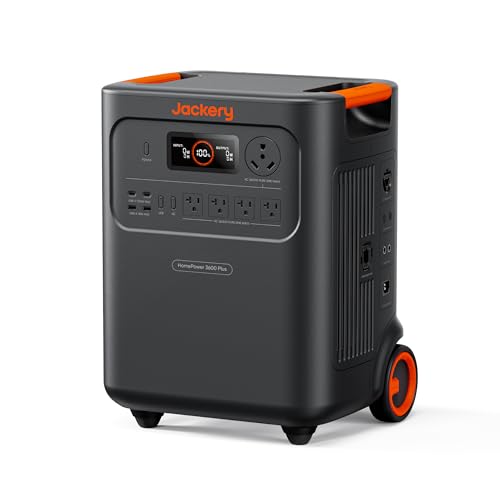
6 Jackery HomePower 3600 Plus Portable Power Station
The Jackery HomePower 3600 Plus is built for households that want real staying power, with 3,600W output (7,200W in parallel) and a 3,584Wh battery that expands up to 21kWh. Plug-and-play with the MTS means no complex installation, and hybrid Ac+dc charging refills it from 0 to 100% in about two hours. Jackery calls it the lightest 3.6kWh LFP station, though at 77.16 lbs it's still the heaviest unit here.
- 3,600W output, 7,200W in parallel
- 3,584Wh battery expandable up to 21kWh
- Hybrid Ac+dc recharge from 0-100% in about two hours
- Plug-and-play with MTS, no complex installation
- Heaviest unit here at about 77.16 lbs
- Among the most expensive picks in this guide
7 Jackery HomePower 3000 Portable Power Station
The Jackery HomePower 3000 is the premium choice for buyers who want a deep 3,072Wh reservoir paired with electronics-grade protection. Its 3,072Wh LFP battery and 3,600W output (7,200W surge) cover home essentials like a fridge, and the UL-certified UPS switches over instantly to guard sensitive gear. It refills in 1.7 hours via hybrid AC and DC, and ships with two 200W solar panels for off-grid charging.
- 3,600W output with a 7,200W surge
- 3,072Wh LFP battery for extended runtime
- UL-certified UPS with instant switchover
- Full recharge in 1.7 hours via hybrid AC and DC
- Heavier than most here at about 59.52 lbs
- Among the highest-capacity but priciest picks in this guide
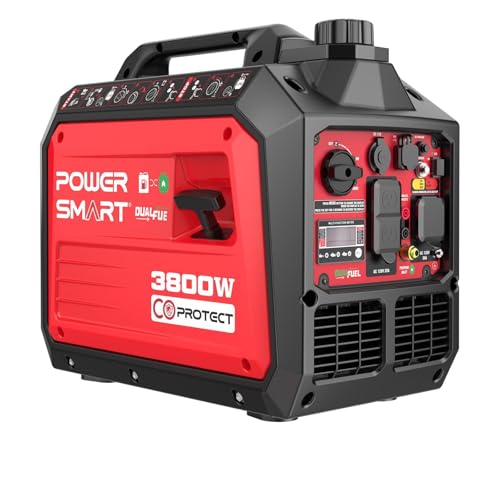
8 PowerSmart 3800 Watt Dual Fuel Inverter Generator
The PowerSmart 3800 Watt Dual Fuel Inverter Generator suits households that want fuel flexibility during an outage, switching between gasoline and propane. It puts out 3,800 starting and 3,300 running watts with up to 10 hours of runtime on gas, and the inverter produces clean power at less than 3% THD. A built-in CO sensor and a 65 dBA noise rating at 23 feet make it one of the more safety-conscious gas options here.
- Dual-fuel: 3,800 starting / 3,300 running watts on gasoline
- Up to 10 hours runtime on gas
- Pure sine wave output under 3% THD
- Built-in CO sensor for safety
- Gas/propane operation requires outdoor use only
- 1,070Wh-class battery stations recharge from solar, which this fuel-based unit cannot
9 Bluetti Elite 100 V2 Portable Power Station
The Bluetti Elite 100 V2 packs a 1,024Wh LFP battery and 1,800W rated AC output (2,700W power) across four AC ports, with a 3,600W surge. Its 10ms UPS keeps Wi-Fi routers and PCs alive through outages, and 70-minute fast charging (or up to 1,000W solar input) refills it quickly. At 25 lbs with a 35% smaller, 30% lighter design and Wi-Fi/Bluetooth app control, it's a capable mid-size home station.
- 1,024Wh battery with 1,800W AC output and 3,600W surge
- Four 1,800W AC ports
- 70-minute fast charging or up to 1,000W solar input
- 10ms UPS for routers and PCs
- 1,024Wh capacity trails the high-capacity Jackery HomePower models
- 1,800W output is lower than the gas units' running wattage for big appliances
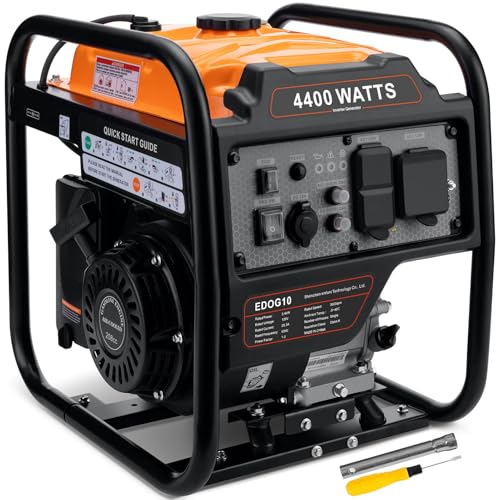
10 Oxseryn 4400-Watts Inverter Generator
The Oxseryn 4400-Watts Inverter Generator is a no-frills open-frame gas unit aimed at emergency home backup on a budget. It produces 4,400 peak and 3,400 running watts, includes a 30A RV outlet, and runs up to 14 hours at 25% load on its 2-gallon tank. Inverter technology, ECO mode, overload protection, and low-oil shutdown cover the safety basics for a 56 lb generator.
- 4,400 peak / 3,400 running watts
- 30A RV-ready outlet plus two 120V AC ports
- 14 hours runtime at 25% load on a 2-gallon tank
- ECO mode, overload protection, and low-oil shutdown
- Gas-powered open frame, so it must run outdoors
- No app control or UPS, unlike the Bluetti and Jackery battery stations
8 Things to Consider Before Buying Portable Generators
Before you compare model to model, get clear on what you actually need to keep running and for how long. The factors below separate a unit that limps through a short outage from one that genuinely backs up your home, and they map directly to the specs listed on each product.
Our Final Verdict
The Jackery Solar Generator 1000 v2 takes the top pick for its blend of a 1,070Wh LiFePO4 battery, 1,500W AC output, and one-hour emergency recharging, making it the most well-rounded indoor-safe choice here. The EnginStar Portable Power Station 300W 296Wh Battery Bank is the value play, an ETL-certified, sub-7-lb station with pure sine wave power for Cpap machines and small electronics. If you want maximum capacity, the premium Jackery HomePower 3000 Portable Power Station brings 3,600W output, a 7,200W surge, a 3,072Wh battery, and a UL-certified UPS. Just know it weighs about 59.5 lbs and sits among the priciest options. Buy the capacity and fuel type your situation calls for, not the biggest spec sheet on the page.
Frequently Asked Questions
What is the best home portable generator?
The Jackery Solar Generator 1000 v2 is our top pick of the ten home generators compared. It pairs a 1,070Wh LiFePO4 battery with 1,500W AC output and a 3,000W surge, charges from 0 to 100% in one hour with emergency charging through the Jackery App, and includes a 200W solar panel for off-grid top-ups.
Can I run a battery power station indoors during an outage?
Yes. Battery-based stations like the Jackery Explorer 1000 v2, Bluetti Elite 30 V2, and EnginStar 300W produce no exhaust and run silently, so they are safe to use inside. Gas and dual-fuel units such as the Erayak 4500W, PowerSmart 3800, and Oxseryn 4400 burn fuel and must run outdoors away from living spaces.
How much power do I need for home backup?
Tally the running watts of what you want on at once, then leave room for startup surges. For a few essentials, the Bluetti Elite 30 V2 at 600W continuous (1,500W surge) may suffice, while whole-room backup is better served by the Jackery HomePower 3000 at 3,600W output with a 7,200W surge or the PowerSmart 3800 at 3,300 running watts.
Which generator is best for sensitive electronics like a Cpap or computer?
Look for pure sine wave output and a fast UPS. The EnginStar 300W lists pure sine wave power and a Cpap backup mode, the Bluetti Elite 100 V2 cites a 10ms UPS that keeps Wi-Fi routers and PCs running through outages, and the Jackery HomePower 3000 carries a UL-certified UPS for instant switchover.
How fast can these units recharge?
Recharge speed varies by type. The Jackery Solar Generator 1000 v2 and Explorer 1000 v2 advertise a 0-to-100% emergency charge in one hour, the Bluetti Elite 100 V2 cites 70-minute fast charging, and the Jackery HomePower 3600 Plus can refill from 0 to 100% in about two hours via hybrid Ac+dc. Most battery models also accept solar input.
What is the lightest option for moving between home, RV, and campsite?
Among these picks, the EnginStar 300W is the lightest at roughly 6.5 lbs, followed by the Bluetti Elite 30 V2 at 9.4 lbs. Both stay easy to carry, though their smaller batteries mean shorter runtime than the heavier high-capacity units like the Jackery HomePower models.
Related Guides


