Best Portable Solar Generator (2026)

Solar generators have quietly split into two camps: pocketable battery banks that top off a phone in the sun, and refrigerator-sized backup units that carry a house through an outage. We sorted through ten of them so the gap between those extremes stops feeling like a guessing game. The right pick depends far more on watt-hours and output wattage than on which logo is stamped on the front.
Portable solar generators cover a surprising amount of ground. At one end sits a 48000mAh hand-held charger meant for a weekend of phones and headlamps; at the other, a 3,584Wh LFP unit that runs pumps and dryers and chains up to 21kWh. Capacity (measured in watt-hours), continuous AC wattage, and how fast each one refills are the numbers that actually separate them, and they rarely move together in a tidy line. A heavier battery is not automatically a better buy. The lightest unit here weighs 7.1 lb; the heaviest tips past 77 lb. To build this guide we gathered current Amazon specifications, images, and Picks land where their numbers earn them, not where a brand's reputation suggests they should. The quick verdict is below if you're in a hurry; the per-model breakdowns dig into the specs that decide which one belongs in your trunk, closet, or campsite.
The short version: The Jackery Solar Generator 1000 v2 is our top overall choice, pairing a 1,070Wh LiFePO4 battery with 1,500W AC output and a one-hour emergency recharge through the Jackery App. For the smallest outlay, the Soaraise Solar Charger Power Bank is the best value, a 48000mAh pack with four built-in solar panels and wireless charging.
- Best overall: the Jackery Solar Generator 1000 v2, with 1,070Wh, 1,500W AC output, and a one-hour emergency recharge.
- Best value: the Soaraise Solar Charger Power Bank, a 48000mAh four-panel pack with wireless charging and a built-in flashlight.
- Premium home backup: the Jackery HomePower 3000 Portable Power Station offers 3,072Wh and 3600W output with a 7200W surge.
- Capacity climbs from the compact 288Wh Bluetti Elite 30 V2 and 288.6Wh Grecell 330W up to the 3584Wh Jackery HomePower 3600 Plus, which expands to 21kWh.
- Weight swings widely, from the 7.1 lb Jackery Explorer 300 to the roughly 77 lb HomePower 3600 Plus, so portability needs deciding up front.
Our Top 3 Picks

- 1,500W AC output with a 3,000W surge peak
- 0-to-100% emergency charge in one hour
- LFP battery holds over 70% after 4,000 charges
- Two Usb-c, one Usb-a, DC car port, three AC outlets
- Comes with a 200W solar panel
- 3600W output, 7200W in parallel for heavy loads
- 3584Wh battery expandable up to 21kWh
- 0-100% recharge in about two hours via hybrid Ac+dc
- Plug-and-play with MTS, no complex install
- Four charging options

- 2042Wh LiFePo4 battery with 2200W output
- Ships with two 200W solar panels
- Station is 41% lighter and 34% smaller than conventional 2kWh units
- 0-to-80% in just 66 minutes via AC
- 20ms switchover for uninterrupted backup
Full Comparison — All 10 Portable Solar Generator
| Image | Product | Features | Price |
|---|---|---|---|
Editor's Choice |
| Check Price on Amazon Read Full Review | |
Best Value |
| Check Price on Amazon Read Full Review | |
Premium Pick |
| Check Price on Amazon Read Full Review | |
 |
| Check Price on Amazon Read Full Review | |
 |
| Check Price on Amazon Read Full Review | |
 |
| Check Price on Amazon Read Full Review | |
 |
| Check Price on Amazon Read Full Review | |
 |
| Check Price on Amazon Read Full Review | |
 |
| Check Price on Amazon Read Full Review | |
 |
| Check Price on Amazon Read Full Review |
How They Compare
Top picks — strengths at a glance
Brands compared
All 10, Reviewed
1 Jackery Solar Generator 1000 v2
This is the unit most buyers should default to. A 1,070Wh LiFePO4 battery feeds 1,500W of AC output with a 3,000W surge peak, enough for AC units, fridges, and electric pots, and the standout trick is a 0-to-100% emergency charge in a single hour through the Jackery App. Bundled with a 200W solar panel, it earns the #1 slot by balancing real output, fast refills, and a 23.8 lb body you can still move.
- 1,500W AC output with a 3,000W surge peak
- 0-to-100% emergency charge in one hour
- LFP battery holds over 70% after 4,000 charges
- Two Usb-c, one Usb-a, DC car port, three AC outlets
- At 1,070Wh it stores less than the 3,000Wh-plus home-backup units here
- 200W panel is a single sheet, where the Explorer 2000 v2 ships two
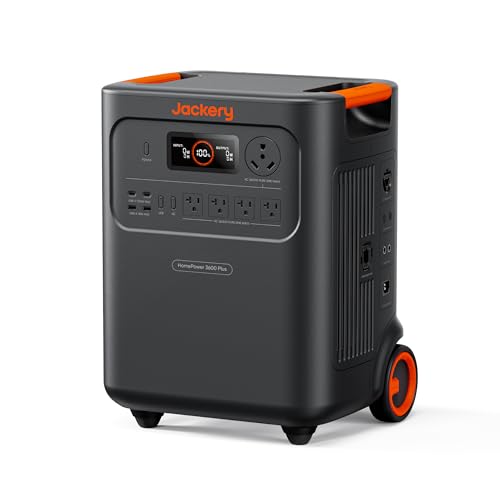
2 Jackery HomePower 3600 Plus Portable Power Station
When the goal is keeping a household running, raw capacity rules, and this one brings 3584Wh with expansion up to 21kWh. It pushes 3600W (7200W in parallel) to handle pumps, heaters, and dryers, refills 0-100% in roughly two hours via hybrid Ac+dc, and Jackery bills it as the lightest 3.6kWh LFP station despite its 77.16 lb heft. The plug-and-play MTS pairing means no electrician for basic home use.
- 3600W output, 7200W in parallel for heavy loads
- 3584Wh battery expandable up to 21kWh
- 0-100% recharge in about two hours via hybrid Ac+dc
- Plug-and-play with MTS, no complex install
- Heaviest unit here at about 77.16 lb
- Solar panel is optional, not included in the box
3 Jackery Explorer 2000 v2 Portable Power Station
Sitting between the 1000 v2 and the big home-backup units, the Explorer 2000 v2 pairs a 2042Wh LiFePo4 battery with 2200W of solar-generator output and two 200W panels in the box. Jackery says the 39.5 lb power station is 41% lighter and 34% smaller than conventional 2kWh LiFePo4 stations, and a 20ms switchover plus 100W Usb-c PD make it credible for both home backup and camping.
- 2042Wh LiFePo4 battery with 2200W output
- Ships with two 200W solar panels
- Station is 41% lighter and 34% smaller than conventional 2kWh units
- 0-to-80% in just 66 minutes via AC
- Listed shipping weight of 66.8 lb makes it a two-hand lift
- 20ms switchover trails the 10ms-class UPS on the Bluetti Elite 30 V2
4 Soaraise Solar Charger Power Bank
For topping off phones and small devices on the move, this 48000mAh charger is the value answer. Four solar panels charge it up to five times faster than single-panel rivals, three ports plus four built-in cables cover most gadgets, and a wireless pad and flashlight round it out. The upgraded 5V/3A Usb-c port pushes an iPhone from 15% to 60% in about 30 minutes. It's a pack, not a station, and the budget tier reflects that.
- 48000mAh lithium-polymer capacity
- Four solar panels charge up to 5x faster than single-panel chargers
- Three ports plus four built-in charging cables
- Wireless charging pad and built-in flashlight
- Lithium-polymer cells, not the LiFePO4 used by the larger picks
- No AC outlet, so it can't run appliances like the power-station units
5 Bluetti Elite 30 V2 Portable Power Station 600W
The lightest true power station on the list at 9.4 lb, the Elite 30 V2 squeezes a 288Wh LiFePO4 battery into a grab-anything package. It rates 600W continuous with a 1500W power-lifting surge, claims a 50% cut in power consumption from its UltraCell tech and smart cooling, and refills fast at up to 380W on the wall across eight charging modes. A 10ms UPS makes it a tidy desk-side safety net.
- Only 9.4 lb for true station-class portability
- 600W continuous with a 1500W surge
- UltraCell tech cuts power consumption by 50%
- Eight charging modes with 380W fast wall charge
- 288Wh capacity is among the smallest stations here
- No notable drawbacks in the listed feature data
6 Jackery HomePower 3000 Portable Power Station
Our premium choice for outage readiness packs a 3072Wh LFP battery behind 3600W output and a 7200W surge, sized for home essentials like a fridge. A UL-certified UPS handles the switchover, ChargeShield 2.0 adds AI-driven charge management, and it refills in 1.7 hours via hybrid AC and DC. Two 200W solar panels ship in the box, making it ready to go off-grid out of the carton.
- 3072Wh LFP battery with 3600W output
- 7200W surge for demanding startups
- UL-certified UPS with fast switchover
- Full recharge in 1.7 hours via hybrid AC and DC
- Premium-tier pricing among the highest here
- At about 59.52 lb it's a stationary backup, not a carry unit
7 Blavor Portable Power Station 1600W
BLAVOR's pitch is self-sufficiency: a built-in foldable 40W solar panel means it can sip sunlight without a separate accessory. The 1024Wh LiFePO4 battery feeds 1600W rated output (3200W surge) that the brand says covers 90% of household appliances, and the cells are rated past 3,500 cycles for over a decade of daily use. Four charging methods, an LCD display, and a 100W Usb-c fast charge fill out a versatile mid-tier package.
- Built-in foldable 40W solar panel
- 1024Wh LiFePO4 battery, 1600W output with 3200W surge
- Cells rated past 3,500 cycles, 10-year lifespan
- Four charging methods plus an LCD display
- 1024Wh trails the 2kWh-plus stations elsewhere in this guide
- Built-in panel is only 40W, slower than the 200W bundled panels elsewhere
8 Grecell Portable Power Station 330W
Built for electronics rather than appliances, the Grecell 330W carries a 288.6Wh battery and 330W output (600W surge) of pure sine wave power for laptops, tablets, phones, fans, Cpap machines, and projectors. Its calling card is port count: eight outputs let you feed eight devices at once, including a Usb-c PD 60W and a built-in Mppt controller for efficient solar charging. A quality-focused battery management system rounds out the safety story.
- 288.6Wh battery, 330W output with 600W surge
- Pure sine wave AC for sensitive electronics
- Eight ports to charge eight devices at once
- Usb-c PD 60W and Usb-a QC 18W fast charging
- 330W output suits electronics, not appliances like the home-backup units
- 288.6Wh capacity sits near the bottom of the pack here
9 Jackery Portable Power Station Explorer 300
When portability trumps capacity, the Explorer 300 is the pick. It crams a 292Wh LiFePO4 battery into a 7.1 lb body Jackery calls 17% lighter than the industry average, with two AC outlets, a 100W Usb-c PD port, two Usb-a ports, and a 120W car port. The LiFePO4 chemistry survives over 4,000 cycles before dropping to 70% capacity, and it pairs with Jackery panels (sold separately) for off-grid topping up.
- Just 7.1 lb, about 17% lighter than the industry average
- 292Wh LiFePO4 battery
- Two AC outlets, 100W Usb-c PD, two Usb-a, 120W car port
- Over 4,000 charge cycles to 70% capacity
- Solar panel is optional, not included
- 292Wh capacity limits it to small devices, not appliances
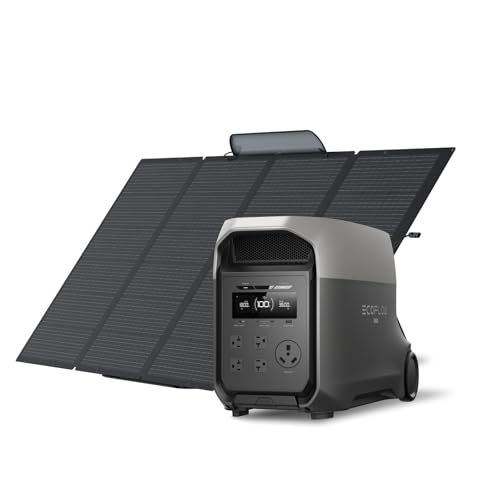
10 EF Ecoflow Delta 3 Ultra Portable Power Station
The Delta 3 Ultra brings EcoFlow into the home-backup tier with a 3072Wh LiFePO4 battery, 3600W continuous output, and a 7200W surge built to handle heavy loads. A sub-10ms UPS keeps devices alive through a grid drop, four charging methods keep it flexible, and it ships with a 400W solar panel, the largest bundled panel here. Quiet operation makes it livable indoors during long runs.
- 3072Wh LiFePO4 battery, 3600W continuous output
- 7200W surge for demanding loads
- Sub-10ms UPS for uninterrupted backup
- Quiet operation for indoor use
- Premium-tier pricing among the highest here
- A 3kWh-class unit built as stationary home backup, not a carry-along
8 Things to Consider Before Buying Portable Solar Generator
Start with the job. A device that has to keep a fridge alive during a blackout asks for very different specs than one charging a drone battery on a trail. Read capacity and continuous output first, then weigh recharge speed and portability against the value tier; our ranking already balances those trade-offs so a higher slot signals a stronger overall fit for the money.
Our Final Verdict
The Jackery Solar Generator 1000 v2 takes the top spot on the strength of its 1,070Wh LFP battery, 1,500W AC output, and the headline one-hour recharge. Cost-conscious shoppers should look hard at the Soaraise Solar Charger Power Bank, whose 48000mAh capacity and four-panel design cover phones, tablets, and small gear without the bulk of a power station. For a premium home-backup build, the Jackery HomePower 3000 Portable Power Station brings a 3,072Wh battery, 3600W output with a 7200W surge, and a UL-certified UPS. None of these is the right answer for everyone, which is exactly why capacity and output should lead your decision over brand loyalty.
Frequently Asked Questions
What is the best portable solar generator overall?
The Jackery Solar Generator 1000 v2 is our top pick of the ten we compared. It combines a 1,070Wh LiFePO4 battery, 1,500W AC output with a 3,000W surge peak, and a one-hour emergency recharge via the Jackery App, which is why it edges out larger and pricier units for most buyers.
Which portable solar generator is best for a tight budget?
The Soaraise Solar Charger Power Bank is the value pick. It's a 48000mAh lithium-polymer pack with four built-in solar panels, four built-in cables, wireless charging, and a flashlight, sized for phones and small devices rather than appliances, so set expectations accordingly.
How much battery capacity do I actually need?
Match watt-hours to runtime. The 288.6Wh Grecell Portable Power Station 330W suits laptops, phones, and a Cpap, while the 3,072Wh Jackery HomePower 3000 targets home essentials like a fridge. If you only need to top off devices on a trip, a high-mAh pack like the Soaraise is enough; whole-home backup calls for the 3,000Wh-plus units.
Can these run a refrigerator or larger appliances during an outage?
The higher-output models are built for it. The Jackery HomePower 3000 lists 3600W output (7200W surge) for home essentials including a fridge, and the Jackery HomePower 3600 Plus delivers 3600W (7200W in parallel) to run pumps, heaters, and dryers. Smaller units like the Grecell 330W are aimed at electronics, not big appliances, so check the rated wattage against your appliance's draw.
How fast do portable solar generators recharge?
It varies by model and method. The Jackery Solar Generator 1000 v2 claims a full 0-to-100% emergency charge in one hour, the Jackery HomePower 3000 fully recharges in 1.7 hours via hybrid AC and DC, and the Jackery HomePower 3600 Plus reaches 100% in about two hours via hybrid Ac+dc. Solar-only charging is slower and depends on sunlight and panel wattage.
Is LiFePO4 battery chemistry worth looking for?
For frequent use, yes. LiFePO4 (LFP) cells last far longer than typical lithium. The Jackery Solar Generator 1000 v2 keeps over 70% of capacity after 4,000 charges, and the Blavor Portable Power Station 1600W rates its LiFePO4 cells beyond 3,500 cycles for more than a decade of daily use. The Soaraise pack uses lithium-polymer instead, which fits its lighter phone-charging duty.
Related Guides


