Best Solar Panels (2026)
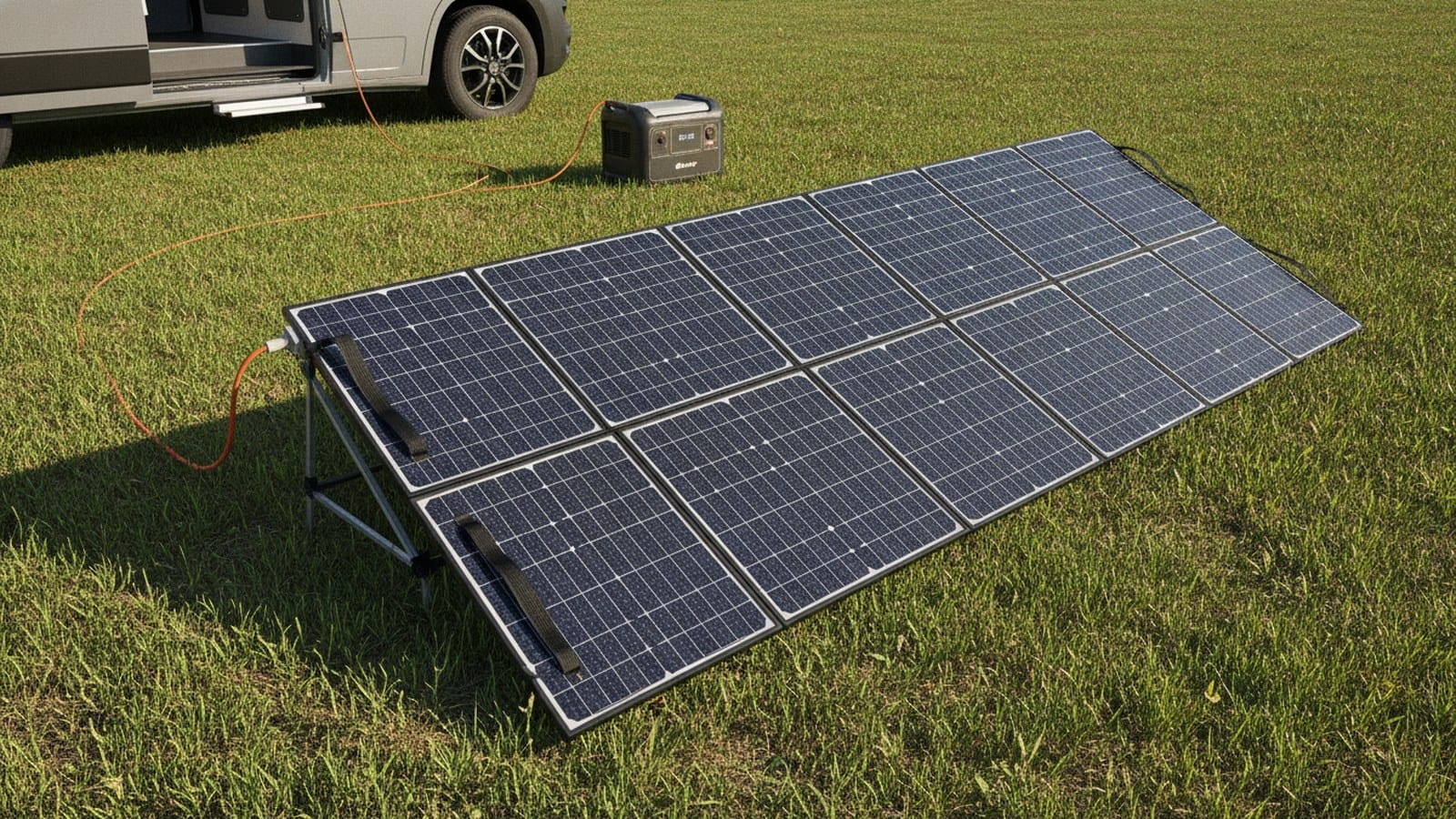
These are not roof panels. Every one of them folds up and plugs into a power station, and three items in this lineup are not panels at all.
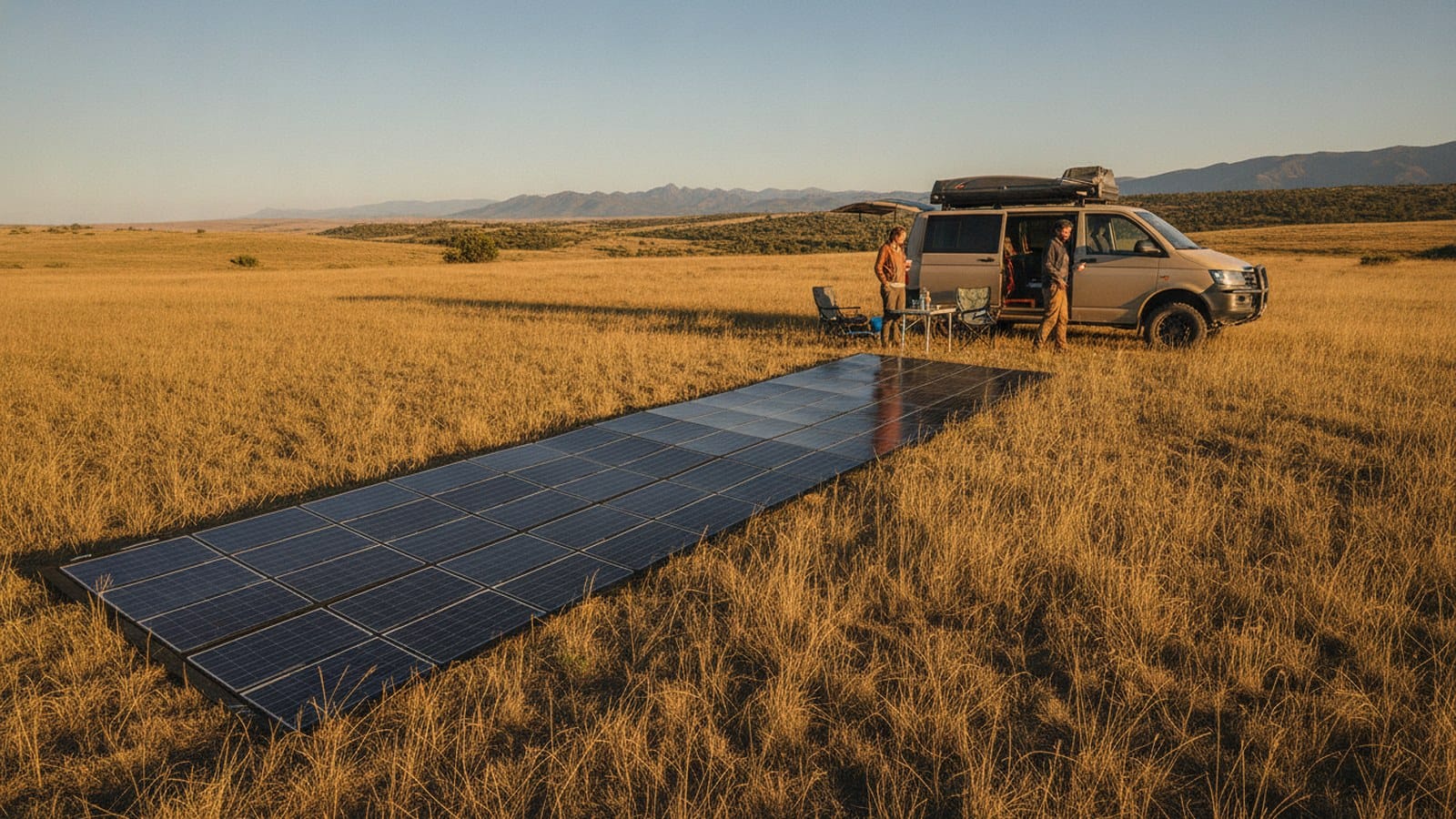
Sort out what you are shopping for first, because this category name misleads. Nothing here bolts to a house. These are folding panels meant to charge a power station on a campsite, in an RV or during an outage. Two items in the feed are power stations rather than panels, and one is a small trickle charger for a car battery. The seven real panels run from 30W to 480W. The number that decides whether any of them works for you is not the wattage.
The short version: For most people pairing a panel with a power station, the Renogy 200W is the pick at 13.89 lbs with a stated 25 percent efficiency. Check one thing before any purchase: your station's input voltage window. A panel outside that range delivers nothing, whatever its wattage says.
- Voltage compatibility decides whether a panel works at all. Below your station's window it reports 0W in full sun; above it, you risk the input.
- The Department of Energy defines Standard Test Conditions as 1000 W/m², a set spectrum and 25°C cell temperature, and states real output falls below the nameplate figure.
- Cold raises a panel's voltage, so a panel that only just fits the window in summer can exceed it on a freezing morning. Leave headroom.
- Three of the ten items here are not panels: two Jackery power stations and a 7.5W car battery maintainer.
- Bifacial gain of up to 30 percent comes from the ground, not the panel. Over dark grass there is almost nothing to reflect.
Our Top 3 Picks

- 1,500W output with a 3,000W surge runs real appliances rather than just gadgets.
- Recharges fully in about an hour from mains.
- LFP cells hold over 70 percent capacity far longer than older lithium types.
- 3,600W, or 7,200W paired, covers pumps, heaters and dryers rather than laptops.
- High-temperature ceramic membrane cells.
- Plug-and-play setup for whole-home backup.

- Fibreglass layer resists the cracking that comes from being packed badly.
- XT60 and DC7909 connectors included, covering the two most common inputs.
- N-type cells generate more from the same area than older panel types.
Full Comparison — All 10 Solar Panels
| Image | Product | Features | Price |
|---|---|---|---|
Editor's Choice |
| Check Price on Amazon Read Full Review | |
Best Value |
| Check Price on Amazon Read Full Review | |
Premium Pick |
| Check Price on Amazon Read Full Review | |
 |
| Check Price on Amazon Read Full Review | |
 |
| Check Price on Amazon Read Full Review | |
 |
| Check Price on Amazon Read Full Review | |
 |
| Check Price on Amazon Read Full Review | |
 | 8Powoxi 7.5W 12V Solar Battery Charger Trickle Maintainer Kit |
| Check Price on Amazon Read Full Review |
 |
| Check Price on Amazon Read Full Review | |
 |
| Check Price on Amazon Read Full Review |
How They Compare
Top picks — strengths at a glance
Brands compared
All 10, Reviewed
1 Jackery Solar Generator 1000 v2
The Jackery Solar Generator 1000 v2 is the battery, not the panel. It delivers 1,500W of AC output with a 3,000W surge, enough for several appliances at once, and recharges from empty to full in about an hour from mains. The cells are LFP, a lithium chemistry that keeps over 70 percent of its capacity far longer than older types. It is the thing a panel plugs into, which makes it relevant to this page but not comparable to the panels on it.
- 1,500W output with a 3,000W surge runs real appliances rather than just gadgets.
- Recharges fully in about an hour from mains.
- LFP cells hold over 70 percent capacity far longer than older lithium types.
- Not a solar panel, so it cannot be compared with the panels in this guide.
- Needs a compatible panel bought separately before it charges from the sun.
- Heavy enough that it stays where you put it.
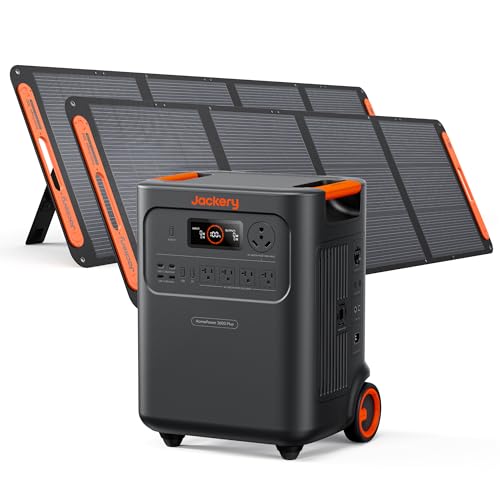
2 Jackery HomePower 3600 Plus Portable Power Station
The HomePower 3600 Plus is Jackery's bigger battery, rated at 3,600W output and 7,200W when two are run in parallel, which is enough for pumps, heaters and dryers rather than laptops and lights. The cells are described as high-temperature resistant with a ceramic membrane. Like the 1000 v2 it belongs on the battery side of a solar setup. It appears in this feed but is not a solar panel and is not ranked against them.
- 3,600W, or 7,200W paired, covers pumps, heaters and dryers rather than laptops.
- High-temperature ceramic membrane cells.
- Plug-and-play setup for whole-home backup.
- Not a solar panel and does not belong in a panel comparison.
- Sized and priced for home backup rather than camping.
- Needs panels and possibly a transfer switch to be useful off-grid.
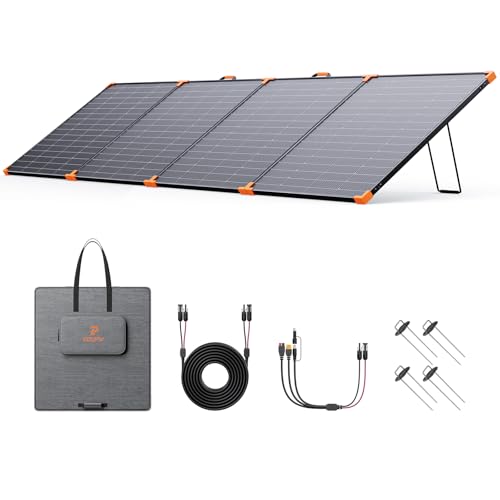
3 BougeRV 200W Portable Solar Panel
BougeRV's 200W panel uses N-type cells and adds a fibreglass layer specifically to resist cracking, which is a different priority from the sealing ratings elsewhere. Sealing keeps water out. A fibreglass layer keeps the panel intact when it is dropped or packed badly, which is closer to how portable gear actually dies. It ships with XT60 and DC7909 connectors, covering the two most common power station inputs without an extra purchase.
- Fibreglass layer resists the cracking that comes from being packed badly.
- XT60 and DC7909 connectors included, covering the two most common inputs.
- N-type cells generate more from the same area than older panel types.
- Reports of wiring pulled from the crimp at the junction box mean it is worth inspecting on arrival.
- No efficiency figure or input voltage stated anywhere.
- No DC5521 connector, unlike the Hqst three-in-one.
4 Zoupw 450W Portable Solar Panel
ZOUPW's 450W panel is the one product in this feed that talks about voltage properly. It states an open-circuit voltage aimed at power stations taking 40 to 60 volts, which is exactly the specification that decides whether a panel works. Everything else here leaves you to work it out. The build uses N-type 16BB monocrystalline cells on an ultralight fibreglass structure, and it weighs 29.5 lbs, which the listing frames as around 30 percent lighter than comparable panels.
- The only panel here that names the power station input window it is built for.
- 450W means a genuinely fast refill on a large battery.
- Fibreglass construction keeps it to 29.5 lbs at this size.
- 29.5 lbs is heavy enough that it stays in the van rather than going far on foot.
- Useless with stations outside its 40 to 60 volt window, and that mismatch shows as zero input.
- Large panels are harder to site clear of shade, and one shadowed cell costs the whole string.
5 Solupup Solar Panels 30W Portable Foldable Solar Charger
SOLUPUP's 30W foldable panel outputs through Usb-a and Usb-c rather than a barrel connector, with a smart chip that identifies the device and adjusts charging. That makes it a direct device charger, and judged as one it is fine. It is not a power station charger. At 30W it would take an impractically long time to move meaningful energy into a large battery, and the USB outputs are the wrong shape for the job anyway.
- Small and light enough to carry on foot without noticing it.
- Usb-a and Usb-c outputs charge phones directly with no adapter hunt.
- Smart chip matches output to the device.
- 30W will not meaningfully charge a power station, whatever the listing implies.
- USB-only output means no barrel connector for station input at all.
- Small panels are shaded easily, and shade costs more than its area.
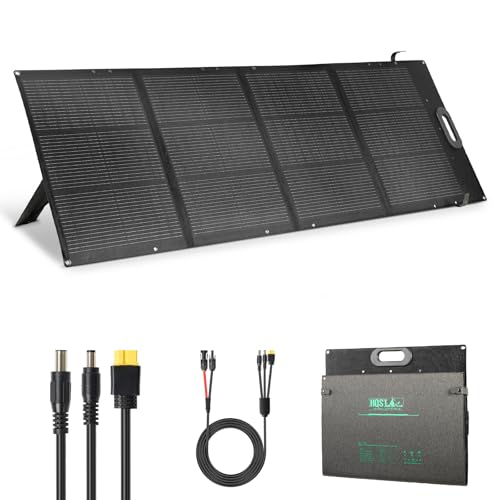
6 Hqst 200W Portable Solar Panel
Hqst states next-generation 16BB N-type cells and up to 25 percent efficiency, and says the panel runs up to 37 percent lighter than most 200W portable panels. The genuinely useful inclusion is a 4.9 foot three-in-one adapter cable covering XT60, DC7909 and DC5521. Connector mismatch is the most common reason a new panel does nothing on day one, and this removes that problem from the box rather than leaving it to you.
- Three-in-one adapter covers XT60, DC7909 and DC5521 straight out of the box.
- Noticeably lighter than most 200W panels, which shows on a long carry.
- 16BB N-type cells with efficiency at the top of this group.
- The junction box and plugs are the parts that fail first once moisture reaches them.
- The weight comparison is against an unnamed typical panel rather than a figure you can check.
- Shade tolerance is no better than any series-wired panel, so partial shadow hits it hard.
7 Zoupw 480W Bifacial Portable Solar Panel N-Type 16BB
At 480W this is the largest panel in the feed, built on N-type 16BB cells with composite materials replacing glass to cut weight. Its headline is bifacial generation, with up to 30 percent extra claimed from light reflected onto the rear face. Read that as conditional. Over snow or pale concrete the rear face has plenty of light to collect. Over dark grass it has very little. The panel cannot supply the reflection itself, so the bonus is really a property of where you set it down.
- 480W is the highest output here and refills a large station in a single good day.
- Bifacial rear face adds real output over snow or pale gravel.
- Composite construction rather than glass keeps the weight sane for the size.
- The bifacial gain depends entirely on what is underneath; over grass it nearly disappears.
- Large surface means more chance of partial shading, which costs more than its area suggests.
- No stated input window, so compatibility has to be worked out from your station's manual.
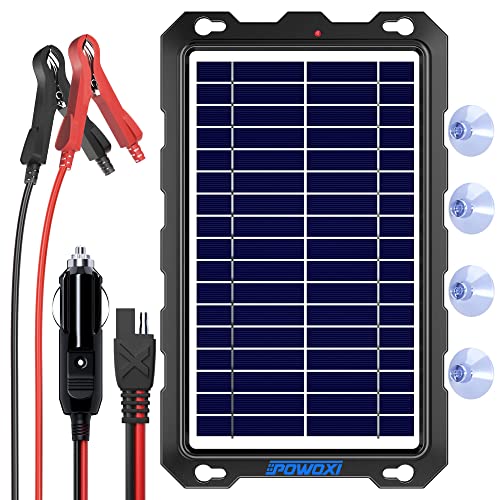
8 Powoxi 7.5W 12V Solar Battery Charger Trickle Maintainer Kit
This Powoxi unit is a 7.5W 12V trickle charger for a car, boat or mower battery. Its job is to replace the small amount of charge a parked battery loses on its own, so the vehicle still starts after a month standing. It is not a portable solar panel in the sense the rest of this page uses the term, and it will not charge a power station or run anything. Included here because it sits in the feed, and described as what it is.
- Does its actual job, which is holding a parked battery's charge through winter.
- Built-in protection stops it overcharging the battery.
- Toughened glass front survives being left on a windscreen.
- 7.5W cannot charge a power station or run anything at all.
- Not a portable solar panel in the sense of the rest of this guide.
- Needs a clear windscreen position, and any shading drops it to nothing.
9 Zoupw 220W N-Type 16BB Portable Solar Panel
ZOUPW's 220W panel states A-plus grade monocrystalline cells at 25 percent efficiency, and it is the only panel here that publishes a sealing rating. IP67 means dust-tight and able to survive brief immersion, and the Etfe lamination is the tough outer film that handles sun and rain better than cheaper coatings. That combination matters if the panel gets left out through a shower rather than packed away at the first cloud. Compatibility is still yours to check, as no voltage figure is given.
- IP67 and Etfe lamination make it the one to leave rigged on an RV.
- Sealed junction box resists the moisture ingress that kills most portable panels.
- 25 percent efficiency from A-plus monocrystalline cells.
- 220W is modest next to the 450W and 480W panels here.
- No input voltage window stated, despite the same maker publishing one on its larger panel.
- Sealing protects the box, not the connectors, which still need keeping off wet ground.
10 Renogy 200W Portable Solar Panel
Renogy states 25 percent efficiency from upgraded 16BB N-type cells, in a panel weighing 13.89 lbs with a magnetic handle. That weight is the point. It is the lightest genuinely useful panel in this feed, which is what decides whether it comes with you or stays behind. It also charges devices directly through one Usb-c Power Delivery port rated 45W and two Usb-a ports, so it is not dead weight on a trip where the power station stayed home.
- 13.89 lbs makes it the one you actually carry rather than leave behind.
- Usb-c Power Delivery and two Usb-a ports charge devices directly with no power station involved.
- 25 percent efficiency from 16BB N-type cells is at the top of what portable panels reach.
- Output drops sharply if anything shadows even one cell, so siting matters more than the rating.
- Connectors need pushing fully home; a partly seated plug takes output to nothing rather than reducing it.
- No stated IP rating, so it should be folded away rather than left out through wet weather.
11 Things to Consider Before Buying Solar Panels
Match the panel to the socket before you match it to your ambitions. Voltage compatibility decides whether you get power at all. Wattage only decides how fast. Weight decides whether you take it with you.
Our Final Verdict
The Renogy 200W is the pick for most people. It states 25 percent efficiency from N-type 16BB cells, weighs 13.89 lbs, and adds Usb-c Power Delivery at 45W with two Usb-a ports, so it can charge devices directly when the power station stays home. The Hqst 200W is the better buy if connectors worry you, because its three-in-one adapter covers XT60, DC7909 and DC5521 in the box. Take the Zoupw 450W or 480W only if you have confirmed your station accepts their voltage and you accept carrying roughly thirty pounds. The Solupup 30W is a phone charger in panel form, not a power station charger. The two Jackery units and the Powoxi trickle charger are in this feed but are not solar panels, so they are described honestly below rather than ranked against the panels.
Frequently Asked Questions
Why is my panel producing so much less than its rating?
Check for shade before anything else. Cells are wired in series, so a shadow over one cell throttles the whole panel out of proportion to its size, and the sun moves through the day. After that, suspect the connectors: a loose or corroded plug is the leading cause of portable solar failure, and it usually takes output to zero rather than reducing it.
How long will a portable panel last?
The cells outlive everything else. What fails is the junction box on the back and the connectors, where moisture works in over seasons of dew and rain and corrodes the contacts. Fold panels away when you are done, keep the plug ends off wet ground, and choose a stated IP rating if the panel will live permanently on an RV.
Do I need to check the panel when it arrives?
Yes, and it takes a minute. At least one reported failure traced to a wire pulled from its crimp or never fully seated at the factory. Push each connector fully home until it clicks, tug the cable gently at the junction box, and test the panel into your power station before you depend on it somewhere remote.
How do I know a panel will work with my power station?
Find your station's solar input range in its manual, then compare it to the panel's open-circuit voltage. The panel needs to sit inside that window with room to spare, because cold weather pushes its voltage higher. Then check the plug matches, or budget for an adapter. Wattage is the last thing to look at, not the first.
Why does my power station show 0W when the panel is in bright sun?
Usually the panel's voltage is below what the station needs to start charging. The panel is generating, but the station cannot lock onto it, so it reports nothing. This catches people with small 12-volt panels and stations that expect a higher input. It is a compatibility problem, not a faulty panel.
Will a 200W panel really give me 200 watts?
No, and it is not meant to. That figure comes from Standard Test Conditions, which the DOE defines as strong even light and a cell temperature of 25°C. Outdoors the light is usually weaker and the panel runs hotter, and both reduce output. Use the rating to compare panels against each other rather than to predict what you will get.
What are XT60 and DC7909?
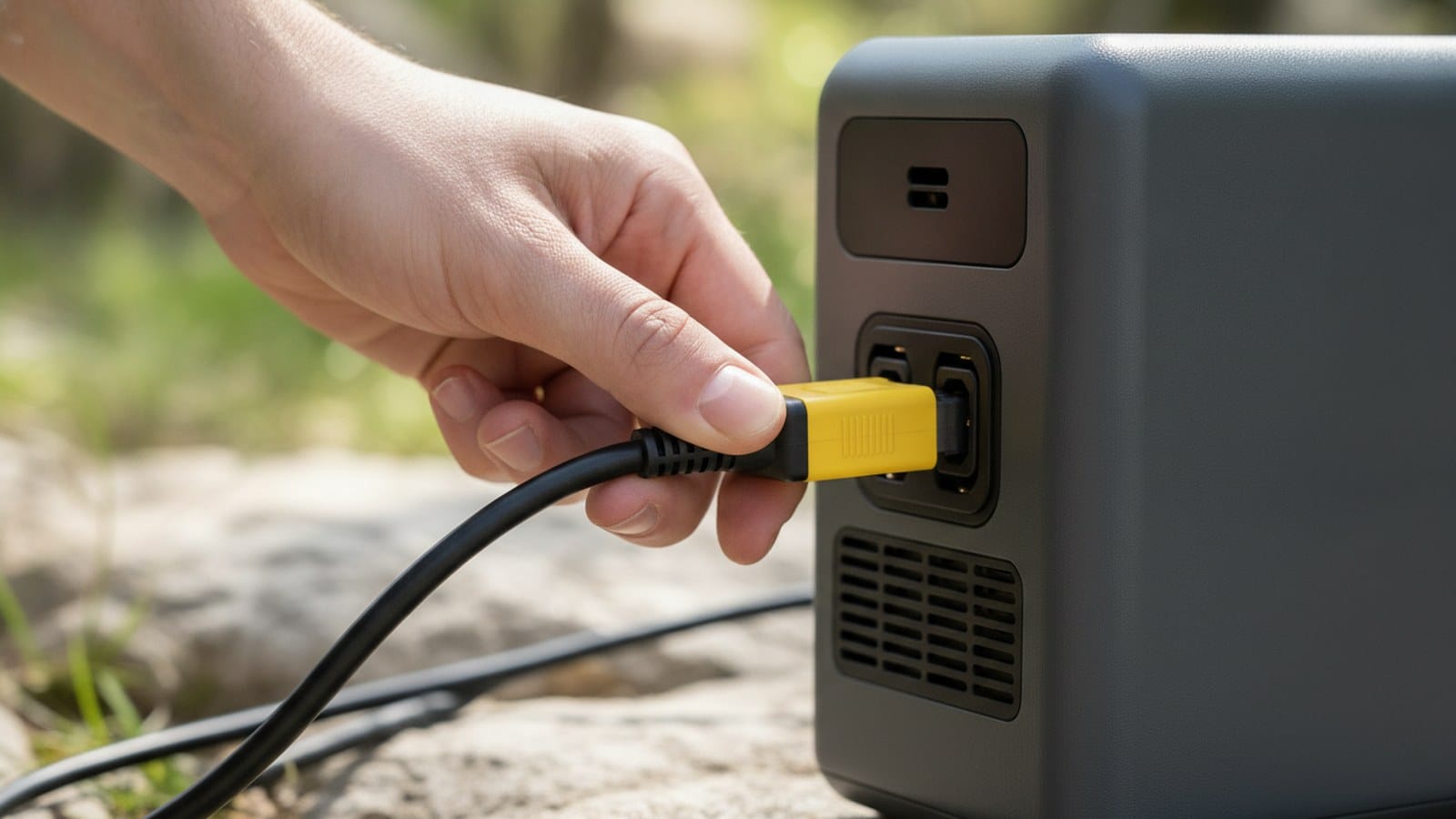
They are plug types. Portable solar mostly uses XT60, DC7909 which some listings call 8mm, and DC5521. They do not fit each other. The Hqst panel here ships a three-in-one adapter covering all three, which saves the usual scramble for a cable that fits.
Is a bifacial panel worth the extra?
Only if you can give it something bright to stand on. The rear face works from reflected light, so snow, pale gravel or light concrete deliver real gains. Grass and soil deliver very little. The claim of up to 30 percent is a best case set by your ground, not a figure the panel produces by itself.
Can I put these on my roof?
No. These are portable folding panels built to be set out, used and packed away. Rooftop solar is a permanent installation with mounting hardware, an inverter, and in most places permits and an electrician. Nothing in this guide is a substitute for that.
Related Guides


