
| Quick Facts | |
|---|---|
| True HEPA capture rate | at least 99.97% of particles at 0.3 microns (EPA/ACAAI standard) |
| Cat allergen (Fel d 1) particle size | generally under 5 micrometers in diameter |
| HEPA effect on airborne Fel d 1 (clinical trial) | dropped from 36.3 ng/m3 to 4.7 ng/m3 |
| Early asthmatic response rate after HEPA filtration | fell from 87.5% to 29.1% of exposed subjects |
| Rhinoconjunctivitis symptom reduction with HEPA purification | 52.2% reduction in a separate clinical trial |
| EPA minimum CADR for a 100 sq ft room | about 65 CFM |
| EPA minimum CADR for a 500 sq ft room | about 325 CFM |
| AHAM's two-thirds CADR rule example | a 120 sq ft room needs a smoke CADR of about 80 or higher |
Does an air purifier actually help with pet hair
Yes for the fraction still floating in the air, no for what has already landed. Pet hair, dander, and odor are three different physical problems, and an air purifier only reaches the airborne share of each.
Shopping for a specific model? See our best air purifier picks — 10 models compared on the specs that decide it.
Pet hair itself is mostly harmless once it's on the floor. A strand of fur is too big and heavy to stay airborne for long, and it isn't really what triggers a sneezing fit anyway. Dander is the actual allergen carrier: microscopic flecks of skin, plus proteins from saliva and sebaceous glands that stick to fur during grooming and then flake off into the air. Odor is neither a solid nor a particle you can trap in mesh. It's gas molecules from urine, saliva, and litter box waste, and no filter mesh, however fine, catches a gas.
That distinction matters because each one needs a different filter stage to catch it. A true HEPA filter is rated to capture at least 99.97% of particles at 0.3 microns, the size regulators consider hardest to trap, per the U.S. Environmental Protection Agency and the American College of Allergy, Asthma & Immunology (ACAAI). Pet dander runs larger than that. The cat allergen protein Fel d 1, for instance, rides on particles generally under 5 micrometers in diameter, according to research hosted by the National Institutes of Health (NIH), so a certified HEPA filter is working well within its rated range rather than straining at the edge of what it can do.
So does an air purifier help with pet hair specifically? Only the loose fluff currently drifting through the room, which a washable pre-filter is built to intercept before it reaches, and clogs, the finer HEPA layer underneath. The mat of fur already woven into the carpet or a dog bed is a vacuum's job, not the purifier's.
How do air purifiers work for pet hair and dander
A washable pre-filter screen catches loose fur and large debris first, then a true HEPA layer traps the finer dander particles riding the air behind it, the same two-stage process whether the shedding culprit is a cat or a dog.
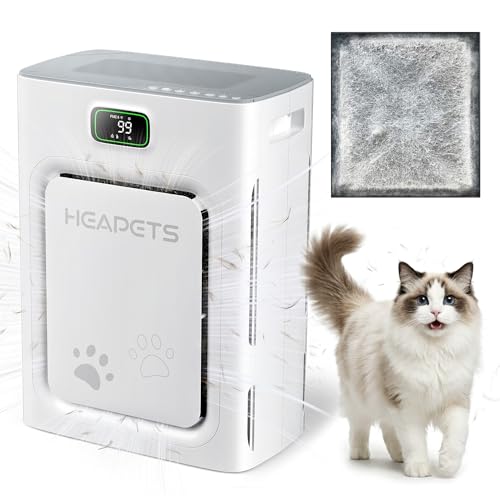
Mechanically, an air purifier that collects pet hair well leans on the same idea a vacuum uses for its pre-motor filter: a coarse screen ahead of anything delicate. The LEVOIT Vital 200S-P, for example, ships with a washable pre-filter meant to catch loose fur before it wraps around the fan or chokes the main filter, and it carries an AHAM VERIFIDE rating confirming its clean air delivery rate was independently tested rather than self-reported. Some pet-specific models push the pre-filter idea further. HEAPETS built its P358 unit around a U-shaped, dual-sided air inlet designed so shed fur doesn't stick and clog the intake the way a flat, single-sided opening tends to.
Behind that pre-filter sits the true HEPA stage doing the actual dander removal, and this is where does an air purifier help with dog hair versus does an air purifier help with cat hair turns out to be the wrong framing. The filtration physics doesn't know or care which species shed the particle. What changes the outcome is coverage: a unit rated for a small bedroom gets overwhelmed fast in an open living room with two dogs, no matter how fine its filter is.
For a side-by-side look at models built around washable pre-filters and pet-rated coverage areas, our pets air purifier comparison breaks down which units suit a single cat's bedroom versus a multi-dog household.
Does an air purifier help with pet odor and litter box smell
Only if it has a real activated-carbon stage. HEPA filters catch particles, not gas, so odor control depends on carbon volume and how close the unit sits to the source.
Odor is the one pet-related complaint a HEPA filter genuinely cannot fix by itself. Per the EPA's Guide to Air Cleaners in the Home, gaseous pollutants and odors need a portable air cleaner fitted with an activated carbon filter or similar gas-adsorbing media; a HEPA layer, however dense, is built to trap solid particles and lets odor molecules pass straight through. That's the answer behind most air purifier pet odor complaints that persist even after the visible hair and dust have cleared up: the carbon stage, not the HEPA stage, is doing that job, and thin, token carbon layers run out of adsorption capacity fast.
Litter box smell is the toughest version of this problem, since ammonia from urine keeps regenerating at the source. HEAPETS built its P339 model around a 7-stage system pairing H13 HEPA with an activated carbon layer marketed specifically at pet odor and dander, and the same brand's P358 uses what it calls a pet-formula activated carbon blend aimed at litter box and dog-smell complaints rather than a generic carbon dusting. Placement matters almost as much as the filter itself: keeping the unit a few feet from an air purifier cat litter setup, rather than jammed right against the box, keeps kicked-up litter dust from clogging the intake early while it still catches the odor plume.
If pet odor rather than allergies is the main complaint in your house, our best pet air purifier guide filters specifically for models with a meaningful carbon stage instead of a token one.
Cats, dogs, and multi-pet homes: does the species change the answer
Not much - cat and dog allergen proteins both ride on dander and saliva particles small enough to stay airborne, so the same HEPA filtration handles either, though the clinical evidence is strongest for cats.
The best data here comes from cat owners, and it's more encouraging than most marketing copy manages to be honest. In one clinical trial reviewed in NIH-hosted research, HEPA filtration cut airborne Fel d 1, the primary cat allergen, from 36.3 nanograms per cubic meter down to 4.7 nanograms per cubic meter, and the share of exposed subjects showing an early asthmatic response dropped from 87.5% to 29.1%. A second trial in the same review found a 52.2% reduction in rhinoconjunctivitis symptoms among participants using HEPA air purification. That's a measured effect, not a projected one, and it's a large part of why do air purifiers help with cat allergies has a clearer research trail than most pet-related claims in this space.
Dog allergen research is thinner on specific before-and-after numbers, but the underlying physics is the same. Can f 1, the main dog allergen protein, rides on dander and saliva particles in the same general size class as Fel d 1, and a true HEPA filter doesn't distinguish between the two. So do air purifiers help with pet dander from a dog the same way they help with a cat? Mechanically, yes. Whether you'll notice the same magnitude of relief is harder to promise without a dog-specific clinical trial to point to, and pretending that number exists would be dishonest.
Cat owners weighing options built around this specific allergen profile can start with our best air purifier for cats roundup, which favors app-controlled HEPA units sized for a typical litter box room rather than an entire house.

How long pet dander stays airborne, and why that changes what you buy
Long enough to matter - dander particles are light enough to stay suspended for extended stretches, which is why continuous runtime and correct sizing beat any single spec printed on the box.
Pet dander doesn't drop out of the air the moment a cat jumps off the couch. Because particles carrying Fel d 1 are generally under 5 micrometers and lightweight, NIH-hosted research describes them as able to remain suspended in the air for long periods, adhering readily to fabric and carpet once they finally do settle rather than simply disappearing. That persistence is also part of why the allergen keeps turning up on clothing carried out of the house, a detail the same research flags as one reason cat allergen exposure is so hard to avoid fully, even outside pet-owning homes.
Pet dander removal from air isn't a one-pass job, then. It depends on how many times per hour the unit actually cycles the room's air. The EPA's own sizing chart calls for a minimum clean air delivery rate of about 65 CFM for a 100 sq ft room, scaling up to roughly 325 CFM for a 500 sq ft room, assuming standard 8-foot ceilings. AHAM's separate two-thirds rule lands in the same neighborhood: a 120 sq ft room needs a smoke CADR of at least 80 to meet that standard. Both guidelines exist because an undersized unit is the single most common reason a pet owner buys an air purifier and still notices the same dander cloud a month later.
What an air purifier can't do for a pet home
It won't remove hair or dander already settled on furniture and floors, won't stop shedding at the source, and an ozone-generating 'ionic' unit can do more harm than good.
An air purifier only filters what's currently moving through its intake; anything that has already landed on a couch cushion, a dog bed, or the baseboards is invisible to it. The American College of Allergy, Asthma & Immunology frames filtration as one piece of a broader plan, alongside grooming pets outdoors when possible, washing pet bedding on a regular schedule, and running a HEPA-filtered vacuum over the surfaces a purifier can't reach. Skip those steps and the purifier ends up compensating for a problem it was never built to solve alone.
The other honest caveat concerns ionizing or 'ionic' air purifiers marketed for pet odor. The EPA specifically warns against devices that intentionally generate ozone as part of their cleaning process, noting that ozone itself is a lung irritant, not a great trade-off for a household already dealing with allergy-prone lungs. The agency is blunt about its own limits here too: it neither certifies nor recommends specific air-cleaner brands, so a marketing claim about ozone safety or filtration performance is worth checking against independent test data rather than taking at face value.