
| Quick Facts | |
|---|---|
| CADR-to-room ratio (general use) | at least two-thirds of the room's square footage, per AHAM |
| CADR-to-room ratio (wildfire smoke) | roughly 1:1 with the room's square footage, per AHAM |
| Ceiling height adjustment | rooms over 8 ft need a unit rated for a larger floor area, per AHAM |
| Smoke-event fan setting | run continuously on the highest setting in a sealed room, per EPA |
Where to place an air purifier: start with the room you actually use
The room where you spend the most waking or sleeping hours should get the purifier first, not the room that looks dirtiest.
Shopping for a specific model? See our air purifier buying guide — 10 models compared on the specs that decide it.
Most households only own one or two units, so the first decision is which room earns one. A bedroom usually wins, since people spend roughly a third of their day there with the door shut and the air recirculating on itself. A living room or home office is the next-best pick if that's where the household actually gathers.
The EPA's guide to portable air cleaners puts this plainly: consider placing the unit in the room you spend the most time in. Before buying or moving anything, measure the room. Multiply length by width to get the square footage, then check that number against the coverage rating printed on the box; a unit rated below the room's actual size will run at full speed constantly and still fall short. Our home air purifier picks list coverage figures for exactly this kind of matching, from compact bedroom units up to large-room models built for open floor plans. Skip the temptation to buy one oversized unit for the whole house and carry it from room to room; a closed door stops airflow completely, so a purifier running in the bedroom does nothing for the kitchen down the hall.
Give the intake and outlet real clearance
A blocked intake or outlet starves the fan no matter how strong the motor is.
Every air purifier pulls air in through one side and pushes it back out through another, and either point can get smothered by ordinary furniture. Pushed against a wall, wedged behind a curtain, or buried under a stack of laundry, the unit still runs and the display still lights up, but the numbers on the box stop meaning much.
EPA guidance on portable air cleaners is specific about this: keep air cleaners away from curtains and anything that might block airflow, and make sure the airflow itself is not obstructed. A few inches of open space on every side is a reasonable floor, more if the unit pulls air from the back or sides rather than straight through the front. Corners are the worst offenders, since two walls restrict airflow at once and the unit ends up recycling the same stagnant pocket of air instead of pulling from the room. If the purifier sits on the floor, keep it clear of thick rugs or under-bed storage that can choke a bottom-mounted intake. None of this requires guesswork: notice where the air visibly moves near the unit, and if it feels stagnant a foot away, it probably is.
Put it near the pollutant source, not just in the room
The closer the purifier sits to where particles originate, the less time they have to spread before getting pulled in.
General room placement gets you most of the way there, but the last few feet matter. A pet's favorite corner, the litter box, the stove, or a window facing a busy street each throws off far more particles than the rest of the room combined, so positioning the unit a body's length from that spot beats parking it dead center for symmetry's sake.
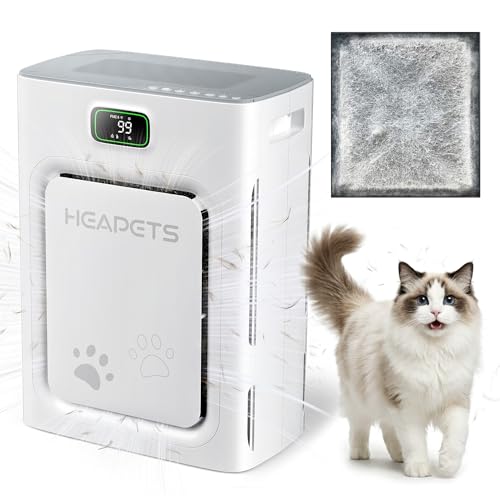
Pet hair and dander behave this way specifically: our pet air purifier roundup breaks down units built around intake shapes that resist clogging from fur, which matters more once a unit is doing double duty near a pet bed. Wildfire and cooking smoke ask for different math. AHAM, the trade group behind the CADR rating most purifiers list, recommends sizing a unit's smoke CADR to roughly two-thirds of the room's square footage for general use, but a full one-to-one ratio, CADR equal to the room's size in square feet, during active wildfire smoke. The EPA's clean-room guidance for smoke events adds a placement rule of its own: pick a room that closes off from the rest of the house, keep the door and windows shut, and run the purifier continuously on its highest setting rather than only after the smell shows up.
Bedroom and nursery placement without the extra noise
A purifier a few feet from the bed cleans just as well as one bolted to the nightstand, without the fan noise or the direct draft.
Bedroom placement carries its own trade-off: closer to the bed pulls cleaner air past your face faster, but it also puts fan noise and airflow right next to a sleeping head. The EPA's advice here is closer to common sense than a hard number: if the air cleaner causes an uncomfortable draft, redirect the airflow away from you. In practice that means a few feet of distance and pointing the outlet away from the pillow, not jamming the unit against the headboard.
Nurseries raise the stakes further, since a newborn sleeps far more hours than an adult and can't ask for the fan to run quieter. The safer layout keeps the purifier across the room from the crib, on a low setting overnight, with the same open-sided clearance that applies everywhere else. When bedroom or nursery noise is the deciding factor rather than raw coverage, our quiet air purifier picks are sorted specifically around low decibel ratings, which matters more in a room where the unit runs eight hours a night than in one that only gets used occasionally.

Placement mistakes that quietly wreck performance
Most placement mistakes are invisible day to day, and they all point back to airflow that never reaches the room.
A handful of habits undo good intentions. Setting the purifier inside a closet or cabinet to hide it from view is the single worst offender, since a closed door traps the cleaned air in a space nobody breathes. Running the unit only when a smell shows up rather than continuously also defeats the purpose; particles accumulate steadily, and a purifier switched on after the fact is playing catch-up rather than staying ahead.
Ceiling height is an easy one to miss. AHAM notes that a room with ceilings above eight feet holds more air than the square-footage math implies, so a unit rated for the floor space alone may still fall short; sizing up covers that gap. Buying one unit and rotating it between rooms sounds efficient but rarely works, since each move resets the clean-air baseline and a closed door blocks it from doing anything for the room it just left. The fix for most of this is less about the purifier itself and more about treating placement as part of the setup, not an afterthought once it's already plugged in.