| Quick Facts | |
|---|---|
| Reported max flat/curling iron temperature | up to 450°F, reached in about 5 seconds (Annals of Burns and Fire Disasters, 2019) |
| Curling-iron share of hair-tool ED injuries (1992-1996 NEISS sample) | 82,151 of 105,081 cases (78%), Academic Emergency Medicine, 2001 |
| Thermal burns among those curling-iron injuries | 97% (79,912 of 82,151 cases) |
| Hair tensile energy, virgin vs. heat-damaged fiber (lab model) | 17.15 J down to 12.42 J, Journal of Cosmetic Dermatology, 2025 |
| Hair moisture content, virgin vs. heat-damaged fiber (lab model) | 11.23% down to 10.35%, Journal of Cosmetic Dermatology, 2025 |
| AAD-recommended flat iron frequency | no more than every other day, on dry hair, low or medium heat |
So, can you curl your hair with a flat iron, and how does that work?
Yes. Wrapping a clamped section of hair around the closed edge of a flat iron and rotating it as you glide down produces a curl, using the same heat that normally presses hair flat.
Shopping for a specific model? See the best flat irons we tested — 10 models compared on the specs that decide it.
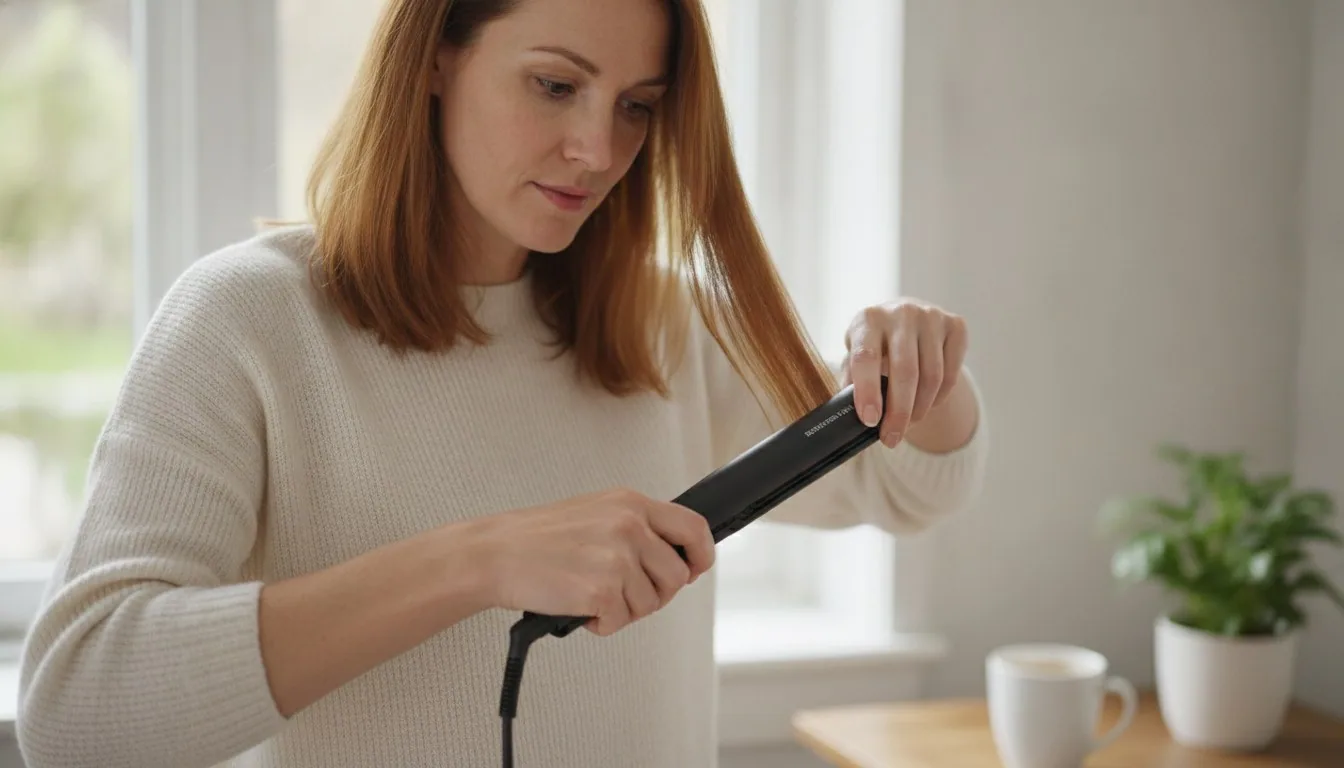
Flip a flat iron on its side and the closed plates form something close to a rounded barrel, which is the whole trick behind the technique. Clamp a section of hair near the root, twist the iron away from your face so the hair wraps around that closed edge, then glide slowly toward the ends while holding the twist. Hair takes the shape it wrapped around as it cools, the same principle a curling iron barrel uses, just with two flat surfaces standing in for a cylinder.
Straightening uses the opposite motion: clamp and pull straight down without rotating, so the plates smooth the cuticle flat instead of curving it. Whether a flat iron for straight hair or a flat iron for curly hair ends up in your bathroom drawer, it's often the exact same tool; what changes the result is whether your wrist twists as you glide. That's really the answer to can a flat iron curl hair: the plates don't care which job you ask them to do.
How to curl hair with a flat iron, section by section
Section dry hair into pieces about one to two inches wide, clamp near the root, rotate the iron a half to full turn, and glide down slowly while holding the twist until you reach the ends.
Start with hair that's fully dry. Flat irons aren't built for damp hair, and pressing water-laden strands is a fast way to hear a hiss and get nothing useful from it. A flat iron curls tutorial really comes down to three variables: section size, rotation, and glide speed. Divide hair into sections roughly one to two inches wide; wider sections won't heat evenly in the middle, and narrower ones just slow you down.
Clamp near the root rather than partway down the shaft, then rotate the iron anywhere from a quarter turn to a full 360 degrees depending on how defined you want the result. A light quarter turn with a quicker glide reads more like waving hair with a flat iron than curling it, giving loose texture rather than a ringlet, while a fuller rotation held a beat longer at the ends gives a tighter curl. Alternating direction section by section, some twisted toward your face and some away, keeps the finished look from reading as one uniform curl.
Let each section cool before you touch it again; hair sets into its new shape as it drops in temperature, and running fingers through a still-hot curl just relaxes what you spent the last several seconds building.
How hot should a flat iron be to curl fine, medium, or thick hair?
Fine or color-treated hair holds a curl on the lower half of a flat iron's heat dial, medium hair sits in the middle, and thick or coarse hair typically needs the higher settings to curl in one pass.
Hair thickness and porosity decide how much heat a curl actually needs. Flat iron temperature for fine hair should sit low, since fine or color-treated strands conduct and lose heat quickly; cranking the dial up doesn't make the curl last longer, it just adds damage without added hold. What temperature to curl fine hair calls for, in practice, is restraint: the lowest setting that still finishes the job. The American Academy of Dermatology Association's general guidance lines up with this, recommending a low or medium heat setting on dry hair, used no more than every other day.
Thicker hair sits at the other end of the dial. This is where a titanium flat iron for thick hair earns its reputation: titanium plates heat faster and hold temperature more evenly through a full glide than lighter ceramic, mattering when dense hair pulls heat away from the plate mid-pass. Research on pediatric burns from curling and flat irons, published in Annals of Burns and Fire Disasters, found the devices reach up to 450°F in as little as five seconds, more heat than most hair genuinely needs.
None of this changes because the goal is a curl instead of a straight finish; the plates run just as hot either way, so skipping a heat protectant for a flat iron because you're curling is a common and avoidable mistake.
Curling short hair, bobs, and pixie cuts with a flat iron
Short hair curls with a flat iron using smaller sections, a narrower plate, and a lower clamp position on the shaft, since there's less length for the curl to travel before the hair runs out.
Short hair plays by slightly different rules, mostly because there's less length to work with before the section ends. A few curling short hair tips make the biggest difference: shrink sections to about an inch or less, clamp closer to the root, and reach for a narrower flat iron, closer to three-quarters of an inch, since a wide plate can't wrap a short section completely.
How to curl a bob with a curling iron follows the same logic as doing it with a flat iron: smaller sections, less rotation to reach full definition, and a shorter hold time since less hair heats through faster. A small barrel curling iron for short hair works on the same principle if you'd rather skip the flat-iron technique altogether.
How to curl pixie cut hair is really the short-hair rules taken further. There's often only enough length at the crown or fringe to wrap once, so the realistic aim shifts from full curls to lift and texture at the root, working with hair pointed away from the scalp since a flat iron pressed too close to the head on short styles tends to catch skin about as often as it catches hair.
What to look for in a flat iron if curling is part of the plan
A flat iron built to curl as well as straighten needs a narrower, rounded-edge plate, adjustable heat, and a plate material, such as ceramic, tourmaline, or titanium, matched to hair thickness rather than the widest plate on the shelf.
How to choose a flat iron for curling comes down to plate width, edge shape, and plate material. A wide, perfectly flat-edged plate presses hair flat in one smooth pass, and that same flatness resists a twist. Irons that are too flat and too wide tend to produce a kink where the plate edge meets the hair instead of a round curl, while rounded edges make the twisting motion feel natural rather than forced.
Plate material shapes the result too. A ceramic flat iron for fine hair spreads heat evenly and avoids the hot spots plain metal can produce, since fine hair scorches at the first overheated patch. Titanium runs hotter and holds temperature better through a full glide, suiting thicker hair as covered above. So what is a tourmaline flat iron? Usually a mineral coating over ceramic or metal plates, marketed to release negative ions as it heats. The pitch behind that ionic flat iron benefit is smoother hair with less static, though how much comes from the coating versus the plate simply gliding well is hard to separate.
Whether you need a flat iron for curly hair that wants occasional smoothing, or a flat iron for straight hair you'd like to double as a curler, plate width matters more than which shelf a model sits on. Our flat iron buying guide breaks down the current lineup by plate type, heat range, and price tier.
Flat iron vs curling iron vs steam iron: sorting out the differences
A flat iron uses two heated flat plates and can straighten or curl depending on motion, a curling iron uses a round barrel built mainly for curls, and a steam iron is a laundry appliance with nothing to do with hair despite the name.
Among the types of irons for hair, a flat iron and a curling iron solve the same problem using different hardware. A flat iron clamps hair between two flat plates and depends on rotation to create a curl; a curling iron wraps hair around a fixed round barrel, so the curl shape is built into the tool itself. That's part of why curling irons feel more forgiving for beginners. Our curling iron guide covers models built for that single job, if a flat iron's dual-purpose curve isn't worth it to you.
Can a curling iron straighten hair, going the other direction? To a point. Clamp-style curling irons, with a spring-loaded clip rather than an open wand, can press hair reasonably flat using the same clamp-and-glide motion as a flat iron, and it works on fine to medium hair. Thick or very curly hair usually still needs the wider, flatter surface of an actual flat iron.
Steam irons don't really belong in this comparison. They're a laundry appliance for pressing wrinkles out of fabric, and the name overlap with hair tools is coincidental. A search for steam iron vs flat iron usually means a steam-assisted hair straightener, a flat iron with a water reservoir that adds moisture while it presses, a category distinct from both a plain flat iron and the appliance in your laundry closet. If straightening stays the main goal, the flat irons built and reviewed specifically as hair straighteners are worth a look.
Protecting your hair, and yourself, while you experiment with curls
Heat protectant, a lower setting than you think you need, and basic handling caution around skin, cords, and children matter as much for curling as for straightening, since burn and hair-damage data don't distinguish between the two uses.
A heat protectant for a flat iron belongs in the routine regardless of whether the plan is a curl or a straight finish, since the plates don't know the difference and neither does your hair's cuticle. A lab model of heat-damaged hair, published in the Journal of Cosmetic Dermatology in 2025, measured the effect directly: fibers exposed to sustained heat lost tensile energy, dropping from about 17.15 joules in virgin hair to 12.42 joules after treatment, alongside a drop in moisture content from 11.23% to 10.35%. That's the measurable version of the dryness and breakage warnings that get repeated so often they start to sound like background noise.
The safety side deserves a direct answer too. A study of five years of U.S. emergency department data, published in Academic Emergency Medicine, found curling irons accounted for 82,151 of 105,081 hair care product injuries in that sample, with thermal burns making up 97% of those cases. None of that means avoid the tool; it means treat it like the small appliance it is: rest it on a heat-safe mat, keep the cord clear of where kids or pets move, and let it cool before putting it away.
It's also fair to say a flat-iron curl usually loosens faster than one from a barrel built for the job, especially on freshly washed hair, and no amount of technique fully closes that gap. That's a reasonable trade for not owning two hot tools, but worth knowing going in.