Curling iron vs flat iron
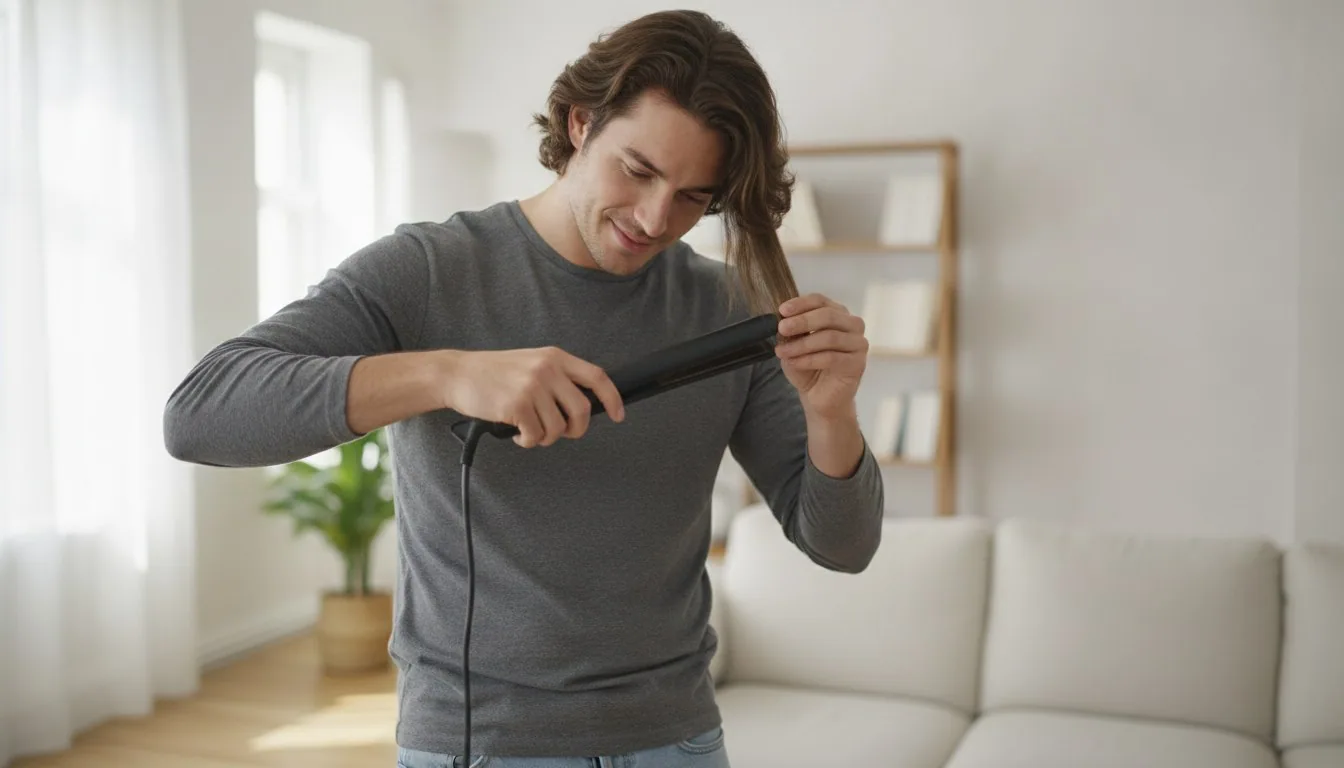
Every hair-tool aisle eventually forces the same decision: a cylindrical barrel with a clamp, or two flat heated plates. Most people assume the two tools do roughly the same job in different shapes, and that assumption is exactly where a wrong purchase starts. The better question isn't which tool is superior, it's which shape actually matches what your hair is doing most mornings.
In the curling iron vs flat iron choice, a curling iron uses a clamped barrel built only for curls, while a flat iron uses two flat plates that straighten hair and, with practice, twist into waves too. Beginners and anyone wanting crisp ringlets should lean curling iron; anyone who mostly straightens should buy the flat iron first.
| Spec | Curling iron | Flat iron |
|---|---|---|
| Core mechanism | A clamp and cylindrical barrel bend hair around a fixed curve | Two flat heated plates compress hair between them |
| Versatility | Built for one job: producing curls or ringlets | Can straighten, wave, and curl with the right twist-and-pull technique |
| Learning curve | Wrap-and-hold technique is close to intuitive from the first try | Twist-and-glide curling technique typically takes practice to master |
| Curl definition | Produces tight, uniform, well-defined ringlets | Produces looser waves and bends rather than crisp ringlets |
| Wave and curl longevity | Can loosen faster since heat contacts less of each strand at once | Even plate-to-strand contact tends to hold waves longer through the day |
| Everyday straightening | Cannot straighten hair | Straightens hair as its primary function |
| Size range to choose from | Barrel diameters commonly run about 0.75 in to 1.5 in or larger | Plate widths commonly run about 0.5 in to 2 in or wider |
| Quick Facts | |
|---|---|
| Curling iron-related ED injuries, 1992-1996 study period | an estimated 82,151 cases |
| Share of those injuries that were thermal burns | 97% |
| Median patient age in that ED study | 8 years |
| Keratin melting and denaturation range | 220°C to 250°C (428°F to 482°F) |
Curling iron vs flat iron: what's physically different inside each tool
A curling iron clamps a section of hair around a heated cylindrical barrel, while a flat iron presses hair flat between two heated plates that glide down the length of the strand.
Shopping for a specific model? See top-rated flat irons models — 10 models compared on the specs that decide it.
Open up either tool and the difference turns out to be entirely mechanical. A curling iron has a heated barrel, usually cylindrical, plus a spring-loaded clamp that pins a section of hair against that barrel while you rotate and hold it. The barrel does the curving; the clamp just keeps hair from slipping while heat sets the bend.
A flat iron works on a flatter logic. Two heated plates, usually ceramic, tourmaline, or titanium-coated, close around a section of hair and glide down its length under light tension. Nothing about the plates is curved, so on their own they straighten. Curls only happen once you add motion, twisting the iron as you pull it down so hair spends a moment wrapped around the plates' edge instead of sliding flat between them.
That's the whole curling iron vs flat iron split in miniature: one tool is built around a curve, the other around a flat surface coaxed into a curve with technique. Versatility, learning curve, how long a curl holds, all of it traces back to that one structural choice.
Versatility: can one tool actually do both jobs
A flat iron can straighten, wave, and, with practice, curl hair, while a curling iron is built for curls alone and cannot straighten.
Versatility is where the curling iron vs flat iron comparison stops being a close call. A flat iron straightens as its primary function, and those same flat plates twist into waves or loose curls once you learn to rotate the iron as it moves down a section. A curling iron cannot reverse that trick; ask it to straighten hair and you get a slightly less curly curl, not a straight line, because the barrel's curve is built into the tool itself.
The tradeoff shows up in the learning curve. Wrapping hair around a barrel and holding it for a few seconds is close to intuitive on the first try, a big part of why curling irons get recommended to beginners. Getting a flat iron to produce a curl means mastering a twist-and-pull motion that isn't obvious from a five-second demo clip, and the smooth footage in styling videos undersells how fiddly that first attempt is. Most people need a week or two of practice before it stops feeling like a fight with the iron.
None of that makes the flat iron the better tool outright, just the more flexible one, provided you're willing to spend the practice time. If you only want curls and have zero interest in a new technique, that flexibility buys you nothing.
Curl definition, wave longevity, and the clamp-versus-wand wrinkle
Curling irons produce tighter, more uniform curls that read as defined ringlets, while flat irons tend to produce looser waves that hold their shape longer because the plates contact more of each strand evenly.
Which tool makes the 'better' curl is really a definition problem: better by what measure? A curling iron, especially a clamped one, wraps hair tightly around a fixed barrel, which is why it produces the crisp, uniform ringlets that read as an intentional curl from across a room. A flat iron's twist-and-pull technique produces something looser by nature, more wave than ringlet, because hair spends less time locked against a single fixed curve.
Longevity tends to run the other way. Because a flat iron's plates apply heat evenly along more of the strand in one pass, the wave it creates often holds through a longer day than a curling iron's ringlet, which loosens and drops as hair cools unevenly. Neither pattern is universal, since texture and product change the outcome more than the tool does, but it's a fair rule of thumb.
There's a related fork worth knowing: flat iron vs curling wand isn't really the same argument as flat iron vs curling iron. A curling wand is a clampless barrel tool, no spring-loaded clip, just a bare heated cylinder wrapped by hand. Dropping the clamp avoids the faint crease it can leave at a curl's base, but a wand still runs on the same curved-barrel logic as a clamped curling iron, not the flat-plate logic of a flat iron.
Picking a size: 1 inch vs 1.25 inch curling iron, and flat iron plate width
A 1 inch curling iron produces tighter, classic curls that suit most hair lengths, a 1.25 inch barrel produces looser, more relaxed waves better suited to longer or thicker hair, and flat iron plate width follows a similar logic in reverse.
Barrel diameter changes your results more than brand or price tier ever does. A 1 inch barrel is the closest thing to a universal size: it produces defined, classic curls on short-to-medium hair and holds up reasonably well on longer hair too. Choosing between a 1 inch and 1.25 inch curling iron mostly comes down to how loose you want the finished curl and how much hair you're working with. The 1.25 inch barrel trades some of that definition for volume and a relaxed, lived-in wave, suiting medium-to-long or thicker hair that can otherwise look flat under a smaller barrel.
Fine hair usually does better on the smaller end of that range, since a thin strand has less weight fighting the curl as it cools. Coarse or thick hair often needs the larger barrel so heat reaches all the way through before you release it. Neither size is wrong, and plenty of people eventually own both once a single barrel can't cover every look they want.
Flat irons mirror that logic on plate width instead of barrel diameter. Narrower plates, often under an inch, section hair precisely and suit shorter cuts or fine hair. Wider plates cover more hair per pass, speeding up straightening on long or thick hair at some cost to precision on shorter styles. If you're shopping by plate width, our flat irons category breaks down current options by that spec.
Heat and hair damage: what the temperature actually does
Hair's internal structure starts changing at surprisingly moderate heat, with keratin denaturing well before either tool reaches its maximum setting, which is why the number on the display matters more than which tool it's attached to.
Both tools damage hair through the same mechanism: heat. Research on chemically treated hair fibers, published in the journal Biopolymers, found that hair's internal structure begins shifting around 70°C, with early lipid changes near 110°C. By 220°C to 250°C, the keratin chains in the cortex start melting and denaturing outright, while the cuticle resists serious degradation above roughly 250°C. As a general industry figure rather than a number tied to either study above, common flat iron settings run around 180°C, comfortably inside the range where cumulative damage builds even though hair never visibly melts.
None of that says one tool is gentler than the other in principle. A curling iron run at 220°C does the same thing to keratin that a flat iron at the same setting does; what changes is how long hair sits against the heat and how evenly it spreads. A flat iron's plates contact more surface area per pass, which is part of why a lower dial setting on a flat iron can produce a comparable result to a curling iron running hotter.
The practical upshot is boring but true: the temperature dial matters more than the shape of the metal. Fine, color-treated, or already-damaged hair has less margin before it crosses into that 220°C-plus zone, so starting low beats defaulting to the highest setting just because it curls or straightens faster.
Burn risk at home: the safety gap most buying guides skip
Thermal burns are the most common injury linked to both tools, far more often than styling mishaps, and young children touching a hot, unattended iron account for the largest share of cases.
Buying guides for either tool tend to skip past safety, a strange omission given how hot these tools run and how often they sit plugged in on a bathroom counter. A five-year analysis of U.S. emergency department data, published in Academic Emergency Medicine, estimated 82,151 curling iron-related injuries out of roughly 105,081 total hair-care-product injuries, meaning curling irons accounted for 78% of the category. Thermal burns made up 97% of those injuries, median patient age was just 8 years old, and 98% happened inside the home.
A separate study in Annals of Burns and Fire Disasters, following 59 children under 11 (mean age 2.4 years) burned by curling or flat irons, found that touching an iron left within reach caused 61% of the injuries reviewed, with pulling a dangling power cord responsible for another 15%. Roughly one in five needed surgical treatment for burns that averaged well under one percent of total body surface area but still went deep enough to require it. That same research found these tools reaching up to 450°F in about five seconds, fast enough that a toddler's grab-and-let-go moment is plenty of contact time.
None of this argues for skipping either tool, just for treating the cool-down step as seriously as the styling step: a heat-resistant mat, a cord kept out of reach, and a habit of switching the iron off the moment you're done rather than leaving it warm on the counter between touch-ups.
So, curling iron or flat iron: making the actual purchase
Buy a flat iron first if you mostly straighten and want the option to rough in waves later; buy a curling iron first if defined curls are the actual goal and you'd rather skip the twist-and-pull learning curve.
Strip away the spec sheets and the curling iron vs flat iron decision comes down to what your hair does on an average day, not which tool is more advanced. If straight or lightly tousled is your baseline look, a flat iron covers more of your routine and can produce a passable wave once you've practiced the twist. If tight, uniform curls are the actual end goal, a curling iron gets there in far fewer attempts.
Budget shoppers and premium buyers land on both sides of this split, since plate and barrel quality, not the basic mechanism, tend to separate a tool that lasts two years from one that lasts ten. If you've settled on straightening as the priority, our best flat irons guide compares current models across plate material and heat range. If curls are the goal, our best curling irons guide does the same for barrel sizes and clamp designs.
The honest middle answer is that plenty of routines eventually want both tools, simply because the two mechanisms behave differently enough that each one earns a place. Buy the one that matches what you do most often first, then add the second once you know exactly which spec you're missing.
A curling iron wins the moment defined, uniform curls are the actual goal and you'd rather skip a learning curve. A flat iron wins as the more useful first purchase for most people, since it straightens daily and can rough in a wave once you learn the twist, even if that wave falls short of a curling iron's crisp ringlet. Neither tool replaces the other completely, which is the honest, if unglamorous, reason so many routines end up owning both.
Frequently asked questions
Is a curling iron or a flat iron better for beginners?
Can a flat iron curl your hair as well as a curling iron?
What is the actual difference between a flat iron and a curling iron?
Should I buy a 1 inch or 1.25 inch curling iron?
What's the difference between a curling iron and a curling wand?
Do I need to own both a flat iron and a curling iron?
Sources & references
- Beauty is pain: pediatric burns resulting from hair curling and flat irons — Annals of Burns and Fire Disasters (via PubMed Central, U.S. National Library of Medicine)
- Curling Iron-Related Injuries Presenting to U.S. Emergency Departments — Academic Emergency Medicine (via PubMed, U.S. National Library of Medicine)
- Thermal Induced Changes in Cuticle and Cortex to Chemically Treated Hair — Biopolymers (via PubMed Central, U.S. National Library of Medicine)