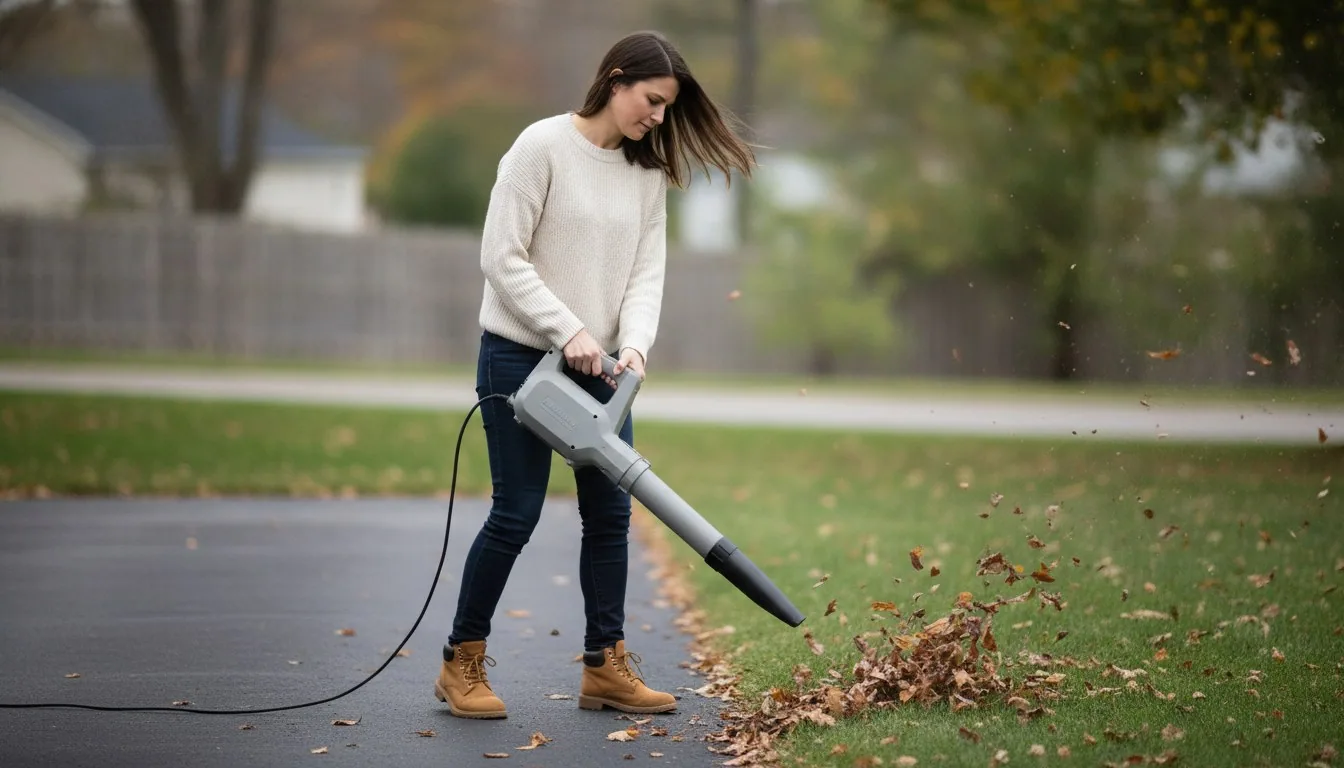
| Quick Facts | |
|---|---|
| CARB estimate: 1 hour gas leaf blower emissions | smog-forming pollution comparable to driving a car about 1,100 miles |
| Share of VOC emissions from gas landscape maintenance equipment | approximately 43 percent (within gasoline lawn/garden equipment category) |
| Share of fine particulate matter from gas landscape maintenance equipment | approximately 50 percent (within gasoline lawn/garden equipment category) |
| EPA handheld small engine emissions standard | Phase 3 exhaust standards, 40 CFR Part 1054, phased in 2011-2012 |
| Tailpipe emissions from battery/electric leaf blowers during use | zero (no combustion process) |
Are leaf blowers bad for the environment, or just gas ones
Gas leaf blowers carry most of the documented environmental cost, largely through inefficient two-stroke engine combustion; electric and battery models avoid that specific problem but aren't impact-free.
Shopping for a specific model? See our best leaf blowers picks — 10 models compared on the specs that decide it.
Framing this as leaf blowers versus no leaf blowers misses where the actual damage comes from. The engine type matters more than the tool category. A gas leaf blower's two-stroke engine mixes fuel with oil and burns both together, and a meaningful share of that mixture never combusts at all, it just leaves the exhaust port as unburned hydrocarbons and particulate matter.
That inefficiency is the reason gas leaf blowers show up so often in environmental reporting while battery models rarely do. A battery or corded electric leaf blower has no combustion process, so it can't produce tailpipe pollutants in the first place. That's a real, measurable difference, not a marketing distinction.
What electric power doesn't fix is the debris side of the equation. Blasting air at 150 to 200-plus mph moves more than leaves. It moves topsoil, mulch, dust, and anything living in the leaf litter, regardless of whether the motor runs on gas or a battery pack. So the fairest short answer to are leaf blowers bad for the environment is: unevenly, and the gas-versus-electric choice is the single biggest variable inside that question.
How much pollution does a gas leaf blower actually produce
The California Air Resources Board estimates that one hour of commercial gas leaf blower use can generate smog-forming emissions comparable to driving a car about 1,100 miles, largely due to incomplete fuel combustion in two-stroke engines.
The number that gets quoted most in this debate comes from CARB, California's state air quality regulator, which found that a commercial operator running one gas backpack leaf blower for an hour can produce smog-forming emissions on the order of a car driven roughly 1,100 miles. That figure comes from CARB's own small off-road engine research, not an outside advocacy estimate, and it's the reason the state has moved to require zero-emission standards for most new small off-road engines.
The mechanism behind that number is straightforward once you understand two-stroke design. These engines lack a separate lubrication system, so oil gets mixed directly into the fuel, and a meaningful portion of that fuel-oil mix exits through the exhaust before it's fully burned. Research hosted by the EPA on national lawn and garden equipment emissions estimated that gasoline-powered landscape maintenance equipment, the category covering leaf blowers, leaf vacuums, trimmers, and edgers, accounted for roughly 43 percent of volatile organic compound emissions and around half of fine particulate matter within the broader gas-powered lawn equipment sector nationally.
None of this means every gas leaf blower pollutes identically. Newer four-stroke gas engines burn more completely than older two-stroke designs, and EPA's Phase 3 exhaust standards under 40 CFR Part 1054, phased in during 2011 and 2012, tightened allowable emissions for small spark-ignition engines built after those dates. An older two-stroke unit bought before that phase-in is a different animal, emissions-wise, than anything sold new today, which is worth knowing if you're deciding whether to retire an old gas blower rather than just choosing between gas and battery on a store shelf.
Do electric and battery leaf blowers solve the problem
Battery and corded electric leaf blowers eliminate the tailpipe emissions that make gas models a smog and carbon concern, though the electricity that charges them still carries an environmental footprint depending on the local power grid.
Switching to a battery leaf blower removes the combustion problem entirely, and that's not a small thing. No fuel-oil mix means no unburned hydrocarbons, no carbon monoxide, and no particulate exhaust leaving the machine while it runs. If you're weighing options specifically to cut emissions, our battery leaf blower guide covers the current cordless lineup for anyone ready to make that switch.
The honest caveat is that a battery still has to be charged, and that electricity comes from a grid with its own generation mix, so a battery leaf blower isn't a zero-impact tool in some absolute sense, just a tool that shifts the emissions upstream to a power plant instead of a backpack tank. In most of the United States, that shift still comes out ahead of gas on a per-hour-of-use basis, because power plants generally burn fuel far more completely and with more pollution controls than a handheld two-stroke engine does.
What battery power doesn't change is airflow force. A battery leaf blower can move air just as fast as many gas handhelds, and speed is what disturbs soil and displaces small creatures, not the power source. If your goal is genuinely reducing environmental impact rather than just swapping fuel types, the how-you-use-it half of this question matters as much as the what-powers-it half. For a side-by-side rundown of every leaf blower configuration on the market, our leaf blowers hub page is the starting point before narrowing into a specific type.
What leaf blowers do to soil, dust, and air quality nearby
A leaf blower's forceful air stream lifts more than leaves, it stirs up topsoil, mulch, and airborne particulates including dust, pollen, mold spores, and dried animal waste.
This part of the environmental story applies to gas and battery blowers alike, since it's about air velocity, not fuel type. A leaf blower nozzle pushes air fast enough to lift lightweight debris off the ground, and that same force lifts fine soil particles, mulch fragments, and whatever fine dust has settled since the last rain. Repeated blowing over the same beds gradually strips topsoil and loosens the surface layer, making it easier for wind and rain to carry that soil away later, a slower but cumulative form of erosion.
The airborne cloud a leaf blower kicks up isn't limited to dirt. It commonly includes pollen, mold spores, and dried animal droppings that were sitting undisturbed in the yard, all of which become breathable particulate matter for anyone standing nearby, including the person holding the blower. That's a separate issue from tailpipe emissions and it applies whether the tool is gas, corded electric, or battery powered, since the disturbance comes from the air stream itself, not the motor.
There's a practical middle ground here that doesn't require giving up the tool entirely. Lower speed settings, staying off bare soil and mulch beds, and blowing toward a collection area rather than scattering debris across open ground all reduce how much material actually becomes airborne. It's a smaller lever than the gas-versus-battery choice, but it's one you control every time you use the machine, regardless of which model you own.
How leaf blowers affect insects, pollinators, and yard wildlife
Fallen leaves shelter overwintering insects and pollinator larvae, and clearing that leaf litter with a blower can injure or displace the creatures living in it.
This is the part of the leaf blowers bad for environment discussion that gets the least attention next to emissions, but it's arguably the most direct harm a blower causes in a typical residential yard. According to the Xerces Society, a nonprofit invertebrate conservation organization, a large share of native bee species nest in the ground or in narrow plant stems, and many butterfly and moth species overwinter as eggs, caterpillars, or chrysalides tucked inside fallen leaves rather than migrating away from the cold.
A leaf blower doesn't distinguish between a dead leaf and a leaf holding a dormant chrysalis. Clearing a bed down to bare soil in autumn, or blasting leaf litter into a pile hard enough to shred it, can kill or displace whatever was sheltering there, whether the blower runs on gas or battery power. The force involved, not the fuel source, is what causes this specific harm, which is part of why calling battery the eco-friendly choice is only true for the emissions half of the equation.
The practical fix costs nothing and doesn't require a different tool: leave some leaf litter in garden beds and under shrubs through winter rather than clearing every surface, and if you do need to move leaves off a lawn, consider mulching them into the grass with a mower instead of blowing them into bags. Neither of those choices is realistic for every yard or every homeowners' association, but even leaving one corner of a property undisturbed gives ground-nesting insects somewhere to survive the season.
Are leaf blowers bad enough that you should stop using one
Not necessarily. A battery or corded electric leaf blower used thoughtfully, on lower speed settings and away from bare soil and leaf litter beds, addresses most of the documented environmental concerns without requiring you to go back to a rake.
The spec sheet undersells how big a difference the power source makes here. Gas leaf blowers carry a genuine, government-quantified pollution cost that CARB and EPA-hosted research both document with real numbers, not vague concern. That alone is reason enough to choose battery or corded electric over gas for anyone buying new, and our leaf-blower vacuum guide is worth a look too if you want a single tool that clears debris and collects it rather than just displacing it across the yard.
What a battery blower can't fix by itself is how you use it. Full-throttle blowing across bare garden beds and thick leaf litter still stirs up dust and still disturbs whatever insects are sheltering underneath, gas or electric. Dialing back the speed, directing airflow away from beds you're not actively clearing, and leaving some leaf coverage in place through winter close most of the remaining gap.
So the answer isn't really a flat yes or no. Are leaf blowers bad for environment outcomes across the board? Only the gas ones carry a heavy, well-documented burden, and even that's a spectrum depending on engine age and how often the tool runs. A battery blower used with some restraint is a reasonable middle ground between full manual leaf clearing and an unrestricted gas engine running every weekend.