Electric leaf blower vs gas
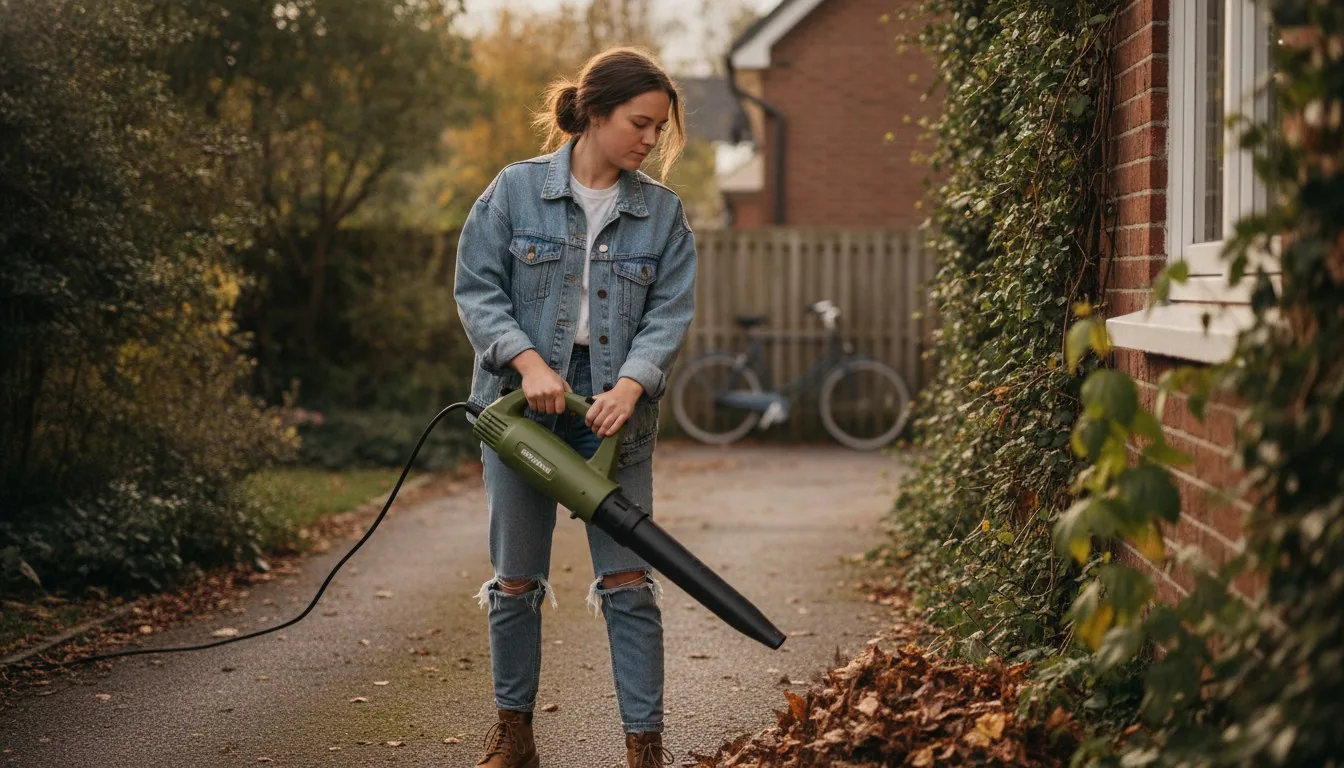
Rake versus power tool stopped being the real debate years ago. Now the fight is between two kinds of power tool: one that smells like a two-stroke mix and starts on the third pull, and one that hums to life the moment you squeeze the trigger. The electric leaf blower vs gas question shows up every fall when someone's cul-de-sac argument about noise turns into an actual purchase decision. Neither side is wrong, exactly. They're built for different yards and different patience levels.
In the electric leaf blower vs gas decision, gas models push more raw airflow and never run out of charge mid-job, while battery models are quieter, lighter, and skip the mixed fuel entirely. Large properties with wet leaves favor gas; small to mid-size yards favor battery for the lower noise and no-fumes convenience.
| Spec | Gas leaf blower | Battery leaf blower |
|---|---|---|
| Peak airflow (CFM) | Up to 765 CFM in this comparison (Husqvarna 150BT backpack) | Up to 780 CFM in this comparison (WORX WG582) |
| Runtime | Limited only by tank size and how much fuel you carry | Roughly 60 to 160 minutes per charge in this comparison, then needs a recharge |
| Noise | No independently comparable figures in this comparison, but gas engines commonly run louder at operator range | WORX WG582 rated 57 dB, the only figure available in this comparison |
| Emissions | Regulated under EPA Phase 3 standards for handheld small spark-ignition engines; produces tailpipe exhaust | No tailpipe exhaust produced during use |
| Weight (handheld models) | Husqvarna 125B handheld weighs 9.4 lb | EGO Power+ and MTKOALA handhelds weigh 7 to 7.7 lb |
| Startup and refueling | Requires a fuel-oil mix and typically a pull-cord start | Starts with a trigger pull; refuels by recharging or swapping a battery pack |
| Backpack format availability | Available in this comparison up to 765 CFM (Husqvarna 150BT) | No backpack battery models in this comparison |
Electric leaf blower vs gas: what's actually different
A gas leaf blower runs a small two-cycle engine on a fuel-oil mix, while a battery leaf blower runs an electric motor off a removable lithium-ion pack that needs charging.
Shopping for a specific model? See our leaf blowers buying guide — 10 models compared on the specs that decide it.
The split starts at the power source, and everything else about how these tools feel in your hands follows from that one choice. A gas blower carries a small internal combustion engine, the kind rated in cc's, that burns a gas-and-oil mixture and needs priming, choking, and usually a pull cord to start. The Husqvarna 125B in this comparison runs a 28cc, 1.1-HP two-cycle engine rated at 470 CFM and 170 MPH, and the larger Husqvarna 150BT backpack steps up to a 51cc, 2.16-HP engine at 765 CFM and 270 MPH.
A battery blower swaps that engine for a brushless electric motor and a removable pack. The MTKOALA Leaf Blower Cordless in this lineup runs a 1200W brushless motor rated at 700 CFM and 200 MPH, with two 5.2Ah batteries good for up to 160 minutes combined runtime. The WORX WG582 rates its own motor at 780 CFM and 190 MPH while advertising a 57 dB noise level, a spec gas engines rarely publish because it wouldn't flatter them.
Neither format is a straight upgrade over the other. Gas holds an edge on peak airflow at the top of this lineup, and it never asks you to stop and recharge. Battery gives up some of that ceiling for a lighter, quieter tool that starts with a trigger pull instead of a cord.
Power and airflow: how gas and battery blowers compare on CFM and MPH
The gas models in this comparison top out higher on CFM than the battery models, though the gap is smaller than it used to be.
CFM (cubic feet per minute) measures volume of air moved, and MPH measures how fast that air exits the nozzle; a useful blower needs a reasonable amount of both; not just one, and this is where the gas vs battery leaf blowers comparison gets more interesting than the marketing copy suggests. Among the gas models here, the TDH Gas Backpack Leaf Blower claims 665 CFM and 205 MPH from a 63cc engine, and the Husqvarna 150BT backpack tops the group at 765 CFM and 270 MPH. The smaller handheld Husqvarna 125B sits lower at 470 CFM and 170 MPH, proof that engine size inside the gas category swings the numbers just as much as fuel type does.
Battery blowers close a lot of that gap at the high end. The WORX WG582 lists 780 CFM at 190 MPH, which edges out every gas handheld in this comparison on raw airflow volume even though its air speed trails the Husqvarna 150BT. The EGO Power+ Leaf Blower turns in a more modest 530 CFM and 110 MPH in turbo mode, while the MTKOALA sits in between at 700 CFM and 200 MPH. Read the spec sheet before assuming gas automatically wins; on paper, a strong battery blower has closed most of the distance.
Runtime and refueling: gas vs recharging a battery pack
A gas blower keeps running as long as its tank has fuel, while a battery blower is capped by pack capacity and needs a recharge once it's spent.
A gas engine's runtime comes down to tank size, and it's the one spec that never involves waiting for a charger. The TDH Gas Backpack Leaf Blower carries a 1.8L tank built for what the listing describes as long-lasting runtime, and the Getell Professional backpack model carries a 1.7L tank with the same pitch. Refueling takes a couple of minutes with a gas can on hand, and there's no clock counting down mid-yard.
Battery runtime is a different kind of math, and it varies more by model than gas tank size does. The MTKOALA pairs two 5.2Ah batteries for up to 160 minutes combined, which is enough for most residential yards in one sitting. The WOKEGI Cordless Leaf Blower ships with two packs as well, and the WORX WG582 claims up to an hour of runtime from its 40V system. Once a pack drains, though, you're either swapping in a charged spare or waiting through a charge cycle, a real interruption if you're clearing a large property in one pass and only budgeted one battery set.
Noise and emissions: the trade-off that shows up in your neighborhood
Battery leaf blowers run measurably quieter than gas engines, and gas engines carry emissions that federal regulators specifically address for small handheld equipment.
Noise is where the two power sources diverge most obviously to a neighbor two yards over. The WORX WG582 battery blower in this comparison advertises 57 dB, and OSHA's own permissible exposure limit is 90 dBA averaged over an eight-hour day, with employers required to start hearing conservation measures at 85 dBA. NIOSH sets a stricter recommended limit at 85 dBA over eight hours, and its exchange rate cuts the safe exposure time in half for every 3 dBA increase above that. None of the leaf blowers in this comparison publish independently verified decibel ratings at the ear, aside from the WORX figure, so treat any noise claim as the brand's own number until you've confirmed it in person.
Emissions are the other half of the trade-off, and this one is regulated rather than left to marketing copy. The EPA classifies handheld leaf blowers as small spark-ignition equipment and phased in Phase 3 exhaust emission standards under 40 CFR Part 1054 during 2011 and 2012, specifically because two-cycle handheld engines burn a gas-oil mix that produces more exhaust per hour of use than a comparable four-stroke engine. A battery blower produces no tailpipe exhaust at all, which is the cleanest argument in its favor and the one gas can't really answer back to.
Weight and handling: what you actually carry through a yard
Handheld gas blowers and battery blowers land in a similar weight range in this comparison, while gas backpack units run noticeably heavier once you add engine and fuel weight.
Weight tracks the power source less than you'd expect once you separate handheld models from backpack units. The Husqvarna 125B, a gas handheld, weighs 9.4 lb, while the MTKOALA battery handheld comes in lighter at 7.7 lb and the EGO Power+ at 7 lb. That's a real but modest gap, the kind you notice after twenty minutes, not five.
Backpack gas units are where the weight difference becomes hard to ignore. The Husqvarna 150BT backpack weighs 22 lb and the Getell Professional backpack weighs about 23 lb once fuel is loaded, both leaning on a padded harness to spread that load across the shoulders and hips rather than the wrist. None of the battery blowers in this comparison ship in a backpack format, which is itself a hint about where each fuel type tends to top out: gas scales up to heavier-duty, harness-worn tools more readily than battery does at the models compared here.
Which one should you actually buy: gas or battery
Choose gas for large properties, wet or heavy leaf piles, and all-day jobs where refueling beats waiting on a charger; choose battery for small to mid-size yards where quieter operation and no exhaust matter more than peak airflow.
There's no universal winner in the gas vs battery leaf blowers debate, and the honest answer depends more on your lot size than on brand loyalty. A large property with a lot of wet leaves in the fall, or a landscaping job that runs for hours, tends to favor a gas backpack unit like the Husqvarna 150BT, where the 765 CFM output and a quick fuel top-off beat waiting on a battery to recharge. A smaller residential yard, especially one where a neighbor's window is thirty feet away, tends to favor a battery model like the WORX WG582 or MTKOALA, where the lower noise and complete absence of exhaust matter more than a CFM number you'll rarely max out anyway.
Budget also plays a real role, and it doesn't split cleanly by fuel type. The WORX 12 Amp Electric Leaf Blower is a corded budget option, while cordless models across both fuel types span a wide range depending on battery count and engine size. If you're comparing options by price tier and features side by side, our gas leaf blower guide breaks down the current gas lineup in detail, and our battery leaf blower guide does the same for cordless models. Whichever you land on, the CFM and MPH numbers on the box only tell part of the story; how loud it is at 7 a.m. on a Saturday tells the rest.
Gas wins on sustained runtime and backpack-scale power for large properties and all-day jobs. Battery wins on noise, emissions, and simple trigger-pull startup, which matters most for small to mid-size yards and noise-conscious neighborhoods. Airflow itself is close to a wash at the top of both lineups, so the deciding factor is usually property size and how much you mind either a fuel mix or a recharge cycle.
Frequently asked questions
Gas vs battery leaf blowers: which one is more powerful?
Do battery leaf blowers run long enough for a full yard?
Are gas leaf blowers louder than battery ones?
Do gas leaf blowers have real emissions regulations?
Is a battery leaf blower worth it for a small yard?
Sources & references
- Occupational Noise Exposure — Occupational Safety and Health Administration
- Noise-Induced Hearing Loss — National Institute for Occupational Safety and Health (NIOSH), CDC
- Regulations for Emissions from Small Equipment & Tools — U.S. Environmental Protection Agency