| Quick Facts | |
|---|---|
| Hot water extraction (steam) dry time | 6 to 12 hours |
| Dry / low-moisture method dry time | 1 to 2 hours |
| Wool carpet dry time | 24 hours or more |
| CDC/EPA mold-risk drying window | 24 to 48 hours |
| EPA-recommended indoor relative humidity | 30-50% (below 60%) |
| BISSELL ProHeat 2X Revolution Pet Pro Plus, Express Clean Mode | about 30 minutes (per product listing) |
How long does carpet take to dry after cleaning
Most carpet dries within six to twelve hours after a hot water extraction and in one to two hours after a dry, low-moisture cleaning; full drying through the padding can stretch to a day or two in humid rooms.
Shopping for a specific model? See our full carpet cleaners roundup — 10 models compared on the specs that decide it.
Ask how long does carpet take to dry after cleaning and the honest answer is that it depends almost entirely on which method your technician used. A standard hot water extraction, the deep steam-style clean most companies run by default, pushes heated water and solution into the fibers under pressure, then pulls most of it back out with a wet vacuum head. Even with strong extraction, carpet finished this way typically needs six to twelve hours before it's dry to the touch.
A dry or low-moisture cleaning skips most of that soak. It finishes in one to two hours because there's far less water sitting in the pile to begin with, though it also tends to lift less deeply embedded soil than a full extraction. That gap in dry time is one of the main reasons companies offer both options, and it's worth asking which one you're booking before an appointment, not after.
None of this is the same question as how long do carpet cleaners take to finish the job on-site. A technician is usually done in one to three hours depending on square footage and how many rooms need treatment; drying is what happens after they pack up and leave. Mixing up service time and dry time is the most common reason people think their carpet is taking unusually long. It isn't. They're just starting the clock in the wrong place.
How does carpet cleaning work
Carpet cleaning works by either flooding the fibers with hot water and solution and extracting it back out, or by applying a low-moisture compound that's brushed in and vacuumed away. The wet method cleans deeper; the dry method dries far faster.
Professional carpet cleaning almost always falls into one of two families. Hot water extraction, sometimes called steam cleaning, forces heated water mixed with a cleaning solution deep into the carpet fibers under pressure, agitates it to break up soil, then pulls the dirty water back out with a high-powered wet vacuum. It's the method most standards bodies, including the IICRC, treat as the benchmark for cleaning depth, because pressurized hot water lifts more embedded dirt than a surface pass ever manages.
The other family is what's sometimes marketed as the carpet cleaners dry method: low-moisture or encapsulation cleaning, where a cleaning compound or foam is worked into the pile with a brush, dries into a fine powder as it binds to soil, then gets vacuumed away. There's no standing water to begin with, so there's nothing left to evaporate later. That's the entire reason dry-method carpets are walkable again within an hour or two while extraction-cleaned carpet needs the better part of a day.
Neither method is strictly better. Extraction usually wins on deep, ground-in soil and allergen removal, while the dry method wins on turnaround, which matters if you can't keep a room closed off for half a day. If speed is the priority, our home carpet cleaners guide breaks down which machines are built around faster-drying settings without giving up much cleaning power.
What actually controls how fast carpet dries
Fiber type, pile height and padding, ambient humidity, and airflow all interact to speed up or slow down drying. Of those, humidity and moving air are the two you can actually control once the technician leaves.
Fiber matters more than most people expect. Synthetic fibers like nylon, polyester, and olefin shed water fast and typically fall in that six-to-twelve-hour window. Wool is different: it's more absorbent by nature, holds moisture inside the fiber itself rather than just on the surface, and can take twenty-four hours or longer to dry fully even under good conditions. Pile height and density add to that. A thick, plush pile traps more water than a low, tight weave, and the padding underneath adds its own drying time on top of whatever the visible carpet needs.
So when someone asks how long does carpet take to dry after cleaning, humidity is usually the hidden variable behind why their number ends up different from a neighbor's. Damp air can't absorb much more moisture, so evaporation slows to a crawl regardless of how good the extraction was. The EPA recommends keeping indoor relative humidity below 60 percent, ideally between 30 and 50 percent, specifically because that range limits both drying time and mold risk. Run the same cleaning in a room sitting at 70 percent humidity in July and the low end of every estimate here can roughly double.
Airflow is the practical lever you actually have once the crew packs up. Still air over a damp carpet just sits there, re-saturating the surface layer as it slowly gives up moisture; moving air constantly replaces that saturated layer with drier air, which is why fans do more for dry time than almost anything else you can do without spending money.
How to make carpet dry faster after cleaning
Open windows or run the AC, point fans low across the floor rather than up at the ceiling, keep the thermostat around 70°F, and stay off the carpet until it's surface-dry. Together those cut real hours off the standard six-to-twelve-hour window.
There's no single trick that fully answers how long does carpet take to dry after cleaning, but stacking a few of these cuts real hours off the total. Cross-ventilate by opening windows on opposite sides of the room, or run central air conditioning, which pulls humidity out of the air as a side effect of cooling it. Point a box fan or two low across the carpet rather than up at the ceiling; moving air across the surface does more work than blowing it straight down. A dehumidifier in the room does roughly the same job as an open window on a humid day, minus the outdoor pollen and dust that window lets back in.
Raising the thermostat a few degrees helps too, since warmer air holds more moisture and pulls it out of the fibers faster, but don't crank the heat so high the room feels stuffy. A steady 70°F with good airflow beats a warm, still 78°F every time. Skip relying on a ceiling fan alone; it moves air around the room without necessarily pushing it across the carpet surface where the moisture actually is.
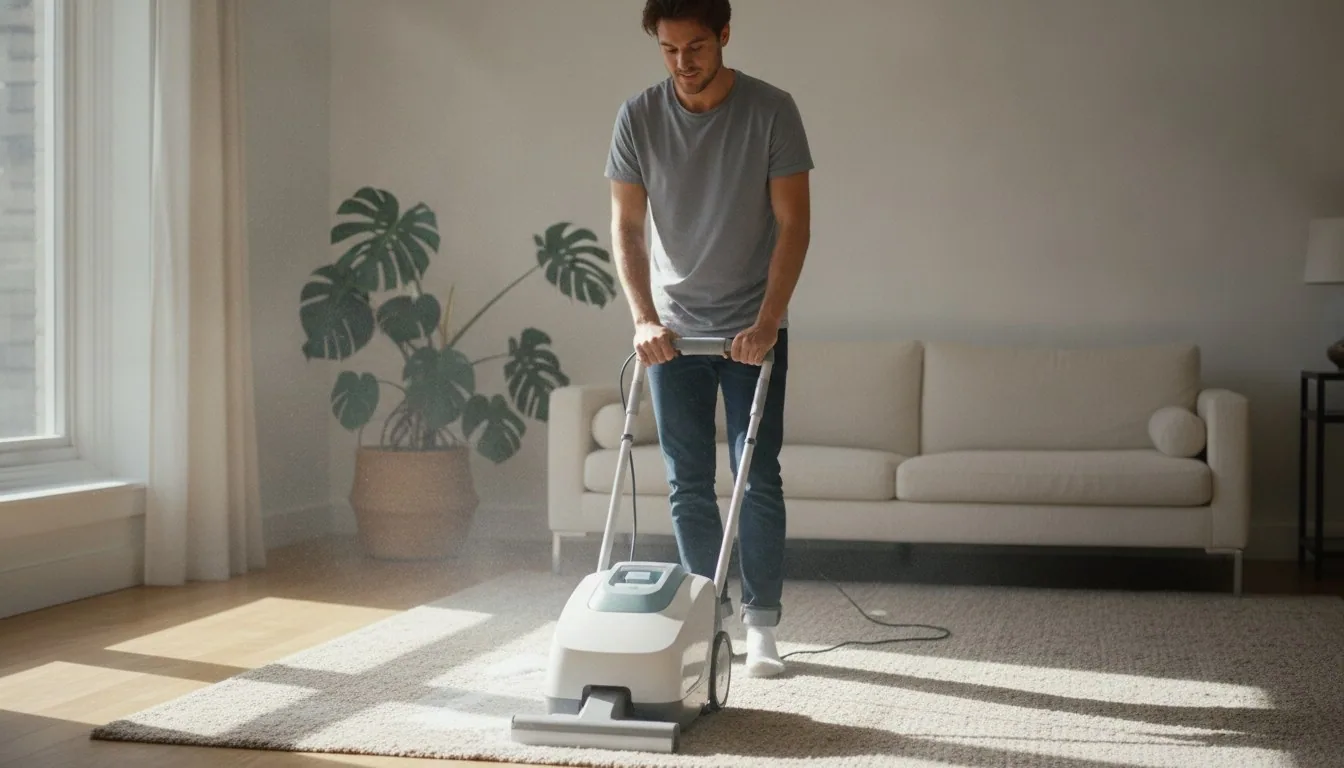
Equipment choice matters before the cleaning even starts. Some upright cleaners are built around faster-drying settings; the BISSELL ProHeat 2X Revolution Pet Pro Plus, for instance, lists an Express Clean Mode designed to leave carpet dry in about 30 minutes, trading some of the deeper Max Clean mode's soak time for speed. If a fast turnaround matters more to you than maximum extraction, our best carpet cleaners guide compares machines like that side by side on exactly that trade-off.
Why does my carpet smell after cleaning
A faint damp, slightly soapy smell right after cleaning is normal residual moisture and cleaning solution evaporating. It should fade as the carpet finishes drying, not intensify into a musty odor a day or two later.
A cleaned carpet smelling like something other than plain carpet is normal for the first several hours. You're picking up leftover moisture, the cleaning solution itself, and sometimes a faint rubbery note from the pad if it got saturated during extraction. None of that is a red flag on its own; it's the same reason a freshly mopped floor smells different than a dry one. Give it the same window you'd give the carpet to dry, and the smell should fade right along with the dampness.
Can you walk on carpet after cleaning while it still smells like this? Generally yes, as long as it's past the soaking-wet stage. Bare feet or clean socks are fine on carpet that's damp but no longer squeezes out water when you press on it. Skip shoes until it's fully dry, since shoes track in dirt that grinds straight into fibers that are still open and more likely to hold a stain while wet.
A smell that shows up, or gets stronger, after the carpet already feels dry to the touch is a different story. That usually points to moisture trapped lower in the pile or pad than the surface suggests, and it's worth checking rather than ignoring.
If the odor traces back to an old pet accident that soaked past the fibers and into the pad, more drying time alone won't fix it. That kind of smell needs an enzymatic or odor-neutralizing treatment aimed at the source, not just fans and open windows.
Does it matter where you live
Local humidity and climate shift the exact hours up or down, but the underlying physics — fiber type, humidity, and airflow — is the same in humid coastal towns and dry inland ones alike.
Search interest in this topic isn't limited to any one region. Someone typing carpet cleaning zephyrhills into Google in humid central Florida is dealing with a very different starting humidity than someone searching carpet cleaning zimmerman mn during a dry Minnesota winter, or carpet cleaning zionsville in Indiana's more moderate spring. A search for carpet cleaning zurich is working with Central European humidity patterns that swing their own way through the seasons. The city changes the starting humidity and temperature; it doesn't change which method dries faster or why fans and dehumidifiers help.
A technician in a coastal, humid market will often lean on the dry method more often, or bring extra air movers as standard equipment, simply because ambient humidity there tends to sit higher on average than in a dry inland climate. That's an adaptation to local weather, not a different set of rules. Whatever the address on the invoice, the same handful of variables — fiber, humidity, airflow, and cleaning method — decide the outcome.