Portable carpet cleaner vs upright
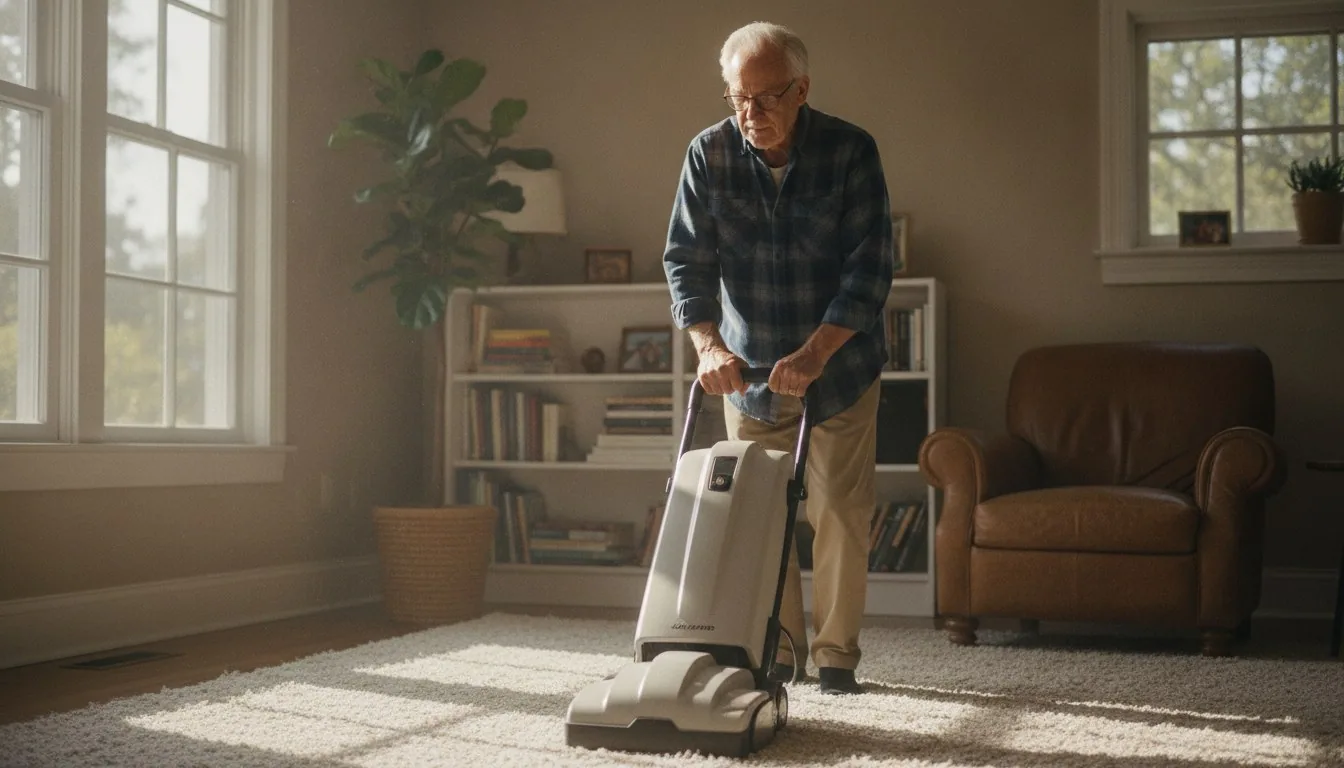
A carpet cleaner promises to erase whatever your carpet has absorbed over the past year, but the machine built for a stray wine stain is rarely the same one built for the whole living room. Size, not brand or color, is the real fork in the road. Get the scale wrong and you either haul a full-size machine out for a single juice spill or drag a spot cleaner across a hundred square feet of hallway carpet, wondering why your arm is tired.
Portable carpet cleaner vs upright comes down to scale: a portable handles spot stains, stairs, and car interiors in a lightweight body you carry room to room, while a full-size upright covers whole rooms faster with bigger tanks and a wider cleaning path. Renters and small spaces lean portable; households with wall-to-wall carpet lean upright.
| Spec | Portable carpet cleaner | Full-size upright carpet cleaner |
|---|---|---|
| Typical weight | About 5 to 8.5 lb (Uwant 18kPa machine to Shark StainStriker) | About 18.5 to 19.2 lb (Hoover PowerScrub Deluxe to BISSELL TurboClean PET) |
| Cleaning path per pass | Narrow tool heads sized for stairs, upholstery, and spot stains, not open floor | About a 7.5 inch powerbrush path (BISSELL TurboClean), built for room-scale coverage |
| Water tank capacity | Small combined tanks, for example a 41 oz total tank on the Uwant 18kPa machine | Separate clean and dirty tanks sized for a full room before refilling |
| Hose and attachment reach | Compact tools reach stairs, car seats, and upholstery a large machine can't fit into | Hose attachments (7 to 8 ft on Hoover and BISSELL models) extend reach to furniture and stairs too |
| Storage footprint | Small enough for a closet shelf or under-sink space | Needs closet or garage floor space, and stays bulkier than a portable even in compact models |
| Stated dry time | Small water volume dries fastest on light, contained spot jobs | Express-style modes (BISSELL ProHeat 2X Revolution Pet Pro Plus) target roughly a 30-minute dry time even on treated whole-room passes |
| Quick Facts | |
|---|---|
| Portable carpet cleaner weight range (category data) | 5 to 8.5 lb |
| Full-size upright weight range (category data) | 18.5 to 19.2 lb |
| Hoover PowerScrub Deluxe hose length | 8 ft |
| BISSELL TurboClean cleaning path | 7.5 in |
| Recommended indoor relative humidity for dust mite control | 35% to 50% |
| HDM allergen reduction: HEPA + hot water extraction vs HEPA alone | 85.5% vs 80.8% |
Portable carpet cleaner vs upright: what's actually different
A portable carpet cleaner is a handheld or shoulder-carried unit built for spot jobs, while a full-size upright is a pushed machine with a wide brush head built to cover entire rooms.
Shopping for a specific model? See our full carpet cleaners roundup — 10 models compared on the specs that decide it.
The distinction has nothing to do with cleaning chemistry. Both formats spray a water-and-solution mix into carpet fibers, agitate it with a brush, then pull the dirty liquid back out with suction. What changes is scale: a portable unit holds a small onboard tank, weighs a few pounds, and comes with a short hose and a handful of narrow tools. An upright looks and moves like a vacuum cleaner, with a wide powerhead built to cover a hallway in fewer passes.
That size gap shows up everywhere in the spec sheet. In our own product data, portable machines like the Shark StainStriker run about 8.5 lb and ship with four interchangeable tool heads for carpet, upholstery, and stairs, while a full-size machine like the Hoover PowerScrub Deluxe weighs roughly 18.5 lb and pairs SpinScrub brushes with an 8 ft hose for furniture and steps. Neither number tells you which one to buy on its own, but together they explain why one lives on a closet shelf and the other gets rolled out of a garage.
If you're comparing the portable carpet cleaner vs upright question purely on convenience, portables win almost every time; if you're comparing it on square footage cleaned per minute, uprights win just as clearly. The rest of this guide is really about matching that trade-off to your own carpet, not picking a winner in the abstract.
When a portable spot cleaner earns its keep
Reach for a portable carpet cleaner when the mess is contained to stairs, upholstery, a car interior, or an area rug rather than an entire floor.
Portable machines are built around one job: getting cleaning solution and suction into a small, awkward, or oddly shaped area that a full-size machine can't reach. Carpeted stairs are the obvious example, along with a couch cushion, a car seat, or a wine stain on an otherwise clean rug. The tool heads that ship with these machines, like the four attachments included with the Shark StainStriker, are sized for exactly that kind of targeted work rather than open floor.
Weight is the other selling point. A unit like the Uwant 18kPa machine comes in around 5 lb with a combined clean and dirty tank holding 41 oz total, light enough to carry up a flight of stairs without switching arms halfway. The BISSELL Little Green Mini, at about 7 lb, follows the same logic and adds a self-cleaning hose tool so you're not scrubbing the hose out by hand after every use.
The tradeoff is capacity and reach. A tank that size empties fast on anything bigger than a hallway runner, and refilling a small reservoir every few minutes turns a large job into a chore nobody finishes properly. If your carpet problem is really a handful of trouble spots rather than the whole room, our portable carpet cleaners guide walks through the current lineup and where each one fits.
When a full-size upright makes more sense
Choose a full-size upright when you're treating an entire room or several rooms of wall-to-wall carpet on a real schedule, not just a stain here and there.
Once the job stops being a spot and starts being a floor, tank size and cleaning path decide the portable carpet cleaner vs upright question more than raw portability does. A machine like the BISSELL TurboClean covers about a 7.5 inch path per pass, which adds up fast compared with a hand tool dragged back and forth over the same square foot. Separate clean and dirty water tanks also mean you're not stopping every few minutes to dump and refill, which is the biggest time sink with a small portable on a large job.
Full-size machines carry more capability for the messier end of carpet cleaning too. The BISSELL ProHeat 2X Revolution Pet Pro Plus pairs a dual dirt lifter powerbrush with an OXY pretreater aimed at set-in pet stains, and its Express Clean Mode is built to leave carpet dry in about 30 minutes rather than the hours a heavily soaked carpet can take to air dry on its own. The Hoover PowerScrub Deluxe takes a similar approach with an 8 ft hose and dedicated upholstery, pet, and crevice tools, so one machine handles the floor and the furniture around it.
None of that comes free. These machines run closer to 18.5 to 19.2 lb, they're built to be pushed rather than carried, and they need somewhere to live between uses that isn't a bathroom cabinet. For a full breakdown of the current upright lineup and how the specs stack up, our home carpet cleaners guide covers the higher-capacity end of the category in detail.
Where a carpet shampooer fits in
A carpet shampooer is an upright or compact machine built around a rotating brush roll that works cleaning solution into carpet pile before extraction, and the term overlaps heavily with what most people now just call a carpet cleaner.
Shampooer is an older term that predates modern water-extraction machines, but it stuck around for a specific design: a body with a rotating or oscillating brush that scrubs solution into the fibers rather than relying on spray-and-suction alone. Products like the BISSELL TurboClean lean on a 4-row Deepreach Powerbrush for that agitation, and the Hoover PowerScrub Deluxe uses SpinScrub brushes built into the same category of machine.
Not every shampooer is a heavy console, either. The Rivenara Carpet Cleaner Machine Upholstery is a 450-watt unit that weighs about 3.84 kg, or roughly 8.5 lb, with a 1.2-meter hose, a 5-meter power cord, an 1800 ml clean water tank, and a 600 ml dirty water tank, closer in size to a portable than a full upright despite doing similar brush-driven work.
If the machine you're picturing has a rotating brush head and works solution into carpet fibers rather than just spraying and pulling it back out, our shampooer carpet cleaners guide is the more accurate place to compare specs than either the strictly portable or strictly upright pages.
Drying time and the mold risk nobody mentions
Over-wetting carpet and leaving it damp for more than about a day raises the risk of mold and mildew, so drying time deserves as much attention as cleaning power when you pick a machine.
Every wet-extraction carpet cleaner, portable or full-size, pushes moisture into the carpet backing and padding before pulling most of it back out. 'Most' is the operative word. Some water stays behind no matter how good the suction is, and a heavily soaked carpet in a humid room can take the better part of a day to dry fully with just airflow.
This is where a machine's stated dry time actually matters as a spec, not just a marketing line. The BISSELL ProHeat 2X Revolution Pet Pro Plus advertises an Express Clean Mode built around a roughly 30-minute dry time, meaningfully faster than letting a fully saturated room air-dry on its own. Cracking a window, running a fan, or keeping the HVAC on afterward all help regardless of which machine did the cleaning.
The US Environmental Protection Agency has actually never issued an official recommendation on how often carpet should be professionally cleaned, despite a frequently repeated claim that it has; per the agency's own published clarification, it points people to manufacturer instructions and industry standards instead. What allergy research does support is keeping indoor relative humidity in the 35 to 50 percent range, a target that limits both mold growth and the conditions dust mites need to thrive.
Allergens, pet dander, and what a carpet cleaner can't fix on its own
A carpet cleaner reduces allergen load but doesn't replace regular vacuuming, and pairing the two works better than either alone.
Carpet acts as a long-term reservoir for dust mite allergen, pet dander, and trapped particulates, which is a big part of why pet owners lean toward machines with dedicated pretreatment steps. A joint practice parameter from the American Academy of Allergy, Asthma and Immunology and the American College of Allergy, Asthma and Immunology recommends at least weekly vacuuming with HEPA filtration in carpeted homes specifically to limit dust mite allergen buildup between deeper cleanings.
Deep cleaning adds a real, measurable benefit on top of vacuuming rather than replacing it. A 2008 study published in the Journal of Environmental Monitoring tracked 50 urban homes and found that HEPA vacuuming alone reduced house dust mite allergen loading by 80.8 percent, while adding dry steam or hot water extraction on top pushed that reduction to 85.5 percent. The same study measured an even larger jump for dust and polycyclic aromatic hydrocarbon loadings with the combined approach.
None of this changes the portable carpet cleaner vs upright calculus much: either one is a periodic deep clean layered on top of routine vacuuming, not a replacement for it. No amount of suction power turns an occasional carpet-cleaner pass into the weekly maintenance that actually keeps allergen levels down.
Buy a portable if your carpet problem is really stairs, upholstery, a car interior, or the occasional accident on an otherwise fine floor. Buy a full-size upright if you're maintaining whole rooms of wall-to-wall carpet on an actual schedule. A fair number of households end up owning both, and that's a practical answer, not an indecisive one.
Frequently asked questions
Is a portable carpet cleaner as effective as an upright?
Can a portable carpet cleaner clean an entire room?
What's the difference between a carpet cleaner and a carpet shampooer?
How often should you deep clean carpet with a machine like this?
Do you need both a portable and a full-size carpet cleaner?
Sources & references
- Has EPA issued specific recommendations on how frequently carpet should be cleaned? — US Environmental Protection Agency, Indoor Air Quality (IAQ)
- Environmental assessment and exposure control of dust mites: a practice parameter — Joint Task Force on Practice Parameters (American Academy of Allergy, Asthma and Immunology and American College of Allergy, Asthma and Immunology), Annals of Allergy, Asthma & Immunology, via PMC
- Evaluation of HEPA vacuum cleaning and dry steam cleaning in reducing levels of polycyclic aromatic hydrocarbons and house dust mite allergens in carpets — Journal of Environmental Monitoring, Royal Society of Chemistry (Yu et al., 2008)