| Quick Facts | |
|---|---|
| PROYAMA 72CC Gas Backpack Leaf Blower output | 72cc 2-cycle engine, 880 CFM, 275 MPH (feed: leaf-blowers/backpack) |
| Husqvarna 360BT Gas Leaf Blower output | 65.6cc, 3.81 HP, 890 CFM, 232 MPH (feed: leaf-blowers/backpack) |
| Husqvarna 150BT Gas Leaf Blower output and weight | 51cc, 2.16 HP, 765 CFM, 270 MPH, about 22 lb (feed: leaf-blowers/backpack, gas) |
| MTKOALA Leaf Blower Cordless output and runtime | 1200W brushless motor, 700 CFM, 200 MPH, up to 160 min runtime (feed: leaf-blowers/battery) |
| LEAPUL Leaf Blower Cordless weight | About 4 lb with two 21V batteries (feed: leaf-blowers/battery) |
| WORX Cordless Leaf Blower (WG583) design | 3-in-1 blower, vacuum and mulcher, brushless motor, 2-speed control (feed: leaf-blowers/vacuum, battery) |
| OSHA permissible exposure limit | 90 dBA averaged over 8 hours (EPA/OSHA reference, not blower-specific) |
Types of leaf blowers explained, and what actually separates them
Leaf blowers split into four working categories: backpack (engine or battery worn on a frame), handheld (lighter, one-hand operation), gas-powered (2-stroke engines, no charging), and vacuum/blower combos (add a collection bag and mulching function). The split that matters most is how the unit is carried and what powers it.
Shopping for a specific model? See our leaf blowers buying guide — 10 models compared on the specs that decide it.
Every leaf blower on a shelf answers two questions before you even look at the spec sheet: how do you carry it, and what powers it? Backpack models like the PROYAMA 72CC Gas Backpack Leaf Blower or the WORX Nitro WG572 80V Cordless Leaf Blower put the weight on a padded frame worn like a rucksack, which is the only practical way to run a large-displacement engine or a big battery pack for more than a few minutes without arm fatigue. Handheld models skip the frame entirely and put everything into one housing gripped in a single hand, trading top-end runtime and airflow for a lighter, simpler tool.
The power source is the second split, and it cuts across the carry style. Gas engines, mostly 2-cycle designs measured in cc displacement, show up in both backpack and handheld bodies and need a fuel mix rather than a charge. Battery packs, measured in volts and amp-hours, have largely taken over the handheld category and are common in backpack models too. Sorting the different types of leaf blowers by carry style and power source first, before comparing any single spec, is what keeps the rest of this comparison useful rather than just a wall of numbers. The sections below walk through each category using the actual specs behind current models rather than category marketing.
Backpack leaf blowers: frame-mounted power for large properties
A backpack leaf blower straps the engine or battery to a padded frame worn on the back, which is what lets it run a bigger engine or pack than a handheld body without tiring out the operator's arm; the PROYAMA 72CC is a common gas example, and the WORX Nitro WG572 80V is a battery-powered one.
The PROYAMA 72CC Gas Backpack Leaf Blower pairs a 72cc 2-cycle engine rated at 3.7 horsepower with dual nozzles, a flat one for tight spaces and a round one for open ground, and shock-absorbing straps meant to spread the roughly 21 lb body weight across the shoulders rather than one arm. That combination of displacement and airflow, 880 CFM and 275 MPH by the listing, sits near the top of the backpack category in this comparison, though the Husqvarna 360BT's 65.6cc engine trades a slightly lower top speed of 232 MPH for a marginally higher 890 CFM.
Battery backpacks follow the same frame logic without the fuel tank. The WORX Nitro WG572 80V Cordless Leaf Blower runs 800 CFM and 150 MPH off four swappable batteries and a shared charging base, and its PowerShare batteries cross over to more than 140 other WORX tools, which matters if you already own some of that ecosystem. What every backpack model shares, gas or battery, is the same tradeoff: more capacity than a handheld can offer, at roughly double the weight, worn in a way that's built to make that weight tolerable rather than to make it disappear. Our backpack leaf blower guide compares the current gas and battery backpack lineup on airflow, weight, and price.
Cordless handheld blowers: no gas, no cord, less weight
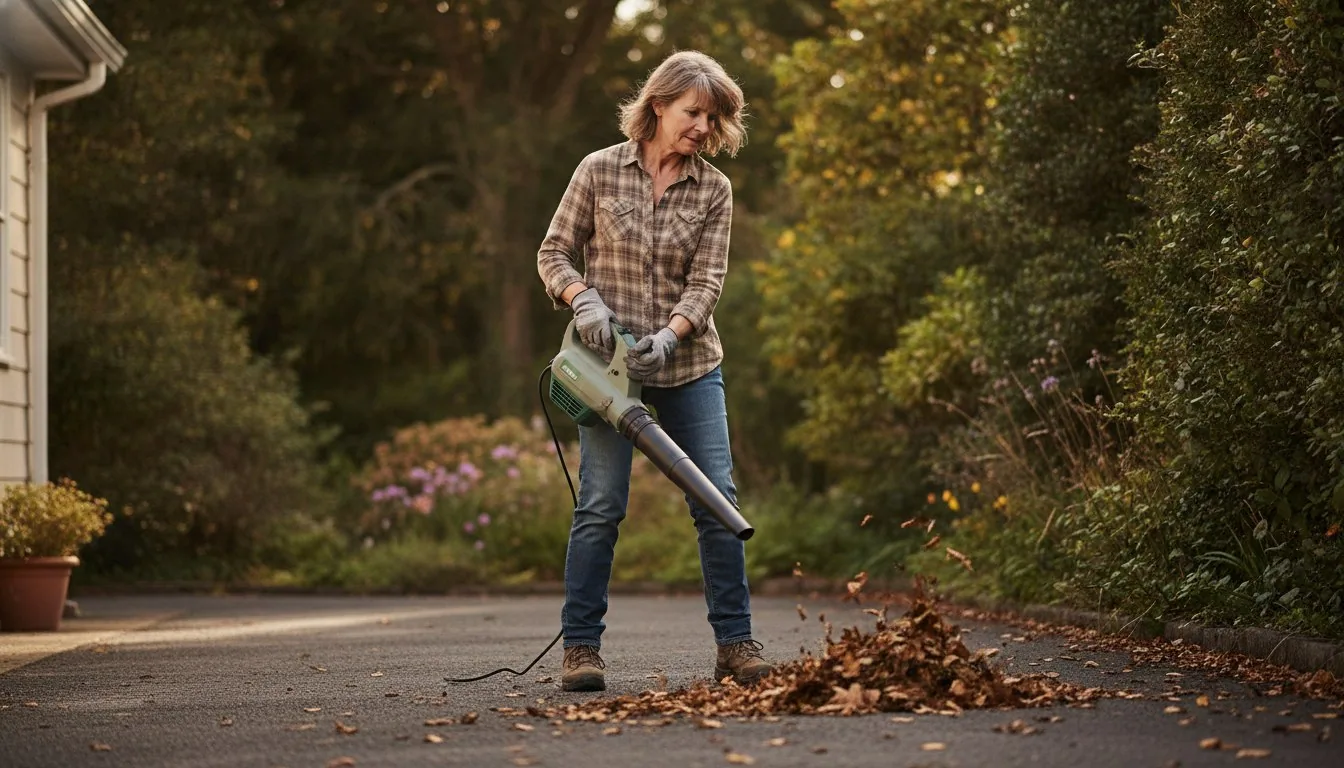
A cordless handheld leaf blower drops the fuel tank and the power cord in favor of a rechargeable battery pack, which cuts weight sharply compared with a backpack unit; the MTKOALA Leaf Blower Cordless is a representative model at 700 CFM with a stated runtime up to 160 minutes.
The MTKOALA Leaf Blower Cordless runs a 1200W brushless motor through three speed modes, pulling power from two 5.2Ah batteries for a combined runtime the listing states at up to 160 minutes, and it weighs a little under 8 lb, light enough for one-handed use across a yard without the shoulder strain a backpack model is built to solve. That weight difference is the real argument for a cordless handheld: at roughly a third the mass of a fueled backpack blower, it asks a lot less of the person holding it, even if the CFM and MPH numbers land a step below the biggest gas backpack units.
Other cordless handhelds in this category lean into portability further. The TNELTUEB Leaf Blower Cordless runs a turbo motor the listing rates at 98,000 rpm across six speed settings with a 180-degree rotating handle, while the WOLFBOX MF60&MF70 Compressed Air Duster shrinks the whole idea down to a 0.5 lb handheld unit built more for detail dusting than yard-scale clearing. The tradeoff that comes with all of it: batteries eventually run flat mid-yard, where a full gas tank on a backpack blower keeps going until it's empty, and swapping in a spare pack is the only way around that limit. Our cordless leaf blower guide lines up the current handheld and backpack battery lineup on runtime, weight, and CFM.
Gas-powered blowers: 2-cycle engines built for continuous runtime
A gas leaf blower runs a small 2-cycle engine on a fuel-oil mix instead of a battery, trading charging time for continuous runtime as long as the tank has fuel; the Husqvarna 150BT is a backpack example at 51cc and 765 CFM, and its output scales up in the larger 360BT.
The Husqvarna 150BT Gas Leaf Blower runs a 2-cycle, 51cc, 2.16 horsepower engine rated at 765 CFM and 270 MPH, with an air purge system built to clear the carburetor and fuel line for an easier restart after the engine has sat. Gas engines in this category don't need a charge cycle at all; as long as the tank holds fuel, the blower keeps running, which matters most on large properties where a battery pack would need a mid-job swap. The tradeoff shows up at startup and in upkeep: 2-cycle engines run on a gas-oil mix rather than straight gasoline, and that mix, along with periodic spark plug and air filter maintenance, is work a battery blower simply doesn't ask for.
The category also spans a wide weight and displacement range. The Thalorus 52cc Backpack Leaf Blower runs a similarly sized engine to the Husqvarna 150BT but at a lighter 13.6 lb body weight by its own listing, while the Husqvarna 360BT steps up to a 65.6cc, 3.81 horsepower engine for higher-end clearing work. Gas 2-cycle and 4-stroke small engines used in leaf blowers fall under the EPA's nonroad spark-ignition engine emissions program, which sets exhaust standards separate from any noise rule a city might apply locally. Our gas leaf blower guide compares the current 2-cycle lineup on displacement, CFM, and weight.
Vacuum and blower combos: one motor, three jobs
A vacuum/blower combo switches the same motor between blowing, vacuuming, and mulching modes, collecting shredded leaves in an attached bag instead of leaving them in a pile; the WORX Cordless Leaf Blower (WG583) is a current 3-in-1 example that runs a brushless motor with 2-speed control.
The WORX Cordless Leaf Blower, model WG583, converts between blowing, vacuuming, and mulching without swapping tools, running a brushless motor with 2-speed control that shreds leaves into a fraction of their loose volume as it collects them. That collection step is the whole reason this category exists: a pure blower moves leaves into a pile someone still has to bag by hand, while a combo unit does the bagging as part of the same pass. The mulch ratios these units advertise vary widely by model, so the specific figure is worth checking on the unit you actually pick.
Corded combos in the same family trade battery runtime limits for a plug-in power source. The WORX Trivac 3 in 1 Electric Leaf Blower runs 350 CFM and 210 MPH off a standard outlet with an 18:1 mulch ratio on some listings in the line, which suits a smaller yard within cord reach better than a large property. What every combo shares against a plain blower is added weight and bulk from the collection bag and impeller housing, a fair trade if raking is the part of the job you're trying to skip. Our leaf blower vacuum guide compares the current corded and cordless combo lineup on CFM, mulch ratio, and bag capacity.
Noise is the practical difference buyers notice first, whatever the type
Gas backpack blowers generally run louder at the source than battery handhelds, though every model's printed rating depends on test distance and load; OSHA's occupational exposure limits, while built for workplace settings, offer a useful reference point for how loud is loud.
A spec sheet for a leaf blower rarely prints a decibel rating the way generators or fans in this catalog do, but the underlying acoustics work the same way: sound follows an engine's RPM and airflow volume, and a 72cc gas engine pushing 880 CFM is working harder, and therefore generally louder at the source, than a battery motor moving 500 to 700 CFM. The gap isn't fixed across every model, since muffler design and impeller shape both affect the result, but it's consistent enough that noise complaints in residential areas are aimed almost entirely at gas equipment rather than battery tools.
OSHA's Technical Manual notes that the decibel scale is logarithmic, meaning a small numeric jump reflects a much larger jump in actual sound energy, and the agency's occupational exposure limit sits at 90 dBA averaged over an 8-hour day, with a hearing-conservation action level of 85 dBA. Those thresholds were written for workplace exposure, not backyard leaf clearing, but they're a fair reference point: a gas backpack blower run at close range for an extended stretch is a meaningfully different noise exposure than a lighter cordless handheld used for ten minutes on a small lot. Some municipalities have gone further and restricted gas-powered leaf blower use directly, citing both noise and the emissions covered in the gas section above, which is worth a quick check of local rules before buying a gas model specifically. Whatever the different types of leaf blowers cost up front, that local-rules check costs nothing and can save a returned purchase.