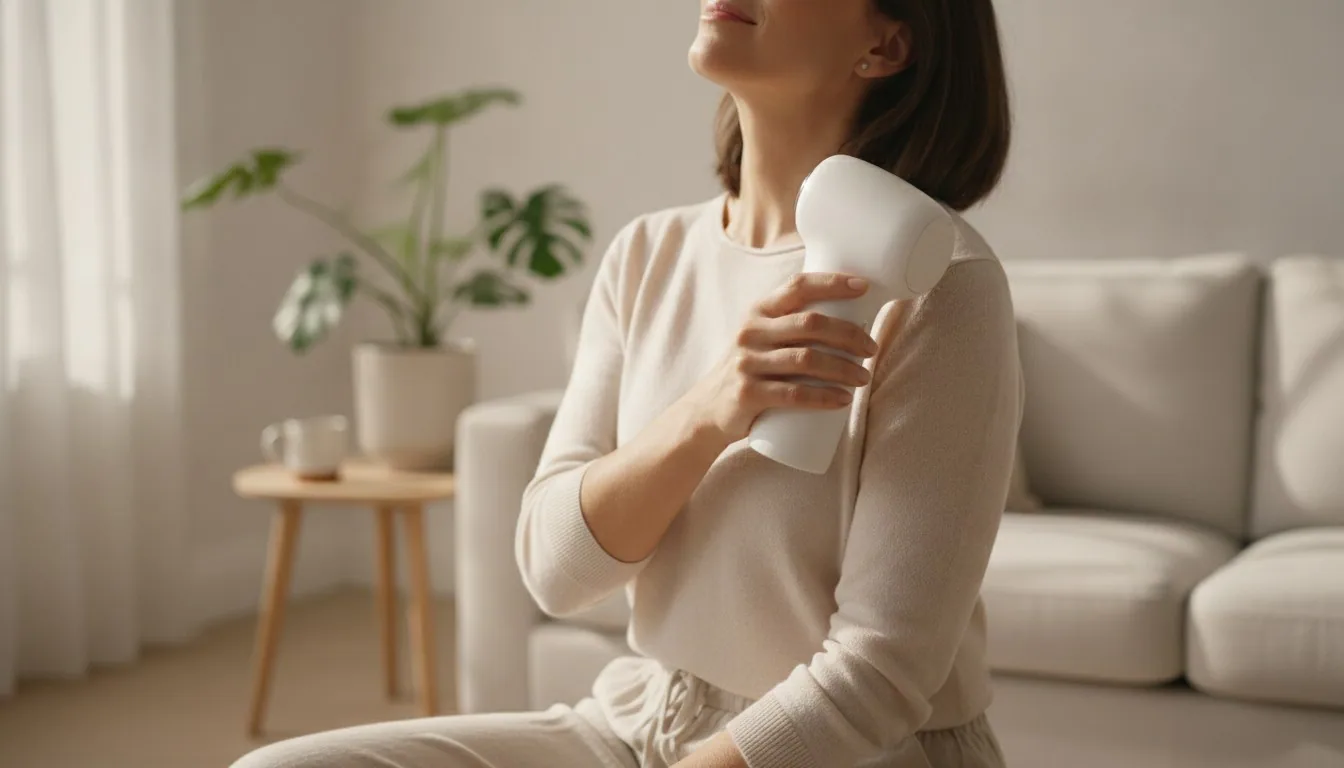
| Quick Facts | |
|---|---|
| Adults who used massage therapy in 2022 (NCCIH) | 10.9 percent |
| Range-of-motion gain from massage gun use (systematic review) | about 3 to 5 degrees |
| Systematic review sample | 11 studies, 281 participants |
| Typical massage gun frequency range | roughly 20 to 50+ Hz depending on setting |
| Cellulite massage results fade after stopping treatment | within about 1 month (AAD) |
| Fibromyalgia benefit threshold for continued massage | 5+ weeks of ongoing sessions (NCCIH) |
| Typical auto-shutoff time for overheating protection | about 10 to 15 minutes of continuous use |
Do massage guns work, or is it just vibration and marketing
Massage guns work for what researchers call short-term outcomes, less perceived soreness, better flexibility, looser muscle stiffness, but the evidence does not support claims about strength gains or long-term structural change.
Shopping for a specific model? See the best massager we tested — 10 models compared on the specs that decide it.
A 2023 systematic review published in the Journal of Functional Morphology and Kinesiology pooled 11 studies covering 281 participants and asked exactly this question. The pattern that emerged was consistent: massage guns reliably improved range of motion, with gains of roughly 3 to 5 degrees in ankle and hamstring flexibility tests after brief two-to-five-minute sessions. That is a real, measurable effect, not just a feeling of looseness.
What the same review did not find is more instructive. Strength and explosive-power measures, jump height, bench press output, sprint acceleration, showed no consistent improvement, and one included study actually recorded a small drop in jump height right after treatment. So the honest framing is narrower than most product pages suggest: a massage gun is a recovery and mobility tool, not a performance enhancer, and the research base backs the first claim far better than the second.
A separate 2024 study on 65 active adults added a useful gut-check. Researchers ran a massage gun at 53 Hz on one calf for five minutes after strenuous exercise and used the other leg, untreated, as a control. Range of motion, circumference, and strength came out statistically the same between the two legs, and soreness scores actually trended slightly worse in the treated leg in the hours afterward. That is not the story most reviews tell, and it is worth sitting with: benefits look real in aggregate, but they are not guaranteed every time, on every muscle, for every person.
How do massage guns work, mechanically
A massage gun drives a motorized arm back and forth into muscle tissue dozens of times per second, a motion called percussive or vibration therapy that briefly increases local blood flow and interrupts pain signaling.
Percussive devices use a small motor to push an attachment head in and out against skin and muscle at a set frequency, commonly somewhere in the 20 to 50-plus hertz range depending on the model and the setting chosen. That repeated compression briefly increases blood flow to the area, similar in principle to what happens during manual massage, and researchers believe part of the soreness relief comes from a gate-control effect: the rapid mechanical input competes with pain signals traveling the same nerve pathways, which can make an ache feel duller for a while.
The attachment head matters more than most buyers expect. A rounder, softer head spreads pressure over a wider area and suits large muscle groups like the quads or lats; a narrower or bullet-shaped head concentrates force into a smaller trigger point but carries more risk of overdoing it on sensitive tissue. Running a device at high frequency for a long stretch on one spot is a common way people turn a helpful five-minute session into next-day tenderness that has nothing to do with the workout that came before it.
How do massages work in general, and where guns fit in
Manual massage therapy and mechanical massagers both work through the same basic channels, increased local circulation, reduced muscle guarding, and short-term nervous system calming, but hands-on massage has a deeper and more mixed evidence base across specific conditions.
NCCIH, the National Center for Complementary and Integrative Health at the National Institutes of Health, tracks the research on manual massage therapy specifically and reports that usage has grown fast: 10.9 percent of U.S. adults used massage therapy in 2022, more than double the share in 2002. The center's review of the evidence is measured rather than glowing. For chronic low-back pain, the evidence shows a real benefit but the strength of that evidence is rated low. For knee osteoarthritis, five of six reviewed studies found short-term pain relief. For fibromyalgia, benefits show up mainly when massage continues for five weeks or longer, a detail that matters because it means a single session is unlikely to move the needle much.
Massage guns did not exist when most of that manual-massage research was designed, so the two bodies of evidence do not map onto each other perfectly. A percussive device is faster, more localized, and easier to self-administer than a full-body session with a trained therapist, which is exactly why it has become popular for muscle-specific complaints like a tight calf or a sore shoulder rather than the whole-body relaxation that a massage table session is built for.
Does a massager help with cellulite, and does a cellulite massager work
Cellulite massagers can temporarily smooth skin texture by moving fluid and stimulating circulation, but no massage device, including FDA-cleared ones, produces a permanent reduction in cellulite once sessions stop.
This is one area where the marketing gap is widest. The American Academy of Dermatology places massage-based cellulite treatments, the vacuum-and-roller style used in professional endermologie systems, in its middle evidence tier: some studies found no measurable difference between treated and untreated skin, others found a noticeable but temporary smoothing. Either way, the AAD is specific about durability: cellulite tends to return within about a month of stopping treatment, which means a handheld roller or vibration massager used a few times will not deliver a lasting change on its own.
What is happening physiologically when a cellulite massager does show a visible difference is mostly fluid movement and skin surface effects, not fat reduction. Moving surface fluid and mildly increasing blood flow can make skin look smoother for a matter of hours or days, similar to what a tight compression garment does temporarily. Buyers expecting a home device to match an in-office energy-based cellulite treatment, the kind that uses heat, suction, or acoustic waves under clinical supervision, are working from a different evidence tier than a consumer massager was ever designed to hit.
How do massage chairs work, and is the evidence different
Massage chairs use rollers, airbags, and sometimes heat to mimic kneading and compression across the back, neck, and legs, and the same short-term pattern seen with manual massage and percussive guns shows up here: real relief for localized muscle tension, with less consistent results on blood pressure and stress markers.
Massage chairs are mechanically closer to full-body manual massage than a handheld gun is, since they combine rolling, kneading, and air-bladder compression across multiple zones instead of one localized percussive strike. That distinction matters for what the broader massage-therapy evidence, described above, would predict: sustained kneading and compression across the neck, shoulders, and lower back plausibly eases the same kind of localized muscle tension that NCCIH's review of manual massage documents, rather than acting through some separate mechanism.
The less settled question is blood pressure and broader stress markers. NCCIH's review of manual massage overall reports mixed, low-to-moderate-strength evidence on relaxation and cardiovascular outcomes rather than a consistent effect, and there is no massage-chair-specific trial in the reference list below to back a stronger claim than that. The fair summary, staying within what is actually documented here, is that a massage chair likely eases physical tension in the areas its rollers contact, in line with the general massage research already covered, while claims about lowering blood pressure or calming the nervous system long-term rest on thinner ground. Readers comparing options across the whole massager category can start with our massager buying guide, and anyone specifically weighing a full-back chair unit against smaller alternatives will find the tradeoffs laid out in our chair and back massager buying guide.
Why does my massage gun not work, and how to get real results from one
A massage gun that seems to do nothing is usually a settings or technique problem, wrong head, too much pressure held too long, wrong timing relative to exercise, rather than a defective device, and the same fixes apply to most percussive massagers regardless of brand.
When a massage gun feels like it is not helping, the cause is rarely the motor. Pressing too hard directly onto a joint or bone transmits force the device was never meant to absorb there, and it can leave an area feeling worse rather than better. Running one head, especially a narrow or pointed attachment, on the same spot for more than a couple of minutes tends to irritate rather than relax tissue, which is the opposite of the intended effect. Timing matters too: research on delayed-onset muscle soreness suggests using a massage gun either right after activity or in the 24-to-72-hour window afterward, not randomly whenever it is convenient.
Battery and mechanical issues are the other common culprit, and they are usually simple to rule out. A gun that will not power on typically needs a longer press on the button, two to three seconds rather than a tap, or a fresh charge if the indicator light shows nothing. Devices that auto-shutoff mid-session are frequently just overheating protection kicking in after roughly ten to fifteen minutes of continuous run time, which is a safety feature, not a fault. If a unit still underperforms after checking pressure, head choice, session length, and charge, treat it as this specific device's issue rather than evidence that percussive therapy in general does not work; the research reviewed above says otherwise when the basics are followed. Anyone shopping fresh after a frustrating experience with one model can compare current options in our massage gun and general massager picks before assuming the whole category is a bust.
What massagers cannot do
No handheld or chair massager, however well built, replaces licensed medical treatment, fixes chronic pain sources like disc or nerve injuries, or builds strength, and devices should be skipped entirely over open wounds, recent fractures, or areas with blood clot risk.
It is worth stating the limits plainly, because the research above is easy to over-read into a broader endorsement than it supports. Cleveland Clinic guidance on percussive devices is explicit that massage guns have not been proven to improve speed, power, or endurance, only recovery-adjacent outcomes like soreness and short-term flexibility. NCCIH's broader massage research reaches a similar ceiling for manual massage: helpful for some pain conditions, generally as a short-term or supportive measure, not a stand-alone cure for anything structural.
Safety limits matter as much as effectiveness limits. Guidance consistently flags recent fractures, open wounds, active skin infections, deep vein thrombosis or other clotting disorders, and pregnancy-related contraindications as reasons to skip percussive or vibration massage entirely, or to check with a clinician first. None of that is meant to talk anyone out of buying one; it is meant to set expectations at the level the evidence actually supports, which is still a genuinely useful one for everyday muscle tightness and post-workout soreness. Foot-specific and hand-specific massagers carry the same basic logic, real short-term relief for tired, overworked muscles, with the same ceiling on anything more ambitious; our foot massager guide and hand massager guide both compare current options built around that narrower, honest use case.