Backpack vs handheld leaf blower: how to choose
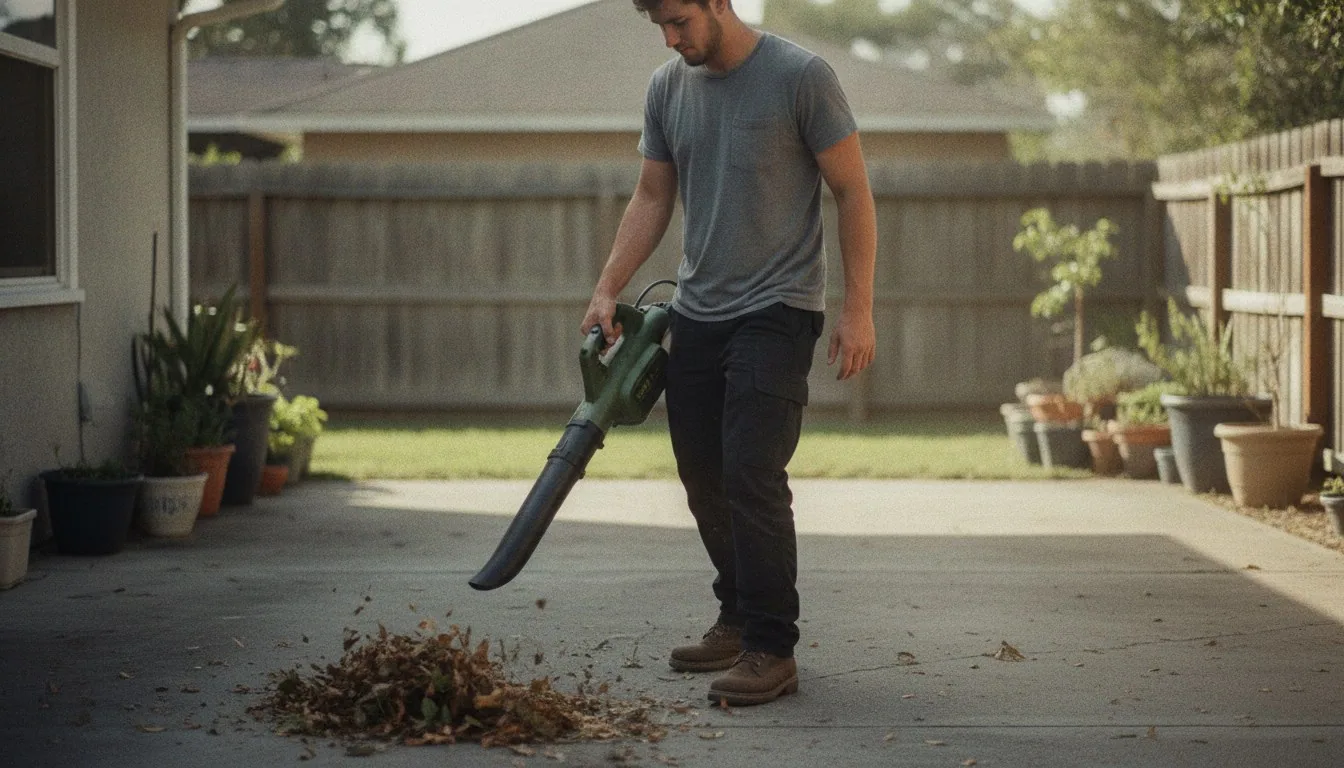
Every fall the same argument plays out in driveways and garden centers: strap a blower to your back, or just grab it and go. A backpack leaf blower and a handheld leaf blower move the same air, more or less, but they put the weight in completely different places, and that one difference decides which one you'll actually want to use for more than ten minutes. The backpack vs handheld leaf blower question isn't about which is more powerful on paper. It's about how long your arm and your back are willing to cooperate.
In the backpack vs handheld leaf blower choice, a backpack leaf blower carries its engine on a harness so the weight rests on your shoulders and hips, built for large properties and long sessions, while a handheld leaf blower is lighter and one-handed, built for quick cleanups, patios, and tight spaces. Pick a backpack for acreage, a handheld for speed.
| Spec | Backpack leaf blower | Handheld leaf blower |
|---|---|---|
| Median weight (our lineup) | About 21.6 lb, carried on a harness | About 7.7 lb, carried in one hand |
| Fatigue over long sessions | Harness distributes weight to shoulders and hips, easier over 30+ minutes | One-arm grip tires faster on extended jobs |
| Best property size | Large lots, mature trees, commercial jobs | Small yards, patios, driveways, cars |
| Setup and storage | Harness takes longer to put on, bulkier to store | Grab-and-go, easier to store on a shelf |
| Typical airflow (CFM) | Higher on most gas models in our lineup | Lower on most compact models in our lineup |
| Noise exposure | Depends on power source, not format | Depends on power source, not format |
| Tank/battery capacity | Larger, fewer mid-job stops | Smaller, more frequent refuel or recharge on big jobs |
Backpack vs handheld leaf blower: the core trade-off
A backpack leaf blower moves its weight onto a harness across your shoulders and hips, while a handheld leaf blower keeps everything in one arm, a trade between comfort over long sessions and simplicity for short ones.
Shopping for a specific model? See top-rated leaf blowers models — 10 models compared on the specs that decide it.
The whole comparison starts with where the weight goes. A backpack leaf blower puts the engine or battery pack behind you, held by a padded harness, and you only carry the tube and nozzle out front. That shifts the real load, often well over 20 lb, onto your hips and shoulders instead of your forearm. Across the backpack blowers in our lineup, the median weight sits around 21.6 lb, and models like the PROYAMA 72CC Gas Backpack Leaf Blower and the Husqvarna 360BT Gas Leaf Blower land in that same range once the harness is doing its job.
A handheld leaf blower skips the harness entirely. The whole unit, motor and all, rides in one hand, which keeps the design simple and the price usually lower. Our handheld and cordless lineup runs a median of about 7.7 lb, roughly a third of a backpack unit's weight, but that number can be misleading on its own: a 7 lb blower held out at arm's length for twenty minutes straight tires a wrist in a way a 21 lb backpack unit, properly strapped in, often doesn't. Neither number tells the whole story until you factor in how long you're actually running it, which is really what the backpack vs handheld leaf blower decision comes down to.
Where a backpack leaf blower wins
A backpack leaf blower wins on acreage, thick leaf piles, and any job that runs long enough for arm fatigue to become the deciding factor.
Size the yard first. A backpack blower earns its extra weight on a property big enough that you're running the machine for half an hour or more without a break, because that's exactly when a handheld unit starts to hurt. The harness spreads the load across your torso instead of concentrating it in a gripping hand, and most backpack models pair that comfort with a bigger fuel tank or battery, so you're not stopping mid-job to refuel or swap a pack.
Power tends to scale with the format too. Gas backpack models like the Husqvarna 150BT Gas Leaf Blower and the Getell Professional Gas Powered Backpack Leaf Blower push several hundred CFM of airflow, enough to move wet, matted leaves that a lighter handheld unit would just skate across. If your yard runs to a quarter acre or more, has mature trees dumping heavy leaf litter every fall, or you're clearing a commercial lot, our backpack leaf blower guide breaks down the current models by CFM, weight, and runtime.
Where a handheld leaf blower wins
A handheld leaf blower wins on speed, storage, and small jobs, patios, porches, and cars, where strapping on a harness would take longer than the cleanup itself.
Some jobs are over before a backpack blower's harness would even be adjusted. Clearing a porch, a short driveway, or the inside of a car doesn't need acreage-grade airflow; it needs something you can grab off a garage shelf, run for two minutes, and put back. A handheld leaf blower does that without straps, without a fuel or battery swap plan, and without the bulk of a backpack unit taking up shelf space between uses.
Cordless handheld models add another layer of convenience: no cord to drag, no gas to mix, just a battery pack you charge between uses. Several models in our lineup, including compact options built around small brushless motors, weigh well under 5 lb, light enough that arm fatigue barely enters the conversation for a job under ten minutes. For anyone whose blower duty is mostly quick touch-ups rather than a full yard clear, our cordless leaf blower guide lines up the current handheld models by weight, runtime, and airflow.
Noise and hearing exposure: what the research actually says
Leaf blowers, backpack or handheld, routinely exceed the noise levels regulators consider safe for unprotected extended exposure, with gas models running loudest.
This is the part spec sheets tend to leave out. A field study of landscaping workers, drawing on NIOSH sampling, measured gas-powered leaf blowers at a mean noise exposure of 96.9 dBA across 157 observations, with individual readings ranging from 71.8 to 105.9 dBA. Battery-powered leaf blowers measured quieter but still not safe by comparison, averaging 86.4 dBA across 39 observations, a gap the same research attributed to the engine noise that gas models add on top of the fan itself.
Both figures sit above NIOSH's recommended exposure limit of 85 dBA, and OSHA's own permissible exposure limit for an 8-hour workday is 90 dBA, with a hearing conservation program required once worker exposure hits 85 dBA as an 8-hour average. On the backpack vs handheld leaf blower question specifically, a backpack blower doesn't inherently run louder than a handheld one, size isn't the variable, power source is, but the format matters indirectly: backpack units are the ones most often run for the longer sessions where hitting that daily exposure threshold actually happens. If you're running either type for more than a few minutes at a time, hearing protection isn't optional gear, it's the cheapest insurance against a genuinely permanent problem.
Weight, fatigue, and how long you can actually run one
A backpack blower's harness makes its higher weight easier to tolerate over a long session than a handheld blower's lighter but one-arm-only design.
Raw weight numbers flatter the handheld category, but they miss how fatigue actually accumulates. Holding even a 7 lb handheld unit at arm's length, angled down toward the ground, engages your shoulder and forearm in a way that gets uncomfortable well before the half-hour mark for most people. A properly adjusted backpack harness moves that same fatigue point out considerably further, since the load rests on your hips and the strongest muscles in your body instead of a single extended arm.
That's the trade the extra roughly 14 lb of backpack weight, our lineup's 21.6 lb median against the handheld median of 7.7 lb, is actually buying: comfort over a long job, at the cost of comfort putting it on and taking it off for a short one. Neither format is wrong about this trade-off. A five-minute driveway clear doesn't justify strapping into a harness, and a two-hour yard clear doesn't forgive an aching forearm from a handheld unit that was never built for it.
Which one should you actually buy
Choose a backpack blower for large properties and long sessions where the harness earns its keep; choose a handheld blower for small jobs, quick cleanups, and easy storage.
Settling the backpack vs handheld leaf blower question starts with how long you'll actually be running the thing, not just how big your yard looks on paper. A large lot with mature trees, a commercial property, or any job that regularly runs past twenty or thirty minutes tends to reward the backpack format's harness and bigger tank or battery, even with the extra bulk to store and put on. A small yard, a patio, a porch, or a car interior rarely needs that much machine, and a handheld unit gets the job done faster, with less setup and less to store between uses.
Some households end up keeping both: a handheld for the quick jobs that come up weekly, a backpack for the seasonal leaf-drop that turns into an actual chore. Whichever you land on, treat the noise numbers as real, not just a spec-sheet footnote, and wear hearing protection past a few minutes of runtime either way. If you're still comparing the wider category before committing to a format, our best leaf blower guide rounds up top picks across backpack, handheld, and cordless styles side by side.
A backpack leaf blower wins on big properties and long sessions, where its harness and bigger tank or battery earn back the extra weight. A handheld leaf blower wins on small jobs, storage, and pure convenience, where strapping into a harness would take longer than the cleanup itself. Match the format to the job size and how long you'll actually be running it, not to whichever spec sheet lists the bigger CFM number.
Frequently asked questions
Is a backpack leaf blower more powerful than a handheld leaf blower?
Which is better for a small yard, backpack or handheld?
How loud is a backpack leaf blower compared to a handheld one?
Do I need hearing protection for a leaf blower?
Can a handheld leaf blower handle a full yard clean-up?
Sources & references
- Occupational Noise Exposure — Occupational Safety and Health Administration
- Hazardous exposures and engineering controls in the landscaping services industry — National Institute for Occupational Safety and Health (NIOSH), via PMC