| Quick Facts | |
|---|---|
| Safe internal temperature | 145 degrees F (62.8 C) for whole beef cuts |
| Rest time | At least 3 minutes |
| Grill setup | Two zones, one fierce and one gentle |
| Before cooking | Pat the surface dry |
| Salt timing | Right before cooking, or 40 minutes ahead |
| Turning | Often, which reduces HCA formation |
| HCA formation rises above | 300 degrees F (NCI) |
| Where to measure | Thickest part, away from bone and fat |
How hot should a grill be for steak when it goes on
Hot enough to brown the surface within about two minutes a side, which needs a full preheat rather than a partial one.
Here is the useful way to think about it. Browning is a surface event. It only starts once that surface is dry and genuinely hot, and it stops the moment the surface cools down.
So the question of how hot should a grill be for steak is really a question about the first thirty seconds. Put a steak on bars that are merely warm and the meat cools them further. Now nothing browns. The steak sits there leaking juice, and the juice keeps the surface wet, and a wet surface cannot brown at all.
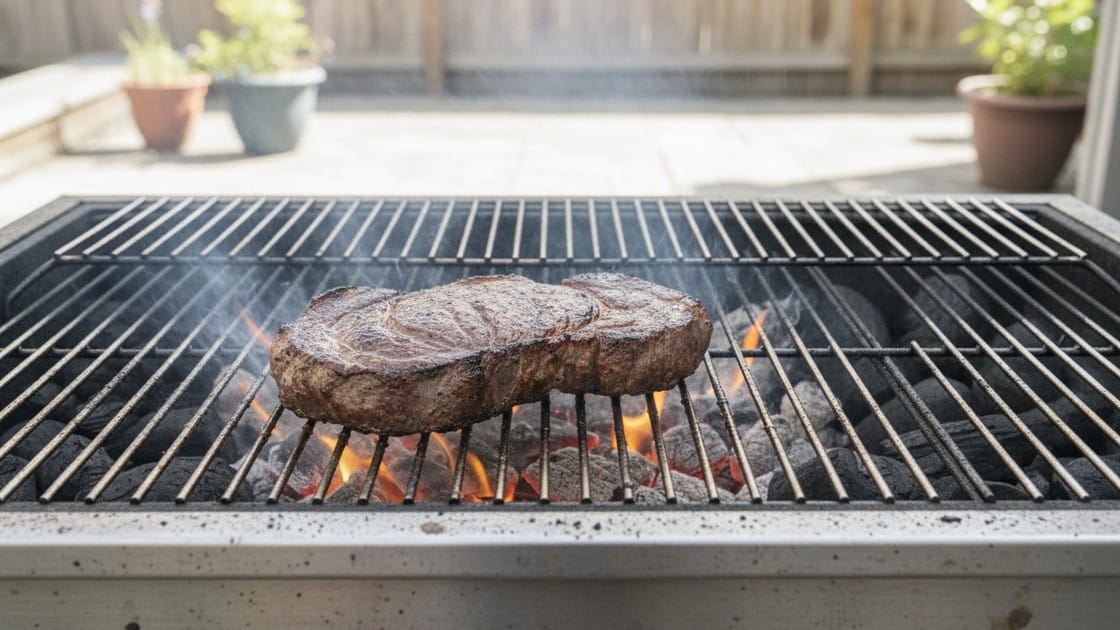
Give the grill its full preheat instead, lid down, until the bars are hot enough that a steak hitting them keeps sizzling rather than falling silent. That sizzle is water boiling off, and it is the sound of the surface staying hot enough to work.
Charcoal is ready when the coals have ashed over and glow evenly. Gas needs a proper preheat with the lid closed, and rushing it is the single most common cause of a grey steak.
Dry the steak, because water is the real enemy
Surface moisture boils off before browning can begin, so a wet steak wastes the hottest part of the cook.
Water boils at 212 degrees Fahrenheit and cannot go higher while it is still water. Browning needs a much hotter surface than that. So while there is moisture sitting on the steak, the surface is stuck at boiling point and none of the useful reactions get going.
All that heat is being spent on evaporation instead of flavour. By the time the surface finally dries, the inside has been cooking for minutes, and now you are racing.
The fix takes ten seconds. Pat both faces and the edges with paper towel right before the steak goes on. If the steak came straight from the fridge in a sealed pack, dry it twice.
Salting ahead helps too, but only with enough time. Salt draws moisture out and then it gets reabsorbed, so either salt right before cooking or salt at least forty minutes ahead. Salting five minutes before is the one timing that leaves the surface wettest.
Two zones beat one hot fire
Sear over the fierce side, then move the steak to a cooler side to finish without burning.
A single blazing fire can only do one job. It browns the outside beautifully and then keeps hammering it while the middle slowly catches up. Thick steaks are where this goes wrong, because the middle takes long enough that the crust turns black waiting.
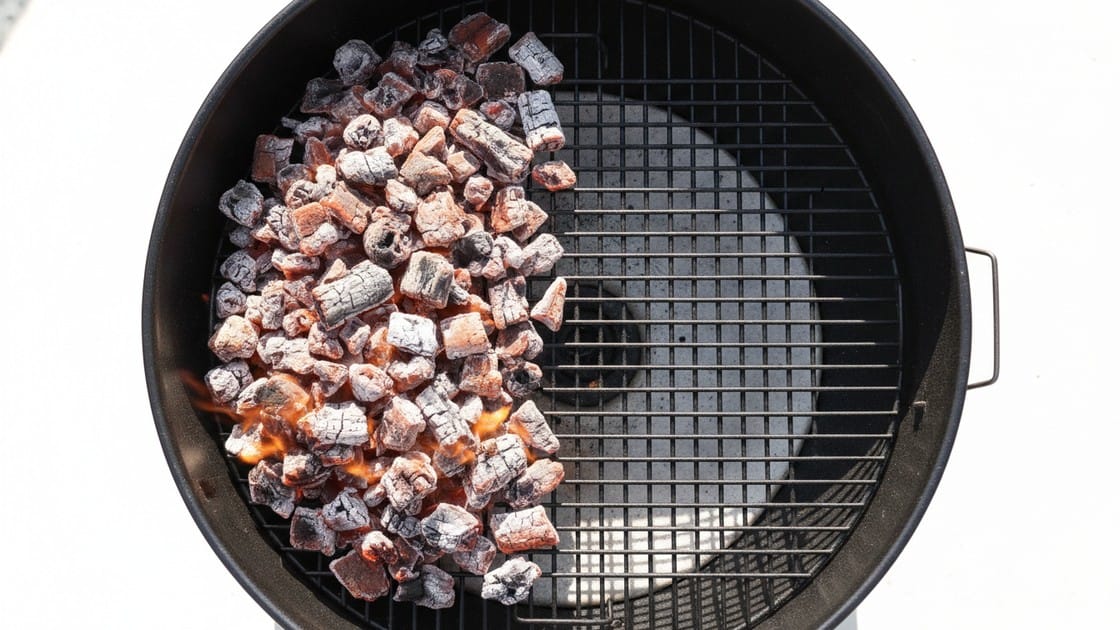
Two zones fix it. On charcoal, bank the coals to one side, so half the grill is fierce and half is gentle. On gas, run one burner high and leave a neighbouring burner off.
Then the sequence is simple. Sear the steak over the hot side until it has real colour on both faces. Move it to the cool side, close the lid, and let the middle come up in the gentler heat. Pull it at the temperature you want.
A steak under an inch thick often does not need the second stage at all, since the middle arrives while the crust is still forming. The thicker the cut, the more the cool side matters.
The inside number is what decides doneness
Whole cuts of beef are done at 145 degrees Fahrenheit followed by a three minute rest.
Grate heat controls the crust. It does not tell you when the steak is ready. Only the internal temperature does that.
The USDA sets 145 degrees Fahrenheit, or 62.8 degrees Celsius, for whole cuts of beef, pork, veal and lamb, and then asks for a rest of at least three minutes before carving or eating. That rest is part of the instruction, not a garnish.
Measure in the thickest part of the steak, keeping the probe away from bone and fat. Take it off a little before the target if you like, since a thick steak keeps rising for a short time after it leaves the heat.
The USDA also warns that grilled meat browns quickly on the outside, so a thermometer is what confirms the inside. The full set of numbers for every cut is in our guide to choosing a grill and cooking on it, and burgers follow a different rule entirely because ground meat has its surface mixed through the middle.
After the steak comes off
Hold cooked meat at 140 degrees Fahrenheit or warmer, and clear leftovers within two hours.
The cooking ends and the food safety does not. If the steak is waiting while everything else finishes, it needs to wait hot.
USDA guidance is to keep cooked meat at 140 degrees Fahrenheit or warmer until it is served. On a grill the simple way is to move it to the side of the rack, away from the coals, so it holds without carrying on cooking. Indoors, an oven at around 200 degrees Fahrenheit does the same job.
Then there is the table. Discard any food left out more than two hours, and cut that to one hour once it is above 90 degrees Fahrenheit outside. Steak weather and that shorter limit tend to arrive together.
One habit matters more than any of it. Do not put the cooked steak back on the plate that carried it out raw, and do not turn it with tongs you used on raw meat. USDA guidance is not to use the same platter, cutting board or utensils for raw and cooked food, because bacteria in the raw juices can contaminate a steak you have just cooked properly.
Anything you reheat later goes to 165 degrees Fahrenheit, or until it is steaming hot. And the rule that catches people out on a busy grill is worth repeating. Never cook a steak partway, take it off, and finish it later.
What very high heat costs you
Fierce heat and flare-ups create compounds worth limiting, and turning the steak often reduces them.
Searing is not free, and it is worth being straight about that. The National Cancer Institute notes that meats cooked above 300 degrees Fahrenheit, as in grilling or pan frying, tend to form more heterocyclic amines. Cooking for a long time at high temperatures does the same.
There is a second route as well. Fat and juices dripping onto the fire cause flames and smoke, and that smoke carries polycyclic aromatic hydrocarbons which then stick to the surface of the meat. A steak sitting in a flare-up is being coated in them.
The practical steps are small. Continuously turning meat over on a high heat source substantially reduces heterocyclic amine formation, so flip often rather than leaving each side down for one long spell. Keep the steak out of direct flame, move it off a flare-up rather than waiting it out, and cut away any charred portion before eating.
None of this argues against a hot grill. It argues for a hot grill you are actively managing, which is what a charcoal setup and a two-zone fire make easy. Compare that against the alternatives in our grill types explainer.