| Quick Facts | |
|---|---|
| Suction power range, cordless robotic cleaners we compare | about 3,038 GPH to 6,800 GPH |
| Suction power, three-motor iGarden KN Series | up to 17,000 LPH combined |
| Flow rate, handheld pole vacuums we compare | about 12.8 GPM to 18.5 GPM |
| Dual-layer filtration example (Aiper Scuba S1) | 180-micron standard filter plus 3-micron ultra-fine layer |
| Single-stage filtration mesh range | about 150 to 200 microns |
| Cordless robotic runtime range | 120 to 300 minutes per charge |
| Rated coverage area range, cordless robotic cleaners | up to 850 sq ft (compact) to 3,229 sq ft (largest-rated) |
| Suction-/pressure-side hose length range | 31 to 39 feet |
| Weight range across cleaner types we compare | about 2 lb (handheld) to 23.15 lb (heaviest robotic) |
| CDC recommended pool chemistry range | free chlorine 1-4 ppm (or bromine 3-8 ppm), pH 7.0-7.8 |
The three ways a cleaner actually gets around your pool
Robotic units carry their own motor and filter, suction-side models plug into your existing pump, and pressure-side units usually run on a separate booster pump, so the mechanism matters more than any single spec.
Shopping for a specific model? See top-rated pool cleaner models — 10 models compared on the specs that decide it.
Every automatic cleaner on the market solves the same problem three different ways, and the mechanism it uses matters more to your buying decision than almost any other spec. Robotic units are self-contained: they carry their own motor, their own filter, and either a rechargeable battery or a low-voltage cord, so they never touch your pool's plumbing at all. Among the models we compare, that independence shows up as dual-layer filtration systems built into the unit itself, plus onboard navigation sensors that plan a cleaning path rather than wandering randomly.
Suction-side units take the opposite approach. They plug into your pool's skimmer basket or a dedicated suction line and borrow flow from a pump you already own; the Hayward Poolvergnuegen in our comparison is a plain example, built to attach directly to a suction port or skimmer with no booster pump required. That makes suction-side models the cheapest way to automate cleaning for a lot of households, since you're not paying for a second motor.
Pressure-side units split the difference again: they connect to a return jet instead of a suction line, and several of the models we track, the Polaris Vac-Sweep 280 among them, run on a separate dedicated booster pump rather than the main circulation pump. That extra hardware is exactly why pressure-side units tend to sit at a higher tier than suction-side ones, worth knowing before you buy rather than discovering it during installation. Our pool cleaner hub sorts all three mechanisms side by side if you want the full spread before narrowing down, and our robotic pool cleaner picks break down the self-contained category for buyers who've already ruled out suction- and pressure-side setups.
Suction power and filtration micron ratings: the numbers that actually predict a clean pool
Suction rated in gallons per hour and the filter's micron rating together predict cleaning performance better than either spec alone.
Marketing copy loves the word "powerful," but two numbers do the actual predicting: suction rated in gallons per hour (GPH), and the filter's micron rating. Among the cordless robotic units we compare, rated suction spans a wide range, from 3,038 GPH on the WYBOT C1 up to 6,800 GPH on the Beatbot Sora 10, with the ECOVACS Ultramarine P1 landing around 4,800 GPH in between. The iGarden KN Series takes a different route entirely, running three brushless motors rated at up to 17,000 LPH combined rather than one larger pump.
Filtration works on a separate axis from suction, and it's easy to confuse the two. A dual-layer setup like the one on the Aiper Scuba S1 pairs a 180-micron standard filter with a 3-micron ultra-fine layer underneath it, so the coarse mesh catches leaves and pebbles while the finer layer traps sand and algae particles the coarse mesh would miss. Simpler single-stage baskets, like the roughly 150-to-200-micron mesh on the AIPER EcoSurfer S2 and Betta SE Plus, skip that second stage, which keeps the unit lighter and cheaper but leaves finer debris to settle out on its own.
Neither spec tells the whole story alone. A unit with huge suction and a coarse filter moves a lot of water fast without trapping much of what's actually suspended in it, while a fine filter paired with weak suction just clogs faster without pulling in more debris to begin with. Check both numbers together, not whichever one is printed largest on the listing.
Suction-side and pressure-side units run on your pool's plumbing, not their own motor
Suction-side units rely on your existing pump's flow, which the US Department of Energy's new pool pump motor efficiency rule is reshaping, while pressure-side units run their own dedicated booster pump instead.
If you're shopping suction-side or pressure-side instead of robotic, the pump you already have, or don't have yet, becomes part of the purchase decision. Suction-side units like the Polaris Lynx are built to work with pool pumps generally, including low-speed and variable-speed models, according to its own spec sheet, and that compatibility matters more than it used to. The US Department of Energy's efficiency standard for dedicated-purpose pool pump motors requires most residential in-ground pump motors between 1.15 and 5 total horsepower, along with those under 0.5 THP, to meet new conservation requirements by September 29, 2025, with motors between 0.5 and 1.15 THP following by September 28, 2027.
That rule doesn't target cleaning equipment directly, but it reshapes the pump market underneath it. A suction-side unit rated only for a single-speed pump running at full flow can behave differently once that pump gets replaced with a lower-flow-capable model, which is exactly the compatibility Polaris and similar suction-side units call out on their spec sheets. Pressure-side units sidestep the issue by running their own dedicated booster pump instead, the Polaris Vac-Sweep 280 is a clean example, so the household's main pump speed matters less to a pressure-side unit than it does to a suction-side one.
Hose length is the other spec worth checking before checkout, since it determines how much of the pool the unit can physically reach. Among the suction- and pressure-side models we compare, hose length runs from 31 feet on the Vac-Sweep 280 up to 39 feet on the Polaris Lynx, with the Zodiac MX6 and U.S. Pool Supply Octopus landing in between at 32 and 33 feet. Measure your pool's longest diagonal before assuming a shorter hose reaches every corner. Our suction pool cleaner guide lists which models are rated for variable-speed pumps versus single-speed only, worth checking before you assume compatibility.
Handheld pole vacuums: the spot-cleaning tool a robot or suction unit doesn't replace
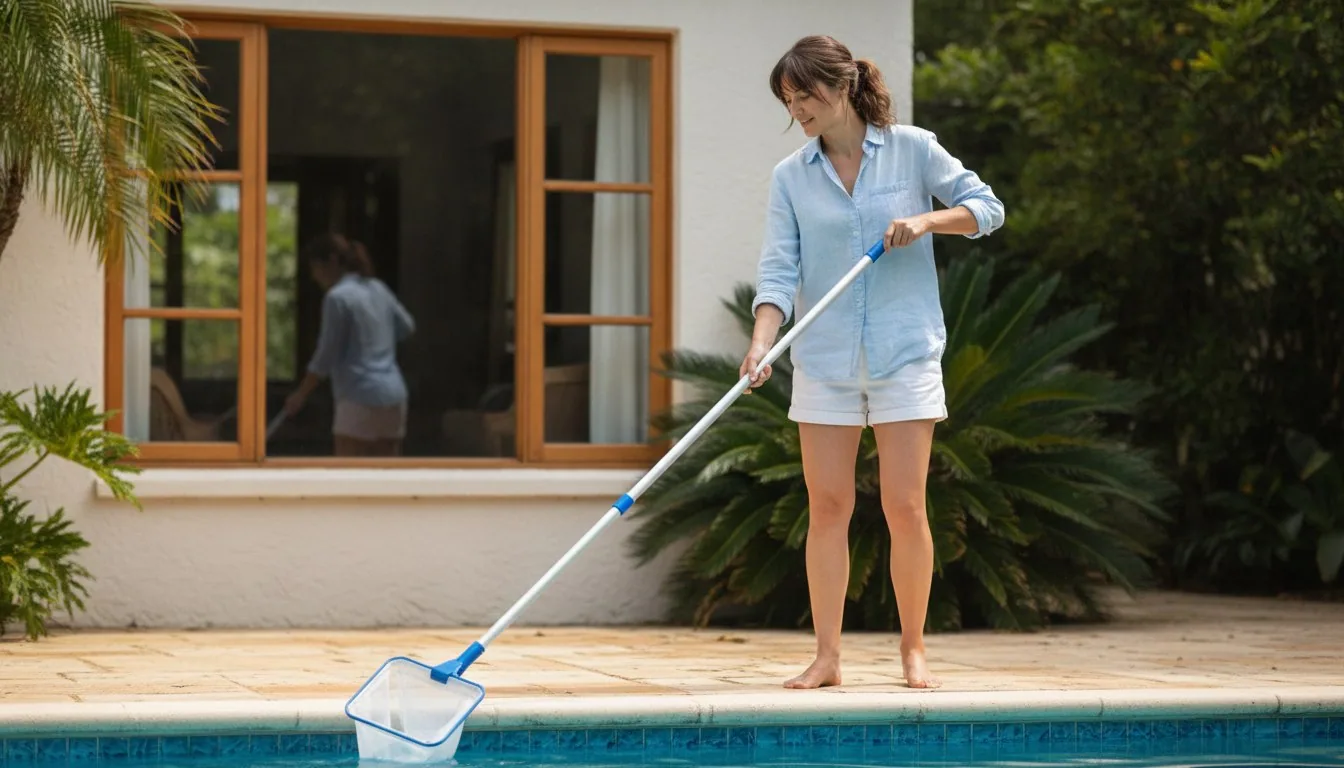
Handheld pole vacuums, rated in gallons per minute rather than gallons per hour, exist for spot-cleaning steps, corners, and spas that automatic cleaners can't reach efficiently.
Not every pool needs a full automatic unit running on a schedule. Handheld, pole-mounted vacuums exist for a narrower job: spot-cleaning a corner, a set of steps, or a spa that a robot or suction-side model can't reach efficiently. The AQUAFYSH Rechargeable Pool & Spa Vacuum in our comparison is built for shallow water down to 0.6 feet, the kind of depth that trips up larger robotic units, and rates its flow at up to 12.8 gallons per minute (GPM) on a 70-minute charge.
Rated suction on this category is measured in GPM rather than GPH, since these are smaller pumps built for short bursts of spot cleaning rather than a full pool circuit. The Enhulk PC10 in the same comparison rates its motor at up to 18.5 GPM, and the KOKIDO Cordless Handheld Vacuum lists a 60-decibel "silent operation" claim alongside a 60-minute runtime, useful context if noise matters for a spa attached to a bedroom wall.
Weight is where handheld units pull furthest ahead of everything else here: the AQUAFYSH vacuum weighs about 2 pounds, against 12 to 23 pounds for the cordless robotic units elsewhere in this comparison. That's the trade-off in plain terms: a handheld vacuum won't clean a whole pool unattended, but it's the cheapest and lightest way to handle the spots an automatic unit keeps missing. Our vacuum pool cleaner guide rounds up both the handheld and cordless robotic models in this category if you want the full range side by side.
Runtime, battery capacity, and coverage area for cordless robotic units
Match a cordless robotic unit's rated coverage area, not just its runtime, to your pool's actual size, since running near the rated limit risks a mid-cycle battery cutoff.
Cordless robotic units run on rechargeable batteries instead of a permanent cord, convenient until the battery runs out mid-cycle in a pool bigger than the unit is rated for. Runtime among the cordless models we compare spans from 120 minutes on the Coasteering Planet Edge and CliBot S1 up to 300 minutes on the Beatbot Sora 10, with most sitting in the 150-to-210-minute range in between.
Battery capacity backs that up in milliamp-hours: the Beatbot Sora 10 carries a 7,800mAh pack, well above the roughly 4,500mAh to 4,600mAh batteries in the Coasteering, CliBot, and ECOVACS Ultramarine P1 units. Bigger capacity generally tracks with both longer runtime and a heavier unit, so there's a real trade-off between how long a machine runs and how much it weighs coming out of the water.
Rated coverage area is the number that decides whether any of this matters for your specific pool. The ECOVACS Ultramarine P1 is rated for pools up to 1,937 square feet on a full charge, the Beatbot Sora 10 claims up to 3,229 square feet (300 square meters), and the Coasteering and CliBot models top out at 850 square feet, better suited to smaller above-ground and flat in-ground pools than larger custom shapes. Match rated coverage to your actual pool size with room to spare, since a unit working right at its rated limit is the one most likely to need a mid-cycle rescue.
What a cleaner can't do for your water
A pool cleaner removes physical debris but doesn't balance chlorine or pH; CDC guidance still calls for testing free chlorine and pH at least twice a day.
An automatic cleaner, robotic or otherwise, removes physical debris: leaves, sand, hair, the odd dead bug. It doesn't balance your water chemistry, and treating it as a substitute for regular testing is a common mistake among first-time owners. The CDC's guidance on pool disinfection recommends keeping free chlorine at 1 to 4 parts per million, or bromine at 3 to 8 ppm, and pH between 7.0 and 7.8, checked at least twice a day and more often during heavy use.
That chemistry matters independently of how well the cleaning equipment is working. The CDC notes that pH outside that range makes chlorine or bromine less effective at killing germs, on top of causing skin and eye irritation and damaging pool equipment, none of which a spotless-looking pool floor will fix. A pool can look debris-free and still be out of balance, since visible dirt and invisible chemistry aren't the same failure and don't respond to the same fix.
Where a cleaner does help chemistry indirectly is by keeping organic debris from sitting on the floor breaking down and consuming chlorine that would otherwise go toward killing germs. That's a real benefit, just not a replacement for test strips or a liquid kit. Budget for both: automated debris removal, and a testing routine for the water itself.
Choose a pool cleaner value tier that matches real use
Budget suction-side and handheld options cover routine debris removal, mid-range robotic units add scheduling and scrubbing, and premium picks add AI navigation and wireless charging, so buy for your pool size rather than the longest spec sheet.
Skip the temptation to buy the longest feature list you can afford. Budget-tier suction-side units and handheld vacuums handle routine debris removal for smaller pools and tighter budgets, asking little more than an existing pump and a garden hose's worth of setup. Mid-range robotic units add real conveniences: app scheduling, wall and waterline scrubbing, and dual-layer filtration, without stretching all the way to premium pricing.
Premium-tier picks, several of the AIPER Scuba V3 and top-spec Polaris models among them, add extras like AI-assisted debris detection, wireless charging docks, or active scrubbing brushes built for stubborn, stuck-on debris on pool walls. Whether that jump is worth it depends entirely on your pool's size and how much hands-on maintenance you're willing to do yourself; a large in-ground pool with heavy tree cover benefits from premium coverage and runtime far more than a small above-ground pool ever will.
If you want the full ranked comparison before deciding, our best pool cleaner comparison weighs all three mechanisms, robotic, suction-side, and pressure-side, against each other on spec and value, and our best automatic pool cleaner guide narrows that same comparison to the self-cleaning category specifically, useful if you've already ruled out handheld and suction-side options and just want the top picks.