Above-ground vs inground pool cleaner
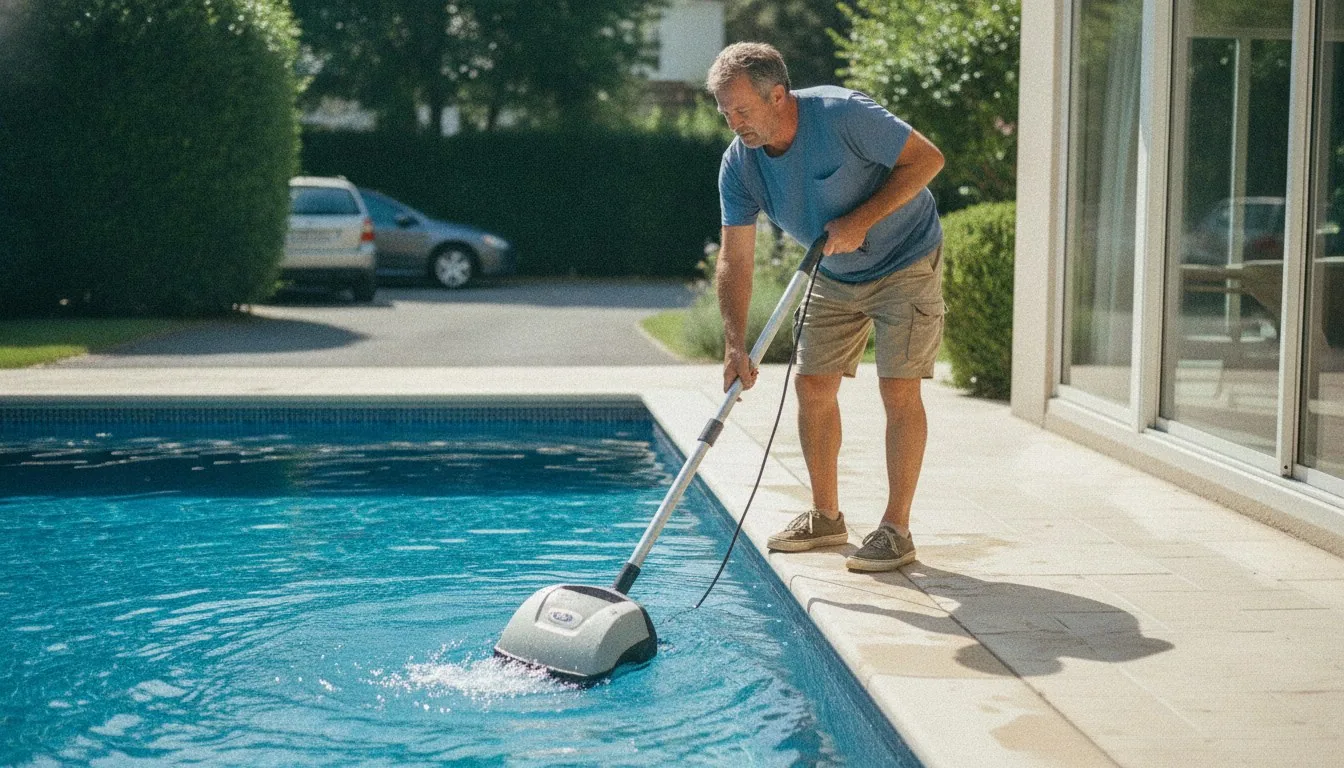
Ask five pool owners whether an above-ground cleaner and an inground cleaner are really different machines and you will get five different answers, most of them wrong in some small way. The real split sits in the plumbing and the shell, not the sticker on the box: a vinyl-lined tank with a flat floor asks a very different mechanical question than a plastered pit with a nine-foot deep end and a full flight of steps. Once you see it that way, the shopping decision stops being about brand loyalty and starts being about what your pool's shape and pump can actually feed the machine.
Above ground vs inground pool cleaner differences boil down to traction and flow more than branding. Inground models climb walls, steps and slopes and draw more water through a larger pump; above-ground models stay flat, run on lower flow, and are lighter to lift out. Robotic cleaners exist for both, but their power and weight scale to match.
| Spec | Above-ground pool cleaner | Inground pool cleaner |
|---|---|---|
| Pump flow required to run suction or pressure models | Lower - matched to a smaller above-ground pump | Higher - often needs a larger pump or a dedicated booster pump |
| Wall and step climbing ability | Not built in - the flat floor never asks for it | Required - traction systems climb rigid walls, steps and slopes |
| Surface the cleaner is built to protect | Vinyl liner - needs gentler brushes and lower suction force | Concrete, gunite, fiberglass or tile - tolerates more aggressive scrubbing |
| Typical hose or cord length | Shorter, sized to a smaller footprint | Longer, to reach a bigger deep end |
| Debris load the cleaner can handle unattended | Moderate - above-ground robotic units are generally less powerful | Higher - inground-rated robotic and pressure units carry larger bags |
| Electrical safety requirements | Same GFCI rule within 20 feet of the water | Same GFCI rule within 20 feet of the water |
| Weight and ease of retrieval | Lighter, easier to lift out solo | Heavier, with more motors and traction hardware |
| Quick Facts | |
|---|---|
| CPSC-tracked pool electrical incidents | 12+ electrocutions and a similar number of shocks over its multi-year study period |
| Robotic cleaner energy use (ENERGY STAR) | about 197 kWh per year |
| Filter-pump-powered cleaner energy use (ENERGY STAR) | about 1,675 kWh per year |
| Booster-pump-powered cleaner energy use (ENERGY STAR) | about 2,989 kWh per year |
| Certified in-ground pump savings (ENERGY STAR) | about energy than a standard pump |
| Certified above-ground pump savings (ENERGY STAR) | about energy than a standard pump |
| CDC recommended free chlorine range | 1 to 4 ppm |
| CDC recommended pH range | 7.0 to 7.8 |
What actually separates an above-ground pool from an inground pool
Above-ground pools are a vinyl liner stretched over a metal or resin frame with a flat floor and a simple corner where floor meets wall; inground pools are built from rigid concrete, gunite, fiberglass or tile, often with steps, benches and a sloped or stepped deep end.
Shopping for a specific model? See our best pool cleaner picks — 10 models compared on the specs that decide it.
An above-ground pool is essentially a vinyl liner stretched over a metal, resin or hybrid frame, sitting on top of the yard rather than dug into it. The floor meets the wall at a hard ninety-degree corner, and the shape stays flat from one side to the other. That geometry is the whole reason above-ground cleaners can be built lighter and simpler: there is no wall to climb, no bench to skirt, and usually no deep end to cross.
Inground pools are a different animal structurally, built from poured concrete, gunite, fiberglass or tiled masonry set into an excavated hole. Many include a shallow end that slopes or steps down toward a deeper end, tanning ledges, built-in benches, and vertical walls that rise several feet above the floor. A cleaner working in that environment has to grip a rigid surface at an angle, sometimes upside down on a wall, which is a mechanically harder problem than pushing across a flat vinyl floor.
Above-ground vs inground pool cleaner: where suction and pressure diverge
Suction and pressure cleaners borrow their power from the pool's own circulation system, so the size of the pump, not the label on the cleaner, decides how well one works in an above-ground or inground pool.
Suction cleaners plug into the skimmer or a dedicated suction line and ride on whatever flow the pool pump pushes through the hose. Above-ground pools typically run smaller pumps sized to a smaller volume of water, so above-ground suction cleaners are tuned to work well on that lower flow; drop the same cleaner into an inground pool with a much bigger pump and it can move erratically or skip whole sections of floor.
Pressure cleaners work the opposite direction, taking water forced out of a return line and using that jet to drive a wheel or turbine that also fills an attached bag with leaves and debris. Because inground pools more often have the plumbing and a dedicated booster pump to supply that kind of pressure, pressure-side units are more common on inground systems, though a handful of pressure cleaners are built for above-ground use with adapters sized to smaller return fittings.
A robotic pool cleaner for an above ground pool skips the wall-climbing job
Robotic cleaners carry their own motor, pump and filter, so they never depend on the pool's circulation system; an above-ground version is simply built lighter, since it never has to climb a wall or work its way down a sloped deep end the way an inground-rated robot does.
A robotic cleaner is its own appliance. A sealed motor drives the tracks, an internal pump pulls water through a filter bag or cartridge, and none of that depends on the pool's pump or plumbing. That self-sufficiency is what makes a robotic pool cleaner for above ground pool owners such a clean fit: it does not care what size pump you run, or whether you have a booster line at all, because it brings its own power supply.
Even so, picking a pool cleaner for above ground pool setups still means matching the machine to the geometry. Above-ground robotic units are generally lighter and less aggressive than inground-rated models, since a flat vinyl floor never forces them to grip a vertical wall against gravity. The real test for the pool cleaner above ground pool owners choose is whether it treats the liner gently while covering every foot of that flat floor without leaning on the pump at all.
Electrical safety rules do not bend for pool type
US CPSC guidance calls for ground-fault circuit-interrupter protection on pool equipment such as pump motors regardless of distance, plus on any receptacle within 20 feet of a pool's water edge, a rule that covers a robotic cleaner's transformer and a suction cleaner's pump motor the same way, whether the pool sits above or below grade.
The U.S. Consumer Product Safety Commission has tracked more than a dozen electrocutions and a similar number of serious electrical shock incidents tied to circuits around swimming pools over its multi-year study period, and its long-standing safety alert urges homeowners to install ground-fault circuit-interrupter protection on every piece of pool, spa and hot tub equipment. That includes cord-and-plug-connected pump motors and any outdoor receptacle within 20 feet of the water's edge, per the National Electrical Code provisions CPSC cites.
None of that changes based on whether the pool is above ground or in the ground. A robotic cleaner's low-voltage transformer still needs to plug into a GFCI-protected outlet, and a suction or pressure cleaner still rides on a pump motor the code requires to sit behind its own GFCI protection. The one practical difference is proximity: above-ground pools often put that outlet on a deck a few feet from the liner, while inground equipment pads sit further back near the filter and heater, but the 20-foot rule follows the water, not the pool type.
How much electricity each cleaner type actually draws
ENERGY STAR data shows a robotic cleaner uses far less electricity than pump-driven alternatives, about 197 kWh a year, versus 1,675 kWh for a cleaner powered by the filter pump and 2,989 kWh for one running off a dedicated booster pump, a spread driven by drive method whether the pool is above ground or in the ground.
ENERGY STAR's efficiency data puts real numbers on a difference pool owners usually only feel through utility bills. A robotic cleaner, running its own small motor independent of the main pump, uses roughly 197 kWh a year. A cleaner powered by the filter pump pushes that up to about 1,675 kWh annually, and a cleaner running off a dedicated booster pump climbs to roughly 2,989 kWh a year, since the booster pump has to run continuously to supply pressure.
That gap tracks the technology, not the pool type, but the two connect in practice. Inground pools are more likely to carry the dedicated plumbing and booster pump that pressure cleaners need, which is part of why inground setups land nearer the higher end of that range more often than above-ground ones do. Separately, ENERGY STAR-certified pump motors use about 20 percent less energy than standard models on inground systems and about 11 percent less on above-ground systems, so the pump driving a suction or pressure cleaner is its own small lever on the total draw.
Debris load and water chemistry come down to the environment, not the label
Nearby trees, wind exposure and how often a pool gets used drive how much debris collects, far more than whether the pool is above ground or in the ground, though a clean floor and walls do make it easier to hold the free chlorine range the CDC recommends.
Above-ground pools sit fully exposed above the yard, which can mean more direct sun and wind depending on placement, while inground pools set into a patio can pick up runoff and clippings from surrounding landscaping. Neither pool type has an inherent debris advantage; an above-ground pool tucked under a tree collects as many leaves as an inground pool in the same yard would.
What debris does affect, regardless of pool type, is water chemistry. Organic material such as leaves, pollen and sunscreen residue consumes free chlorine, and the CDC recommends keeping residential pool water in a free chlorine range of roughly 1 to 4 parts per million with pH held between 7.0 and 7.8, checked at least twice a day when the pool sees heavy use. A cleaner that keeps the floor and walls clear reduces that organic load, which makes it easier to hold those numbers without over-dosing chemicals, one more reason the debris-handling gap between above-ground and inground cleaners matters beyond appearance.
Picking the right cleaner without guessing
Match the machine to your pool's shape and existing plumbing first, then worry about specific models: a modest-pump above-ground pool usually wants a lightweight suction or robotic unit, while an inground pool with steps and a deep end benefits from a heavier, wall-climbing robotic or pressure cleaner.
The above-ground vs inground pool cleaner question really just proxies for two things: your pump's flow and your pool's wall geometry. If you are still weighing suction against pressure against robotic for your specific setup, our pool cleaner hub walks through how each technology works and which pool features push you toward one over another, before you narrow down a model.
Once you know which category fits, our best pool cleaner guide compares current models across debris capacity, coverage pattern and build quality, whether your pool is above ground or in the ground. And if a fully hands-off, corded or cordless robotic unit is what you are after specifically, our best automatic pool cleaner picks line up the current options side by side so you can see how much motor and traction each one actually brings before you commit.
Above-ground and inground pool cleaners share the same three technologies, suction, pressure and robotic. Inground-rated units add motor strength, wall traction and longer cords to reach depths and climb walls that above-ground pools simply do not have. Put an inground-rated robot in a small above-ground pool and you get an oversized machine to haul out every week; put an above-ground unit in a deep inground pool and it stalls at the first wall it cannot climb.
Frequently asked questions
Can you use an inground pool cleaner in an above ground pool?
Can an above-ground pool cleaner work in an inground pool?
Is a robotic pool cleaner worth it for an above ground pool?
Do above ground pools need an automatic pool cleaner?
How much electricity does a pool cleaner use?
Sources & references
- Safety Alert: Install Ground-Fault Circuit-Interrupter Protection for Pools, Spas and Hot Tubs (CPSC Document #5039) — U.S. Consumer Product Safety Commission (CPSC)
- Pool Pumps — ENERGY STAR (U.S. EPA / U.S. Department of Energy)
- Guidelines for Keeping Your Pool Safe and Healthy — Centers for Disease Control and Prevention (CDC)