Robotic vs pressure-side pool cleaner
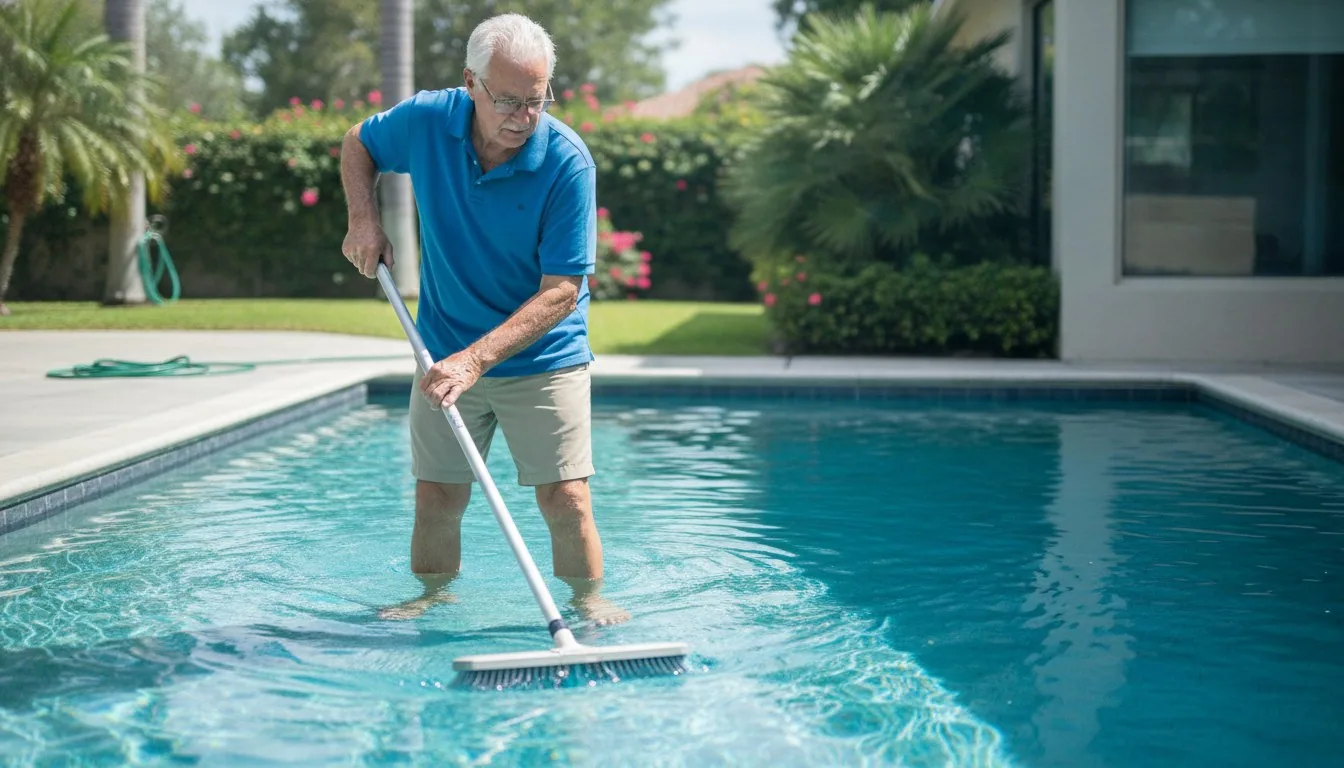
Every pool eventually forces the same equipment decision: run cleaning duty off the pressure line already plumbed into the yard, or add an independent machine with its own motor and its own filter. Robotic and pressure-side designs solve the same problem: keeping water clear of leaves, sand, and the fine grit that clouds a pool. They just do it from opposite directions. One borrows power that is already there; the other brings everything it needs in a single shell.
Robotic pool cleaner vs pressure-side pool cleaner: the robot usually wins on navigation, fine-debris filtration and wall-to-waterline coverage, while a pressure-side pool cleaner wins where a return-line port and booster pump already exist and heavy leaf litter is the main problem. Choose based on existing plumbing, debris type, and how hands-off you want maintenance to be.
| Spec | Robotic pool cleaner | Pressure-side pool cleaner |
|---|---|---|
| Power source | Onboard motor, pump and battery or low-voltage transformer, fully independent of pool plumbing | Water pressure from a return-line port, usually via a dedicated booster pump |
| Navigation | Sensor-based mapping and obstacle detection built into the unit | No onboard navigation; moves wherever water pressure pushes it |
| Filtration fineness | Multi-stage filters down to roughly 3 microns in some models | Single mesh debris bag sized for large particles, not fine sediment |
| Waterline and wall coverage | Several models scrub walls and the waterline in addition to the floor | Cleans floor and walls via water-jet propulsion; waterline is not a design target |
| Large debris capacity | Onboard baskets sized for heavy leaf loads in some models | Trailing bag with a wide inlet built for leaves, acorns and pebbles |
| Installation | Drops straight into the water; no plumbing changes needed | Needs a dedicated pressure port and, in most setups, its own booster pump |
| Energy draw | Runs on its own low-voltage circuit, separate from the main filter pump | Often adds a dedicated booster pump as extra always-on equipment |
| Quick Facts | |
|---|---|
| Pressure-side feed hose length (Polaris Vac-Sweep 280) | 31 ft |
| Pressure-side debris inlet width (Polaris Vac-Sweep 280) | 2.25 in |
| Pressure-side full cleaning cycle (Polaris Vac-Sweep 280) | about 3 hours |
| Robotic dual-stage filtration (Aiper Scuba S1) | 3-micron ultra-fine filter plus 180-micron standard filter |
| Robotic suction rating (Beatbot Sora 10) | 6,800 GPH |
| Robotic runtime per charge (Beatbot Sora 10) | up to 300 minutes |
| Robotic debris basket capacity (Beatbot Sora 10) | 5 L basket, holds roughly 650 leaves |
| ENERGY STAR pump-speed rule | half speed cuts energy draw to about 1/8 |
What is a pressure-side pool cleaner, exactly
A pressure-side pool cleaner is a motor-less unit that plugs into a dedicated return-line port; water pressure, usually boosted by a separate pump, pushes it around the pool while debris collects in a trailing filter bag.
Shopping for a specific model? See top-rated pool cleaner models — 10 models compared on the specs that decide it.
Water is the whole engine here. A pressure-side pool cleaner has no motor of its own, so it plugs into a dedicated pressure port on the pool wall, and water forced through that port, often by a separate booster pump rather than the main filter pump, drives the unit forward and powers its internal water-management system. The Polaris Vac-Sweep 280 pressure-side cleaner in this lineup shows the pattern clearly: a booster pump pushes water through double venturi jets, the reaction propels the unit around the floor and walls, and 31 feet of feed hose keeps it tethered to the port while it works. Debris collects in a single-chamber filter bag built around a 2.25-inch inlet, wide enough for the acorns and pine litter that would jam a finer mesh, and Polaris rates the unit to clean a pool in about three hours.
Shop listings still separate a pool cleaner, pressure side model, from robotic units for exactly that reason: one needs matching plumbing, the other does not. What is a pressure side pool cleaner good at mechanically? Handling volume, mostly. There is no circuit board to fail and few moving parts beyond the internal hydro-gears, which is part of why this hardware has a reputation for running for years with minimal fuss. The trade-off is that the same simplicity means no memory of where it has been: it goes wherever the jet points it, sweeping some sections twice while skipping others outright.
How a robotic pool cleaner cleans differently
A robotic pool cleaner carries its own motor, pump and filter, so it plugs into power directly and cleans along a mapped or sensor-guided path instead of drifting with water pressure.
Drop a robotic pool cleaner in the water and it runs its own show. Inside the shell sits a motor, an impeller and a filtration chamber, all powered through a low-voltage transformer or, in several current models, an onboard rechargeable battery. There is no hose, no dedicated port, and no separate pump to install; the whole system arrives as one unit.
That independence is also what buys better navigation. The iGarden Robotic Pool Cleaner KN Series in our robotic pool cleaner guide uses built-in sensors and what its spec sheet calls smart 3D navigation to plan an efficient path across the pool, while the Aiper Scuba S1 pairs 11 high-precision sensors with dual-path algorithms to reach the floor, walls, waterline and shallow steps in a single session. The Dolphin (2026 Model) Nautilus AG goes a step further, pairing an active scrubbing brush with its own Smart Navigation Technology that scans the pool to plan an efficient path, rather than relying on suction alone. None of that is possible with water pressure as the only power source; it takes an onboard processor and independent propulsion to pull off.
Robotic pool cleaner vs pressure-side pool cleaner: coverage and filtration
Robotic cleaners generally filter finer and reach more surfaces, including walls, the waterline and steps, while pressure-side units are built to move high volumes of large debris through a wide-mouth bag.
Coverage is where the split gets practical fast. The Beatbot Sora 10 in this lineup cleans the floor, walls, waterline and shallow platforms in one cycle, rated at 6,800 GPH suction with a 5-liter basket sized to hold roughly 650 leaves before it needs emptying. Pressure-side units mostly stop at floor and wall coverage; reaching the waterline was never part of the original design brief, since the cleaning action comes from jets aimed along the bottom and sides rather than a brush that can track upward.
Filtration is the other divide. The Aiper Scuba S1 robotic pool cleaner pairs a 180-micron standard filter with a 3-micron ultra-fine layer, tight enough to catch the dust and pollen that cloud water before algae gets a foothold. A pressure-side bag, built for durability against sticks and pinecones, was never engineered to that tolerance. Buyers fighting persistent haze more than falling leaves will likely notice that difference within the first week of use.
Installation, energy draw and running costs
Robotic cleaners need no plumbing work and typically cost less to run day to day, while pressure-side systems usually call for a dedicated pressure port and, in most installations, an added booster pump.
Getting a robotic cleaner running takes minutes: plug in the transformer, or charge the battery, and drop the unit in. A pressure-side pool cleaner asks more of the property. It needs a pressure return already plumbed in, and unless the pool was built around a low-pressure design, that typically means adding a dedicated booster pump rated to keep flow consistent for the unit's hydro-gears.
That booster pump is not free to run. ENERGY STAR, the joint U.S. Department of Energy and Environmental Protection Agency program, lists pressure-cleaner booster pumps as their own certified product category, separate from a pool's main circulation pump, precisely because they are a distinct piece of always-on equipment with their own energy footprint. Per ENERGY STAR's guidance on pump physics, cutting a pump's speed in half cuts its energy draw to roughly an eighth. That is the sort of detail that looks trivial on a parts list and less trivial on the electric bill by August. A robotic cleaner sidesteps that math by running a small motor on its own low-voltage circuit. In value terms, robotic units tend to sit in the mid-range to premium tiers up front, while pressure-side gear is often the budget-to-mid-range choice if the plumbing already exists, though skipping a needed booster pump to save money is a false economy.
Maintenance: how much hands-on work each one needs
Both types need regular basket or bag emptying and occasional filter or brush upkeep, but neglecting either changes pool water chemistry differently.
Neither cleaner replaces basic pool care. The CDC's healthy-swimming guidance for pool operators calls out scrubbing surfaces to remove the slime layer, biofilm buildup that can blunt disinfectant effectiveness, as a maintenance step distinct from filtration, and that job still falls to a brush or a wall-climbing robotic model with scrubbing built in, not to a pressure-side unit that only sweeps.
Upkeep on the machines themselves differs mostly in frequency and mess. Robotic filters need rinsing after most sessions, more often when a fine-mesh setup is doing the heavy lifting; pressure-side bags fill more slowly per session but rely on a working booster pump behind them, and a worn hydro-gear or clogged venturi jet will quietly cut cleaning performance long before anything visibly breaks. Either way, budget for periodic filter or bag replacement as a normal running cost, not a surprise one.
So, which one should you buy
Buy a robotic pool cleaner for independent navigation and finer filtration with no plumbing work; buy a pressure-side pool cleaner if a pressure port and booster pump already exist and heavy leaf debris is the recurring problem.
Choosing between a robotic pool cleaner and a pressure-side pool cleaner really comes down to what is already plumbed into your yard. If there is no pressure-cleaner port today, a robotic model is usually the simpler and more capable buy: no booster pump to add, finer filtration, and a machine that actually tracks where it has been. For a deeper look at models built around different runtimes and pool footprints, our expanded robotic pool cleaner roundup breaks down ten more options worth comparing.
If a booster pump and pressure port are already installed, or a heavily wooded yard buries the pool in leaves most weeks, a pressure-side pool cleaner still earns its keep: it is mechanically simple and built for volume. Either way, it helps to see both cleaning types stacked against every other option before committing money to one; our full pool cleaner buying guide compares all the leading picks, robotic and otherwise, on the same scoring criteria so the decision is not made in a vacuum.
For a pool without existing pressure-cleaner plumbing, a robotic cleaner is the easier and generally more thorough buy: it maps its own path, filters finer, and doesn't ask you to add a booster pump. A pressure-side pool cleaner still earns its keep on properties already wired for one, especially under heavy tree cover where a wide-mouth debris bag beats emptying a robot's basket every session. Neither replaces a skimmer or manual brushing entirely; both are aids to a maintenance routine, not a substitute for one.
Frequently asked questions
What is a pressure side pool cleaner?
Do robotic pool cleaners need a booster pump?
Can a pressure-side pool cleaner run without a booster pump?
Pressure side vs robotic pool cleaner: which handles a heavily wooded yard better?
Does a robotic pool cleaner clean the waterline the way a pressure-side one does?
Do robotic pool cleaners really use less energy than a pressure-side setup?
Sources & references
- Pool Pumps — ENERGY STAR (U.S. Department of Energy / U.S. Environmental Protection Agency)
- Operating and Managing Public Pools, Hot Tubs and Splash Pads — Centers for Disease Control and Prevention, Healthy Swimming