| Quick Facts | |
|---|---|
| CDC minimum free chlorine (pools) | 1 ppm |
| CDC pool pH range | 7.0 to 7.8 |
| CDC water testing frequency | at least twice daily; hourly during heavy use |
| ENERGY STAR in-ground pump energy savings | up to than a standard single-speed pump |
| Cordless robotic cleaner runtime range (Buyer Reports comparisons) | about 120 to 300 minutes per charge |
| Common two-stage filter mesh sizes (Buyer Reports comparisons) | 150 to 200 micron coarse layer plus 3 to 10 micron fine layer |
| Suction power range among cordless models (Buyer Reports comparisons) | roughly 3,000 to 6,800 GPH |
Types of pool cleaners explained: four systems, four trade-offs
Pool cleaners split into robotic, suction-side, pressure-side, and manual or handheld categories, each using a different power source and each shifting cost between the purchase price, the electric bill, and your own time.
Shopping for a specific model? See our pool cleaner buying guide — 10 models compared on the specs that decide it.
Every automatic pool cleaner sold today runs on one of three power sources: its own electric motor, the suction created by your existing pump, or the pressure from a return line pushed by a booster pump. Manual and handheld vacuums make up a fourth branch, and they run on nothing but your arm. Once you know which bucket a given machine falls into, marketing phrases like smart navigation or four-zone cleaning matter less than one basic plumbing question: what is actually pushing this thing around your pool?
That split decides three things buyers usually only discover after purchase: how much extra strain lands on the filter, how much the unit adds to the electric bill, and how hands-off the whole chore actually becomes. A suction-side cleaner and a robotic cleaner can look almost identical in a listing photo and cost about the same, yet one runs your main pump longer every day and the other never touches it.
This piece walks through all four pool cleaner types in the order most buyers compare them: robotic first, then suction-side and pressure-side, and finally the manual vacuums that never really went away. For a full side-by-side of current models across every category, our pool cleaner buying guide breaks down the lineup by price and score.
Robotic pool cleaners: their own motor, their own brain
Robotic pool cleaners plug into a wall outlet, run on their own low-voltage motor, and carry a self-contained filter, so they never touch your main pump or its filtration system.
A robotic cleaner is a self-contained unit. It has its own drive motors, its own navigation sensors, and its own filter basket or cartridge, and it draws power through a low-voltage transformer plugged into a standard outlet rather than through your pool's plumbing. That independence is the appeal: it can map a pool, climb walls, scrub the waterline, and empty into its own basket without the main pump running at all.
Runtime is the spec worth checking first, and it varies more than the marketing suggests. Across the cordless robotic models we've compared, stated runtimes span roughly 120 to 300 minutes per charge. Filtration tends to follow a two-stage pattern too: a coarse mesh around 150 to 200 microns for leaves and larger debris, paired with a finer 3 to 10 micron layer for silt and pollen, a combination that shows up on several models in this category, though not every one specs a two-stage filter.
The trade-off is upfront price, and eventually battery health. A robotic unit costs more to buy than a basic suction cleaner, and the battery inside a cordless model will fade over a few seasons the way any rechargeable pack does. Our robotic pool cleaner guide breaks down how current models stack up on navigation, runtime, and coverage.
Suction-side cleaners: budget-friendly, but your pump does the work
Suction-side cleaners connect directly to the pool's skimmer or a dedicated suction port and use the existing pump's suction to move around and pull debris back through the main filter.
A suction-side cleaner is the simplest automatic option mechanically. A hose runs from the unit to your skimmer or a dedicated suction line, and the vacuum created by your existing pump both drives the cleaner around the pool and pulls debris back into your filtration system. There's no separate motor in the unit itself, no battery, and often no booster pump: one suction-side model in our comparisons connects straight to the suction port or skimmer with no booster pump required.
That simplicity keeps the purchase price down, and suction-side units in our comparisons ship with hoses in the 30-plus-foot range, enough to reach most corners of an in-ground pool. The catch: everything a suction cleaner picks up, sand, hair, fine grit, goes straight into your main filter, which usually means more frequent backwashing or cartridge cleaning than a robotic unit filtering on its own.
Suction-side cleaners also depend entirely on your pump schedule. Turn the pump off and the cleaner stops dead wherever it happens to be. If your pump already runs on a timer for turnover and sanitation, adding a suction cleaner barely changes your routine, and some models are built with a regulator valve that keeps water flow steady even on low-speed or variable-speed pumps. Our suction pool cleaner guide compares the current lineup in full.
Pressure-side cleaners: built for big debris, powered by a booster pump
Pressure-side cleaners run off water pushed out of a return line, typically through a dedicated booster pump, and collect debris in their own bag instead of your main filter.
Pressure-side cleaners flip the suction-side setup around. Instead of pulling water in, they ride on water pushed out through a return line, usually via a separate booster pump rather than the main filter pump. That extra pump costs more to maintain, but it buys real capability: the pressure-driven model in our comparisons runs dual jets strong enough to move heavier material, leaves, acorns, small pebbles, into a dedicated single-chamber filter bag instead of the pool's main filter.
Because debris lands in its own bag, a pressure-side cleaner spares the main filter the extra load a suction cleaner adds, useful if you already fight short filter runs from a heavily treed yard. The trade-off shows up in reach: the unit we've tracked ships with roughly 30 feet of hose, plenty for a typical backyard pool, though it's worth measuring against your pool's dimensions first.
Pressure-side cleaners sit in an odd spot in most retail catalogs, sometimes grouped with suction-side units since both run on hydraulic force rather than an onboard motor, and the marketing rarely draws a clean line between them. If your yard drops a steady stream of leaves into the water, the separate debris bag is the detail worth chasing down before you buy.
Manual and handheld vacuums: the low-cost backup every pool still needs
Manual and handheld pool vacuums require you to hold a pole or a cordless unit and guide it by hand, and they stay useful for spot-cleaning steps, corners, and shallow water that automatic types miss.
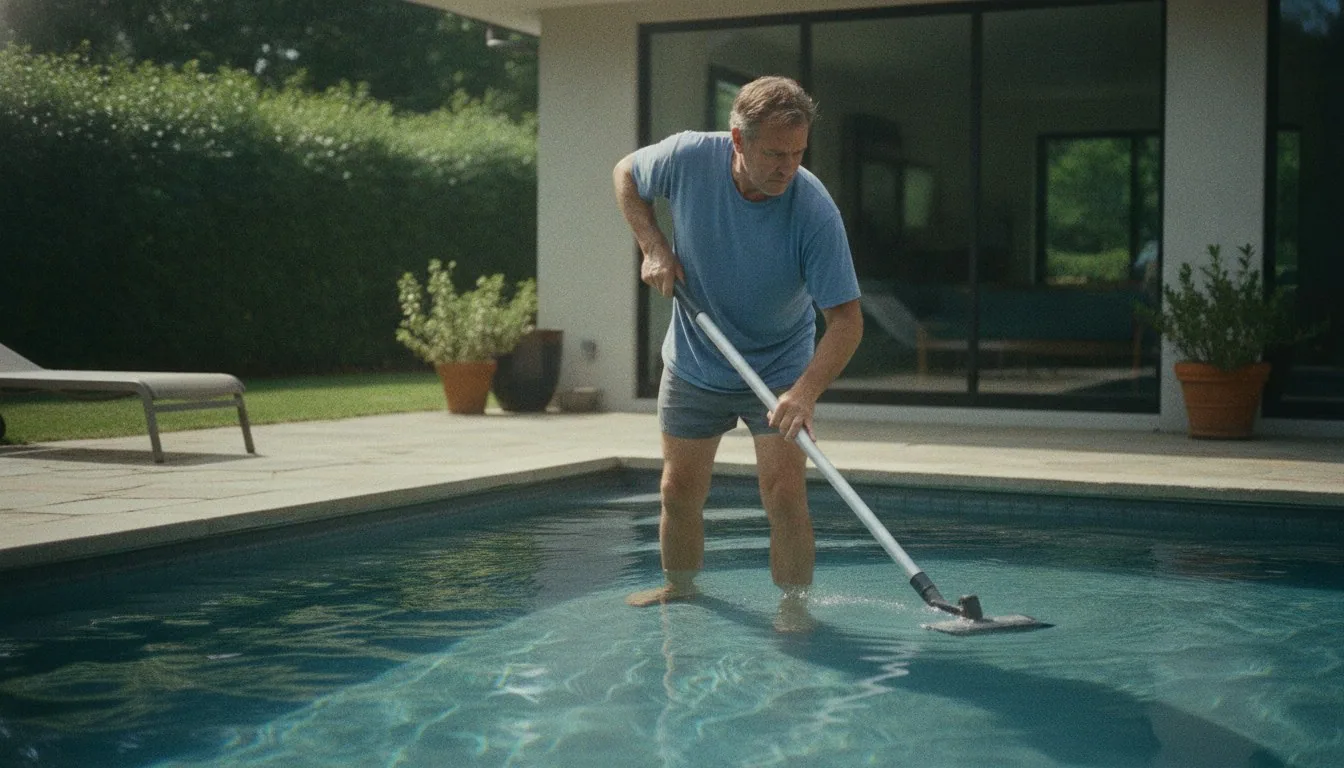
Manual pool vacuums are the oldest category by far: a vacuum head on a telescopic pole, connected by hose to the suction side of your pump, that you walk across the pool floor yourself. Cordless handheld versions have mostly replaced the hose-and-pole setup for quick jobs. Models in our vacuum pool cleaner comparisons run their own small motor and battery, with telescopic poles extending to around seven feet and runtimes closer to an hour than an afternoon.
What these units are good at is precision: steps, corners, tanning ledges, and the shallow strip along the waterline where a robotic or suction cleaner sometimes struggles to park or reach cleanly. One handheld model we've tracked is rated to work in water as shallow as 0.6 feet, well under a foot deep, a reasonable stand-in for hot tubs and small kiddie pools.
None of this makes a handheld vacuum a replacement for an automatic cleaner on a full-size pool. It's a supplement, not a substitute, and most owners who own one also run a robotic or suction unit for the daily work. Our vacuum pool cleaner guide covers the current handheld and cordless options for quick touch-ups.
What each pool cleaner type costs to run, in electricity and filter wear
Robotic cleaners use their own small low-voltage motor and don't add pump runtime, while suction-side and pressure-side units both depend on the main pump, so their real running cost is tied to how efficient that pump already is.
The sticker price on a pool cleaner is only part of what it costs to own. Suction-side and pressure-side units are both parasitic on your existing pump: they only work while the pump runs, so their real energy cost is whatever your pump already burns per hour. A robotic cleaner carries its own motor and battery, with a power draw usually smaller than the pump's.
This is where pump choice ends up mattering more than cleaner choice. ENERGY STAR, the joint EPA and Department of Energy program, certifies in-ground pool pumps that use up to 20 percent less energy than a standard single-speed model, and the bigger savings come from variable-speed pumps: dropping pump speed by half cuts energy use to roughly one-eighth under the pump affinity law. If a suction or pressure-side cleaner runs for hours a day regardless, that pump upgrade moves your electric bill more than the cleaner brand attached to it.
Filter wear follows similar logic. The CDC's guidance for operating public pools calls for scrubbing surfaces to remove biofilm regularly and maintaining filtration equipment on the schedule the manufacturer specifies. That advice is written for commercial operators testing water twice a day and hourly during heavy use, but the point holds at home too: a filter doing extra work from a suction cleaner needs backwashing or cartridge cleaning more often, and skipping it invites cloudy water back even with a cleaner running daily.
Matching a cleaner type to your actual pool
The right pool cleaner type depends more on your pool's shape, debris load, and how hands-off you want maintenance to be than on any single spec sheet.
A small, mostly shaded above-ground pool with light debris doesn't need the same equipment as a large in-ground pool under mature trees, and matching the type to the situation matters more than chasing the highest score on a chart. Above-ground pools with simpler plumbing often do fine with a suction-side unit or a handheld vacuum for occasional touch-ups. Larger in-ground pools carrying real leaf and debris load, especially near trees, tend to justify the extra cost of a pressure-side cleaner or the independence of a robotic one.
Budget shifts the calculus too, though not in a straight line. A suction-side cleaner is usually the cheapest way into automatic cleaning, a pressure-side setup adds the cost of a booster pump on top of the unit itself, and a robotic cleaner front-loads the cost into the machine but skips the extra pump entirely. None of the four types of pool cleaners is objectively best; they're built around different failure points, and the honest way to choose is by ruling out what your pool doesn't need rather than chasing the longest spec sheet.
Whichever direction you land on, the plumbing question is the one to answer first: does this cleaner run on its own motor, on suction, on pressure, or on your own arm. Settle that, and everything else on the spec sheet becomes detail to compare within the category you've already picked.