| Quick Facts | |
|---|---|
| ENERGY STAR: filtration at 6 hours/day vs. 24 hours/day | cuts pool pump energy use by about 75% |
| ENERGY STAR: variable-speed pump at half speed | uses roughly one-eighth the energy of full speed |
| CDC Model Aquatic Health Code: water turnover definition | time needed to circulate a volume of water equal to the venue's full capacity |
| CDC-targeted splash pad turnover time | 30 minutes or less |
| Peer-reviewed chlorine exposure testing (PVC, HDPE, polypropylene) | degradation increased with chlorine concentration and exposure time (tested at 3 weeks and 3 months) |
| Robotic cleaner run basis | one full program cycle per session; frequency, not duration, is the adjustable variable |
| Suction- and pressure-side cleaner run time | equal to however long the main filtration pump runs that day |
How long should you run a pool cleaner each day
How long a pool cleaner should run depends on its type: robotic units follow their own programmed cycle, while suction- and pressure-side cleaners run only as long as the main pump and filter do, since they have no motor of their own.
Shopping for a specific model? See the best pool cleaner we tested — 10 models compared on the specs that decide it.
There isn't one number that answers how long should a pool cleaner run for every backyard, and anyone offering a single figure without asking what kind of cleaner is skipping a step. Pool cleaner covers three different mechanical relationships to a pool's plumbing, a robotic unit, a suction-side cleaner, and a pressure-side cleaner, and each answers the run-time question on its own terms.
A robotic pool cleaner is the closest thing to an appliance with its own opinion. It plugs into household power through a transformer or runs on a rechargeable battery, drops to the pool floor, and works through whatever cleaning program its internal control is set to, then climbs out or parks itself. Owners don't really set run time on these units so much as choose how often the built-in cycle repeats: once a day for a pool that collects steady light debris, every second or third day for a well-covered pool that stays cleaner longer.
Suction- and pressure-side cleaners work differently because they have no drive motor of their own in the suction case, or rely on a booster pump in the pressure case, and either way their operation is tied to the main filtration pump's schedule. A suction cleaner cannot move without water being pulled through it by that pump, so how long to run it collapses into a simpler question: how long is the pump running today. Turn the pump off and the cleaner stops mid-stroke.
Robotic pool cleaners: cycle length and how long they last
A robotic pool cleaner runs one full cleaning cycle per session, with the cycle length set by the unit's own program, and most owners run that cycle daily or every other day. How long do robotic pool cleaners last comes down mostly to the sealed battery pack or drive motor, not the cycle length itself.
Ask how long a robotic cleaner should run per session and the honest answer is: however long its program is built for, since these are closed systems rather than open-ended timers an owner dials in. The variable within someone's control is frequency, not duration, running the cycle every day versus skipping days when a pool cover or a lighter debris load makes daily cleaning unnecessary.
The more interesting half of the question is how long do robotic pool cleaners last as machines rather than per session, and two systems wear on genuinely different timelines. The motor, gears, and drive wheels, kept clean of hair and debris, tend to hold up for years of routine use, similar to how a well-built appliance motor rarely fails first. The battery pack or, on corded models, the transformer and cable are the parts that show their age soonest, especially if the unit sits charging in direct sun rather than somewhere shaded and ventilated.
That split matters for anyone trying to figure out how long do robotic pool cleaners last before replacement makes more sense than repair. A unit with a swappable battery pack effectively resets its own clock once that pack is replaced, while a sealed battery means the whole cleaner is only as durable as that one component, the exact pattern seen in cordless home vacuums. Our robotic pool cleaner guide breaks down how models differ on this point, since that design choice affects a cleaner's practical lifespan more than almost any other spec.
Suction- and pressure-side cleaners: tied to the pump's schedule
Suction- and pressure-side pool cleaners have no independent run time; they operate exactly as long as the main filtration pump runs, which is why the real question is how long to run the pump, not the cleaner.
A suction-side cleaner is essentially a hose and a set of internal valves; it has no drive motor, no battery, no clock of its own. Water pulled through the skimmer or a dedicated suction line moves it around the pool floor, so if the pump is off, the cleaner is off too, full stop. That single fact answers how long should a pool cleaner run for this category almost by itself: it runs on the pump's schedule, period.
That schedule is worth getting right, and ENERGY STAR's own guidance on pool pumps is refreshingly specific: cutting filtration run time from a continuous 24 hours down to 6 hours a day cuts pump energy use by about 75%. For a suction-side cleaner riding along on that same pump cycle, six hours of pump time is also six hours of cleaning time, no separate setting required. Owners running a variable-speed pump have another lever; ENERGY STAR notes that reducing pump speed by half lets the unit use roughly one-eighth as much energy, though the slower flow also means a suction cleaner moves more sluggishly, a real trade-off between electricity use and cleaning thoroughness rather than a free win.
Pressure-side cleaners add a wrinkle: some run off the main pump, others off a dedicated booster pump with its own separate schedule. Where a booster pump exists, it gives an owner more control over how long the cleaner itself runs without touching main filtration hours at all, arguably the closest a suction- or pressure-based system gets to the independent scheduling a robotic cleaner takes for granted.
Manual and handheld vacuum-style cleaners run on your schedule, not a program
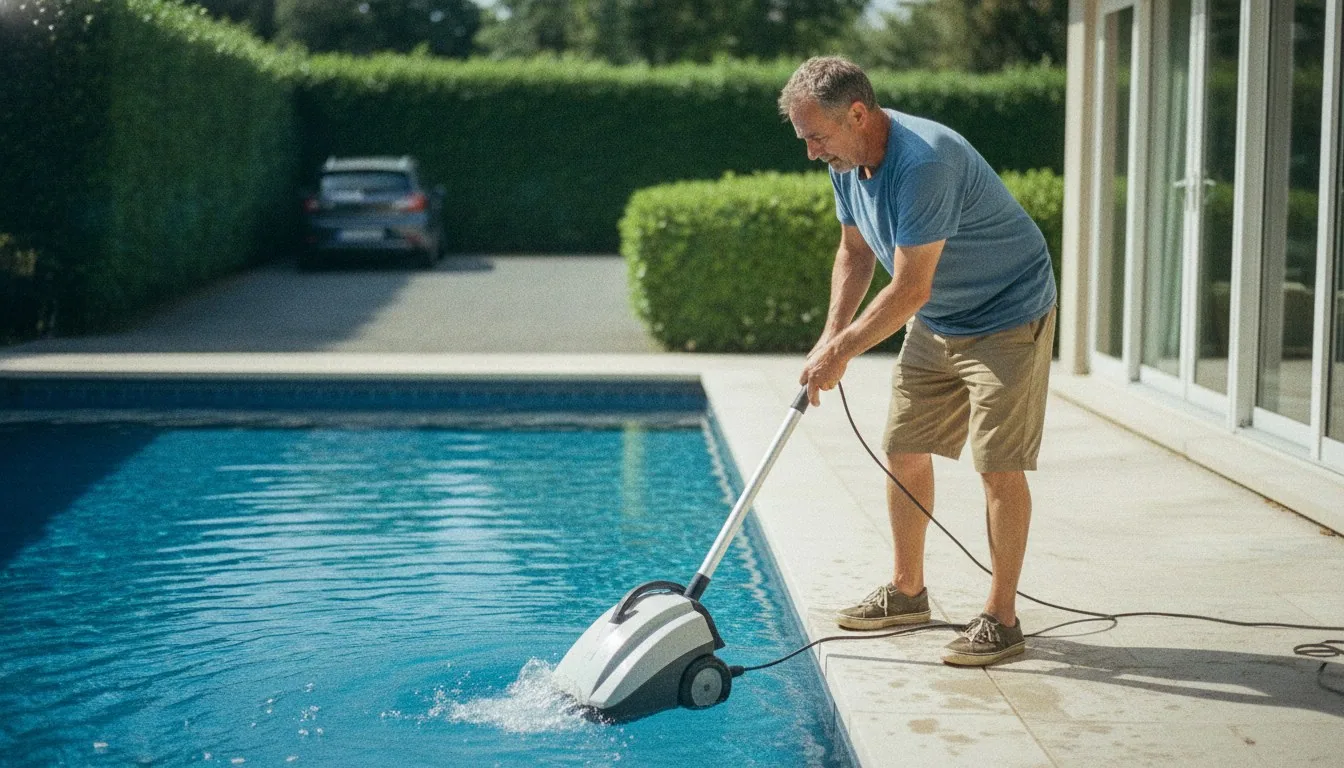
Handheld and manual vacuum-style pool cleaners have no fixed run time at all; the session lasts exactly as long as the person holding it keeps working the pool floor and walls, which makes them the most flexible but also the most labor-dependent option.
A handheld pool vacuum, cordless or hose-fed, is the one category where how long should a pool cleaner run genuinely means how long are you willing to stand there. There's no program, no pump schedule, just a person moving a wand across the floor until the visible debris is gone. Session length is entirely a function of pool size and how much has settled since the last pass; a small above-ground pool might, as a rough guide, take ten or fifteen minutes, while a larger in-ground pool with a season's worth of leaf debris can run considerably longer.
The trade-off is worth stating plainly: a handheld unit gives precise control over exactly where cleaning attention goes, corners, steps, the deep end where automated cleaners sometimes struggle, at the cost of someone's time standing poolside doing it. Our vacuum pool cleaner guide compares cordless handheld options against hose-fed ones, since battery runtime on the cordless side caps how long a single session can last regardless of how dirty the pool is.
Running a cleaner too long causes its own kind of wear
Leaving any pool cleaner running past what a pool actually needs doesn't clean it better past a certain point; it just adds wasted energy and, for suction- and pressure-side units, extra hours of hose and seal material sitting exposed to chlorinated water.
It's tempting to assume more run time is strictly better, the pool equivalent of scrubbing a little harder. Past the point where visible debris is gone, extra hours mostly push electricity use up and add wear cycles to parts that don't need them. Chlorinated water is genuinely hard on the plastics and rubber seals pool equipment is built from, and that isn't a marketing claim, it's measurable.
Peer-reviewed testing on PVC, HDPE, and polypropylene, three plastics common in pool hoses, fittings, and cleaner housings, found degradation increased with both the concentration of chlorine solution and how long the sample sat exposed to it. PVC held up most consistently across the test conditions, while polypropylene showed the greatest ductility loss, growing brittle as exposure stretched from three weeks to three months. None of that means a weekend of heavy pool use will damage a cleaner's housing; the concentrations tested were far higher than a typical backyard pool's chlorine level. But the relationship between exposure time and material wear is why leaving a suction-side cleaner's hose sitting in the water longer than it needs to is a habit worth breaking.
Robotic and battery-powered cleaners face a different overrun risk that has nothing to do with pool water: the charging cord. Lithium-ion packs, the same chemistry used in cordless vacuums and power tools, generate real heat while charging, and leaving a unit plugged in on a hot pool deck for hours after it's topped off isn't doing the battery any favors. Unplug once charged rather than leaving it connected overnight by default, it's one of the more overlooked ways a well-built cleaner ages faster than it should.
How long do pool cleaners last, and how to stretch that
How long a pool cleaner lasts depends more on maintenance and which part wears first, battery, hose, or flex seal, than on the model itself; a cared-for unit of almost any type commonly outlasts a neglected one by years.
How long do pool cleaners last is really a maintenance question wearing a shopping question's clothes. Two identical units, one rinsed and stored dry between seasons with hoses drained rather than left kinked and full of water, the other left poolside in direct sun all off-season, will not age at the same rate, and it isn't close. Storage and cleaning habits do more to determine a cleaner's working life than almost any spec on the box.
For robotic units, the battery or transformer is usually the first thing to go, followed by drive belts and tracks that pick up wear from grit and hair, the pattern already covered for how long do robotic pool cleaners last. For suction- and pressure-side cleaners, it's the diaphragm, bladder, or internal valve, the flexible parts that flex thousands of times per cycle, that tend to fail before the housing cracks or wears through. None of these are exotic parts, and replacing just the failed one is often possible without buying an entirely new machine.
The CDC's Model Aquatic Health Code offers a useful mental model even though it governs public pools, not backyard ones: it defines water turnover as the time needed to circulate a full pool's volume, and sets that target by venue risk rather than one universal number, 30 minutes or less for a splash pad, longer for a general-use pool. Applying that logic at home, matching run time and cleaning frequency to actual use rather than a flat daily habit, separates equipment still working fine in year six from equipment replaced in year two. Our pool cleaner hub compares how the different cleaner types stack up on this durability question before you commit to one.